

From platform tiers to media spend guidance, here is what mid-market B2B teams budget for LinkedIn ABM with Recotap.
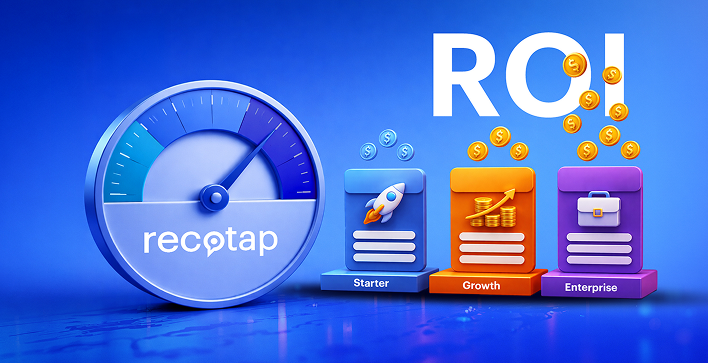
Recotap pricing follows a subscription model structured around three tiers: Starter, Growth, and Enterprise. Rather than per-seat or per-contact billing, Recotap has a usage-based billing method. The model scales with feature usage and the data integrations you bring in. This keeps costs predictable as your team and target account list grow.
For exact pricing, the right move is to first book a demo so that the team can scope a quote against your actual target account list size, feature needs, and data sources.
Your total ABM investment is the Recotap fee plus what you spend inside LinkedIn Campaign Manager.
Recotap offers two onboarding paths, and choosing the right one early avoids friction later.
Self-serve onboarding is designed for teams with existing ABM experience who want to move fast and configure the platform independently. You connect your CRM, import your target account list, use Bombora data and bring your G2 data to launch campaigns without needing hands-on guidance. The platform's interface and help documentation support this path. The Customer Success team helps you navigate through your onboarding process without handling campaign nitty gritties.
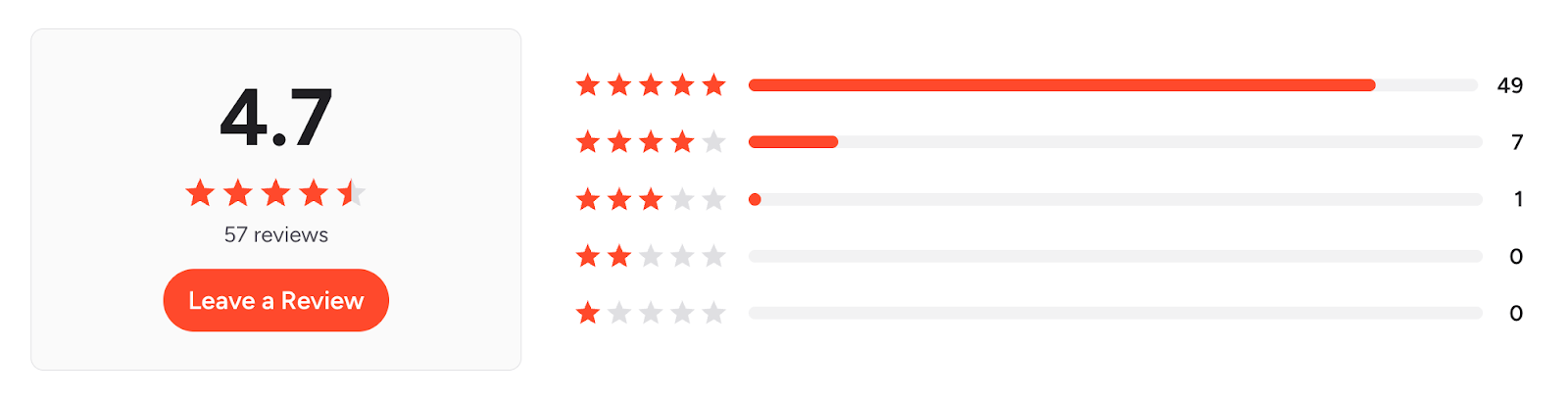
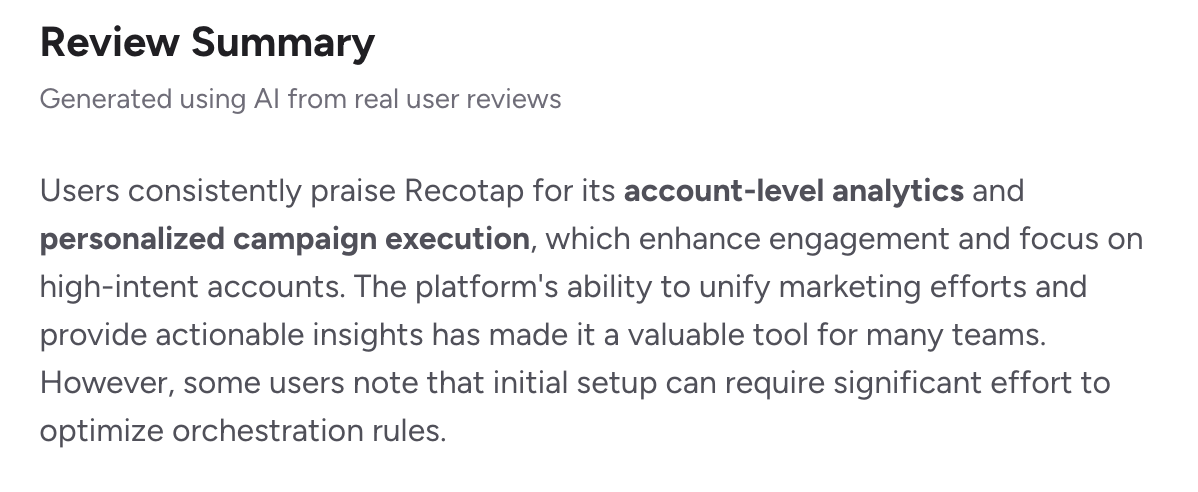
Multiple G2 reviewers specifically called this out: the team helped them "narrow down the metrics that actually mattered" and "worked closely during the initial phase, helping translate sales requirements into a scalable orchestration and segmentation setup."
Recotap-as-a-service is the supported model where Recotap's customer success team works alongside you to translate your sales requirements into orchestration logic, segment configuration, and campaign structure. If your team is new to ABM or scaling from a pilot to a full program, the supported path significantly reduces the time it takes to get to first value.
Both paths are available. The choice depends on your team's existing ABM maturity, headcount, and how fast you need to show results.
The honest version of the Recotap pricing conversation is not "how much does this cost?" It is "how much are you already spending without it?"
Here is what mid-market teams typically spend to replicate Recotap's capabilities by stitching together individual tools and roles:
The real problem is not just the total. It is the stitching. Six separate tools still require someone to manage the handoffs between them. Intent data does not automatically flow into your segmentation. Segmentation does not automatically trigger campaign updates. Campaign performance does not automatically connect to your CRM pipeline stages. You end up with a $150K stack and resource that still demands significant manual coordination to function.
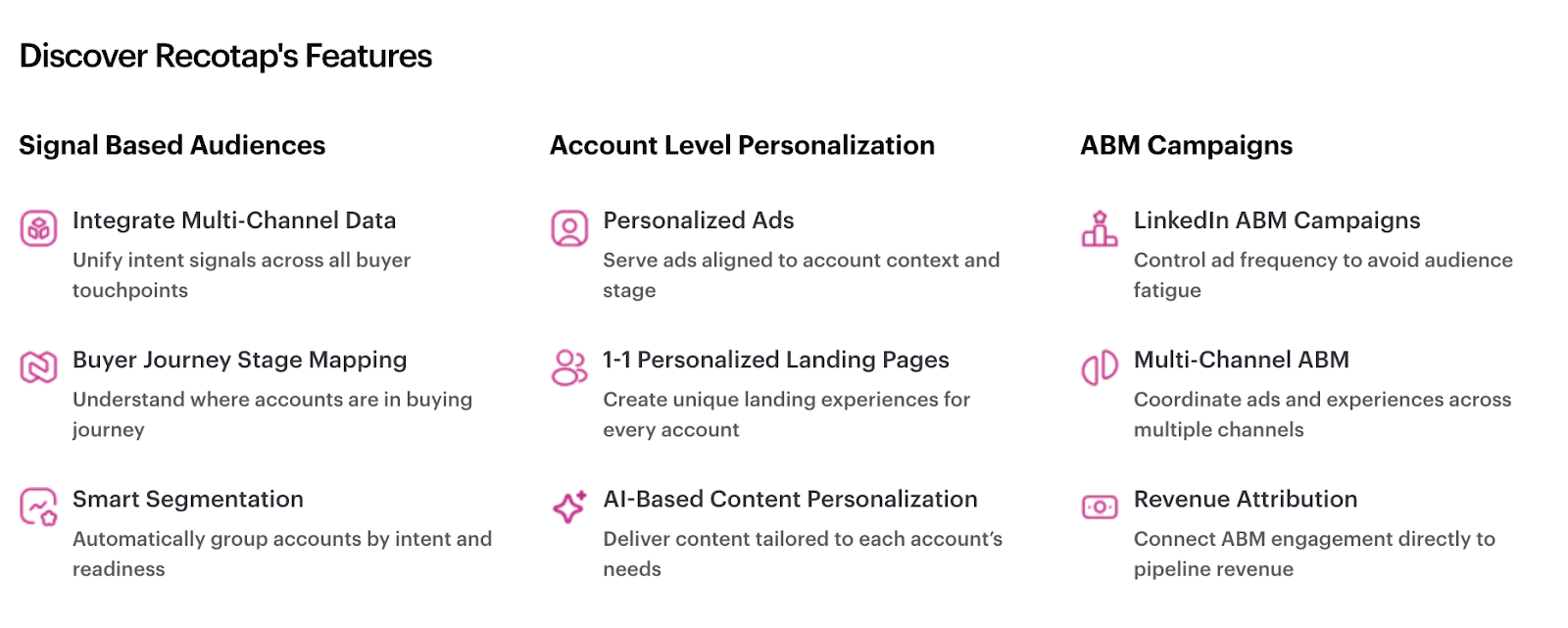
Recotap eliminates those handoffs entirely. Signals flow into segmentation. Segmentation drives campaign targeting. Campaigns update as accounts move stages. Performance connects to pipeline and revenue. The integration is the product, not just a nice-to-have.
A concern heard frequently in early conversations with new prospects: "I want to make sure we're not just investing in something that's going to add to the list of tools we're currently using." Recotap is the opposite of that. It replaces the stack. It does not stack on top of it.
Every Recotap customer has won back the subscription cost by closing one B2B deal within three months. That is not a projection. That is the consistent outcome pattern across the customer base.
The math changes depending on your average contract value:
At $30K ACV: One closed deal in a quarter covers the platform subscription with room for the ad budget. You have broken even. Everything after that is upside.
At $50K ACV: One deal gives you significant headroom. The platform cost becomes a small fraction of the return. The ROI conversation is effectively over between Q1-Q2.
At $100K ACV: The platform fee is almost insignificant against the deal value. You are not evaluating ROI at this point. You are evaluating how fast you can scale.
The framing that captures this best comes directly from practitioners who have been through the evaluation: "ROI is simply revenue to spend, with the cost of the platform included." The math is that direct.
There is also the cost of doing nothing. Teams running LinkedIn ABM without account-level orchestration consistently see 70% of their impressions go to 10-15% of their target accounts. One team spent $31K over a quarter with zero qualified leads to show for it. Another had 92% of impressions concentrating on 20% of their account list while strategic accounts received no exposure at all. The cost of not having orchestration is measurable, and it is often larger than the platform subscription.
One deal closes the gap. The question is how many deals you are leaving on the table while you wait.
Recotap is specific by design, not by limitation. Here is what the qualifying profile looks like:
Built for:
There are segments where Recotap is genuinely not the right fit, and being clear about this saves everyone time:
If your deal sizes are below $15K ACV or your LinkedIn budget is below $3K per month, ABM is likely not the right investment at this stage. Recotap will tell you that directly rather than sell you something that will not work.
The right comparison is the total cost of ownership, not the license fee. Here is how the competitive landscape looks:
6sense and Demandbase: Both sit in the $43K–$100K+ per year range for mid-market deployments, before factoring in ad spend, professional services, and dedicated headcount to operate them. Multi-year contract pressure is common. Multiple prospects have eliminated both from consideration solely on price before the sales process even begins.
Terminus: Premium, opaque, sales-led pricing. No public price points. Budget commitment required before you know what you are paying.
HubSpot ABM: Bundled into Marketing Hub Enterprise at approximately $43,200 per year for five seats, but limited in intent data depth and campaign orchestration sophistication. Requires additional tools to match Recotap's functionality.
ZenABM: Lower entry point but covers only LinkedIn analytics and attribution. Does not include campaign orchestration, ad personalization, or landing page personalization. You would still need separate tools to replicate the full capability stack.
Recotap's position: Full ABM execution capability at a price point where the ROI math works on a single deal. For Indian mid-market companies specifically, Recotap is one of the very few ABM platforms with transparent, accessible pricing structured for this segment. Most enterprise platforms price out India-headquartered B2B companies entirely.
A platform that requires separate intent data, a designer, a developer, and dedicated marketing ops on top of its license fee is not cheaper than Recotap. The comparison has to account for everything you need to make it work, not just the number on the contract.
The Recotap pricing conversation is really a cost-of-ownership comparison, not a sticker price comparison.
If you are running LinkedIn ABM and hitting the ceiling of what native Campaign Manager can do, the math on Recotap is worth running. Book a demo to see the platform in action against your target account list.
Q: How does Recotap pricing compare to 6sense and Demandbase?
Enterprise ABM platforms like 6sense and Demandbase typically cost $43K–$100K+ per year for mid-market deployments, before ad spend and headcount. Recotap delivers signal orchestration, personalized campaigns, and revenue attribution at a fraction of that cost. The gap widens further when you factor in total cost of ownership: Recotap consolidates capabilities that would otherwise require six separate tools and roles.
Q: What is the total cost of running LinkedIn ABM with Recotap?
Your total investment is the Recotap subscription plus your LinkedIn ad budget. The platform subscription covers signal orchestration, campaign execution, personalization, and analytics. LinkedIn ad spend is managed separately through your LinkedIn ad account. Nothing is hidden inside the platform fee.
Q: Does Recotap offer a pilot or proof of concept before an annual commitment?
Yes. Recotap provides a demo environment so that teams can evaluate the platform before committing. Multiple customers have completed full evaluations using the demo setup before signing. This is particularly relevant for teams that want to validate fit against their specific target account list and integration requirements.
Q: How long before I see ROI from Recotap?
Every Recotap customer has closed one B2B deal within three months of going live, which covers the platform cost entirely. At $30K+ ACV, breakeven happens in a single quarter. Time-to-value is also compressed by Recotap's supported onboarding path, where the customer success team helps configure orchestration logic and campaign structure from day one.
Q: What does Recotap cost for a team of one or two people?
The Starter plan is built for lean teams. It covers core ABM capabilities, including journey stage prediction, personalized ads, smart pages, and CRM integration without requiring a large team to operate or manage.
Q: Which ABM platforms have transparent pricing for Indian mid-market companies?
Most enterprise ABM platforms price out Indian mid-market companies entirely or require long sales processes before sharing any numbers. Recotap customizes its plan tiers based on usage and structures pricing around feature usage and data integration rather than per-seat or per-contact billing. This makes it genuinely accessible for India-headquartered B2B companies targeting global markets through LinkedIn.
Q: Is LinkedIn ad spend included in Recotap's pricing?
No. Recotap's subscription covers the platform. LinkedIn ad spend is managed separately through your LinkedIn ad account. This keeps pricing predictable and lets you scale your ad budget independently of your platform tier.
Q: Will Recotap just add another tool to our existing stack?
No. Recotap consolidates six separate capabilities into one platform: third-party intent data, first-party website visitor tracking, ad personalization, 1-1 landing page personalization, revenue attributed analytics, and campaign orchestration. It replaces tools, it does not stack on top of them.
Q: What ABM ROI benchmarks should I expect from LinkedIn campaigns?
Teams in comparable segments have seen cost per lead drop from the $1,000–$1,200 range to approximately $300, with account penetration improving from 15–25% to 80–90% of the target list. The primary benchmark, though, is pipeline influence: one closed deal at $30K+ ACV in a quarter is the breakeven threshold, and most teams exceed it within the first three months.
Table of Contents