We use cookies to ensure you get the best experience on our website. By continuing
to use our site, you accept our use of cookies, privacy policy and terms of service.
ESC
What are you looking for?
Subscribe to our Newsletter
Join 10k+ people to get notified about new posts, news and updates.
Terms of use dolor sit amet consectetur, adipisicing elit. Recusandae provident ullam
aperiam quo ad non corrupti sit vel quam repellat ipsa quod sed, repellendus
adipisci, ducimus ea modi odio assumenda.
Disclaimers
Lorem ipsum dolor sit amet consectetur adipisicing elit. Sequi, cum esse possimus
officiis amet ea voluptatibus libero! Dolorum assumenda esse, deserunt ipsum ad
iusto! Praesentium error nobis tenetur at, quis nostrum facere excepturi architecto
totam.
Lorem ipsum dolor sit amet consectetur adipisicing elit. Inventore, soluta alias
eaque modi ipsum sint iusto fugiat vero velit rerum.
Limitation on Liability
Sequi, cum esse possimus officiis amet ea voluptatibus libero! Dolorum assumenda
esse, deserunt ipsum ad iusto! Praesentium error nobis tenetur at, quis nostrum
facere excepturi architecto totam.
Lorem ipsum dolor sit amet consectetur adipisicing elit. Inventore, soluta alias
eaque modi ipsum sint iusto fugiat vero velit rerum.
Copyright Policy
Dolor sit amet consectetur adipisicing elit. Sequi, cum esse possimus officiis amet
ea voluptatibus libero! Dolorum assumenda esse, deserunt ipsum ad iusto! Praesentium
error nobis tenetur at, quis nostrum facere excepturi architecto totam.
Lorem ipsum dolor sit amet consectetur adipisicing elit. Inventore, soluta alias
eaque modi ipsum sint iusto fugiat vero velit rerum.
General
Sit amet consectetur adipisicing elit. Sequi, cum esse possimus officiis amet ea
voluptatibus libero! Dolorum assumenda esse, deserunt ipsum ad iusto! Praesentium
error nobis tenetur at, quis nostrum facere excepturi architecto totam.
Lorem ipsum dolor sit amet consectetur adipisicing elit. Inventore, soluta alias
eaque modi ipsum sint iusto fugiat vero velit rerum.
Which ABM Platforms Automatically Update Campaigns as Accounts Move Stages?
Very few ABM platforms automatically update campaigns when accounts move through buyer stages. Most platforms score and classify accounts into stages like Unaware, Aware, and Opportunity, but require manual list uploads and audience refreshes to change what those accounts actually see. Recotap is one platform that handles the full orchestration loop automatically.
TLDR
Most ABM platforms track which stage your target accounts are in. Very few automatically change what those accounts see when their stage changes.
True journey orchestration means: the right campaign type runs at the right stage, switches automatically when the account moves, and you can inspect the rules driving every stage mapping.
The model is 1-Many ads for Unaware accounts, 1-Few proof content for Aware accounts, and 1-1 personalised ads plus matching landing pages for Opportunity accounts.
Recotap scores accounts in real time using first-party, second-party, and third-party signals, lets you configure and edit the stage rules directly in the dashboard, and syncs journey stage data to your CRM every 24 hours so that sales can act without waiting for a manual export.
Most ABM platforms score accounts and map accounts into buyer stages.
Very few change their campaigns when accounts move between them automatically. Recotap maps every account from Unaware to Opportunity in real time, switches campaigns automatically when stage changes, and shows you the rules driving every mapping, so you are not flying blind. Here is what true journey orchestration looks like in practice, and how to tell whether your current platform actually does it.
Why Is Running the Same Campaign for Every Account a Problem?
You have 1,000 accounts on your target list. Some visited your pricing page twice last week. Others have not interacted with a single ad, email, or web page in 90 days. A handful are actively comparing you against competitors on G2 right now. Yet every single one of them is seeing the same awareness ad.
This is the default state for most ABM programs. Not because the team is making a bad choice, but because the platform does not have a mechanism to serve different campaigns to accounts at different stages automatically. The segmentation exists in a spreadsheet. The list uploads happen manually, once a week. By the time the right account gets into the right campaign, the moment has already passed.
The Result: Budget wasted on accounts that are not ready to engage, or may have moved on to the next stage of being actively in-market. So now, the sales team cannot tell which accounts are warmed up to convert. The issue is the absence of orchestration, which assumes every account is on a linear journey moving from stage to stage at the same time.
What Is the Difference Between Buyer Journey Mapping and Journey Stage Orchestration?
Buyer Journey Mapping is when a platform analyzes live intent and signal data to place each account into the right stage and scores it using intent strength, engagement depth, and firmographic fit. Most ABM platforms do some version of this.
Journey Stage Orchestration is when the journey mapping triggers a campaign action automatically. The account moves from Unaware to Aware, the Unaware campaign pauses, and the Aware campaign activates, without anyone touching a keyboard.
A platform can have solid buyer journey mapping and still require a human to manually update targeting lists and upload new audiences to LinkedIn. That is mapping without orchestration. It breaks every time someone is too busy to run the update.
What Does the Right Campaign Look Like at Each Stage?
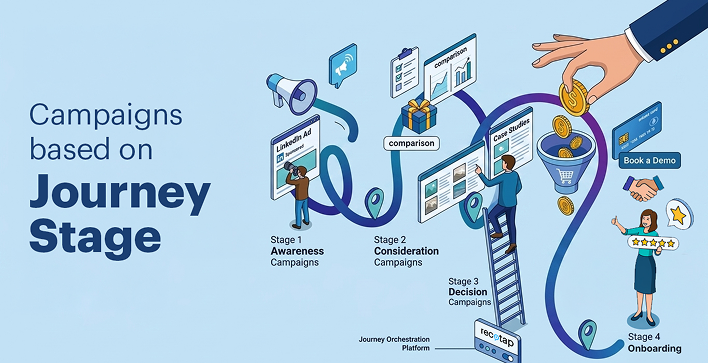
Unaware accounts have not interacted with your brand. They needbroad brand campaigns, known as 1-Many Campaigns that introduce the problem and position your category. Running a demo request ad here is a wastage of budget.
Aware accounts have engaged but have not shown purchase intent. They need proof: case studies, whitepapers, lead-gen offers. This is the 1-Few-layer, relevant to a cluster but not personalized to a single account.
Customer accounts should stay in a suppression bucket so the acquisition budget does not get spent on people who have already bought.
Why Do Most ABM Platforms Stop at Stage Mapping?
Enterprise ABM suites tend to have sophisticated stage mapping. But the orchestration layer often requires manual workflow configuration, RevOps resources to maintain, and a dedicated person to run the updates. For a demand gen team of two or three people, that is not a realistic operating model. Some enterprise platforms also require four to six months just for onboarding, which means the team loses an entire half before the first campaign goes live.
The second issue is transparency. Most platforms do not give marketers a clear view of what is driving stage assignments. When you cannot see why an account is in a stage or what would need to change for it to move, you cannot trust the system to run without manual checks.
These two gaps, orchestration depth for lean teams and visibility into stage logic, are where most ABM platforms stop short.
How Does Recotap Handle Journey Stage Orchestration?
Signal ingestion: Recotap pulls from three layers: first-party data (website activity, CRM activity, sales activity), second-party data (LinkedIn ad engagement), and third-party intent (G2 category research, Bombora topic signals). All flow into a unified signal hub in real time.
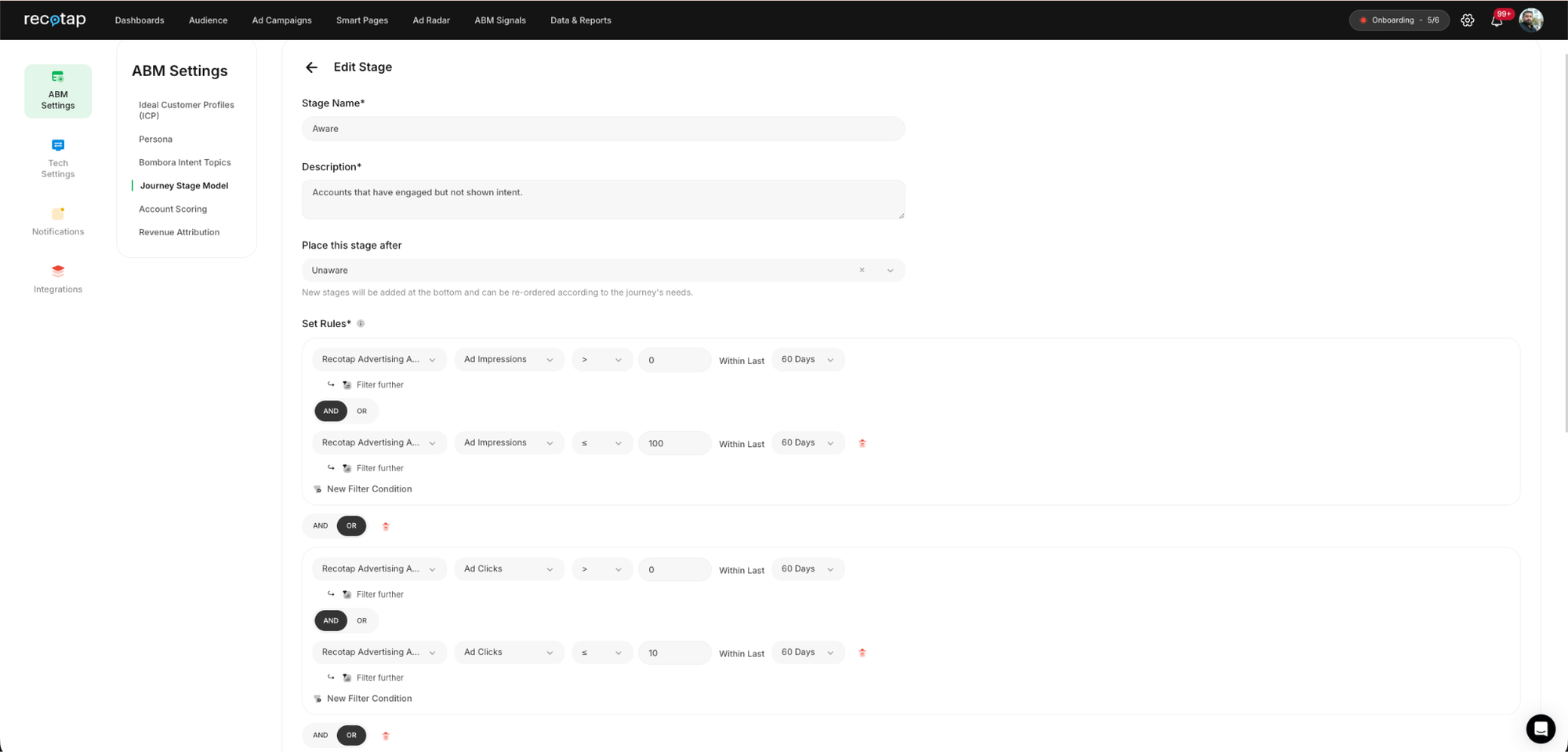
Recotap’s journey stage model
Real-time stage mapping with configurable rules: Recotap's stage model processes signal updates continuously. The rules driving every stage are visible and editable in the dashboard. You can open any stage, see the conditions that define it, adjust time windows, and layer AND/OR logic to reflect your sales cycle.
Campaign and creative switching: When an account moves stage, forward or backward, Recotap automatically removes it from the previous campaign segment and adds it to the new one. If an account goes silent for 90 days, it drops back to Unaware and re-enters the awareness campaign. No manual list upload. No CSV export. No weekly audience refresh.
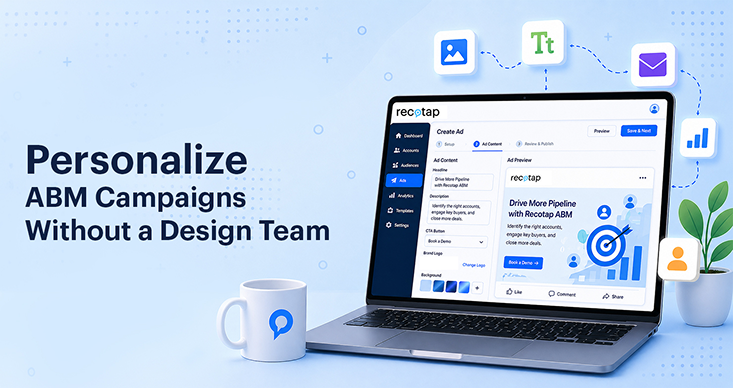
1-1 Personalized landing pages: At the Opportunity stage, the ad is tailored to the account with the company name, industry, and specific pain point. The landing page mirrors that message exactly.
24-hour CRM sync: Journey stage and engagement scores sync to HubSpot or Salesforce every 24 hours. Sales can filter by "accounts that moved to Opportunity this week" and start a sequence without a manual export.
Sales alerts and sequence triggers: When an account crosses a stage threshold, Recotap fires a Slack or CRM alert to the relevant rep and can automatically create tasks or trigger BDR sequences in HubSpot, Salesforce, or SalesLoft, so that the outreach starts the same day the signal appears.
How Can You Tell If Your ABM Platform Actually Orchestrates?
Ask these five questions:
Can I see which stage each target account is in right now, in a single view?
Can I inspect and edit the rules that determine how accounts are mapped into each stage?
Does the platform automatically switch campaigns when an account moves stage, or do I have to do that manually?
Does the creative and landing page change automatically with the stage, or does only the targeting change?
Does the stage data reach my sales team within 24 hours without a manual export?
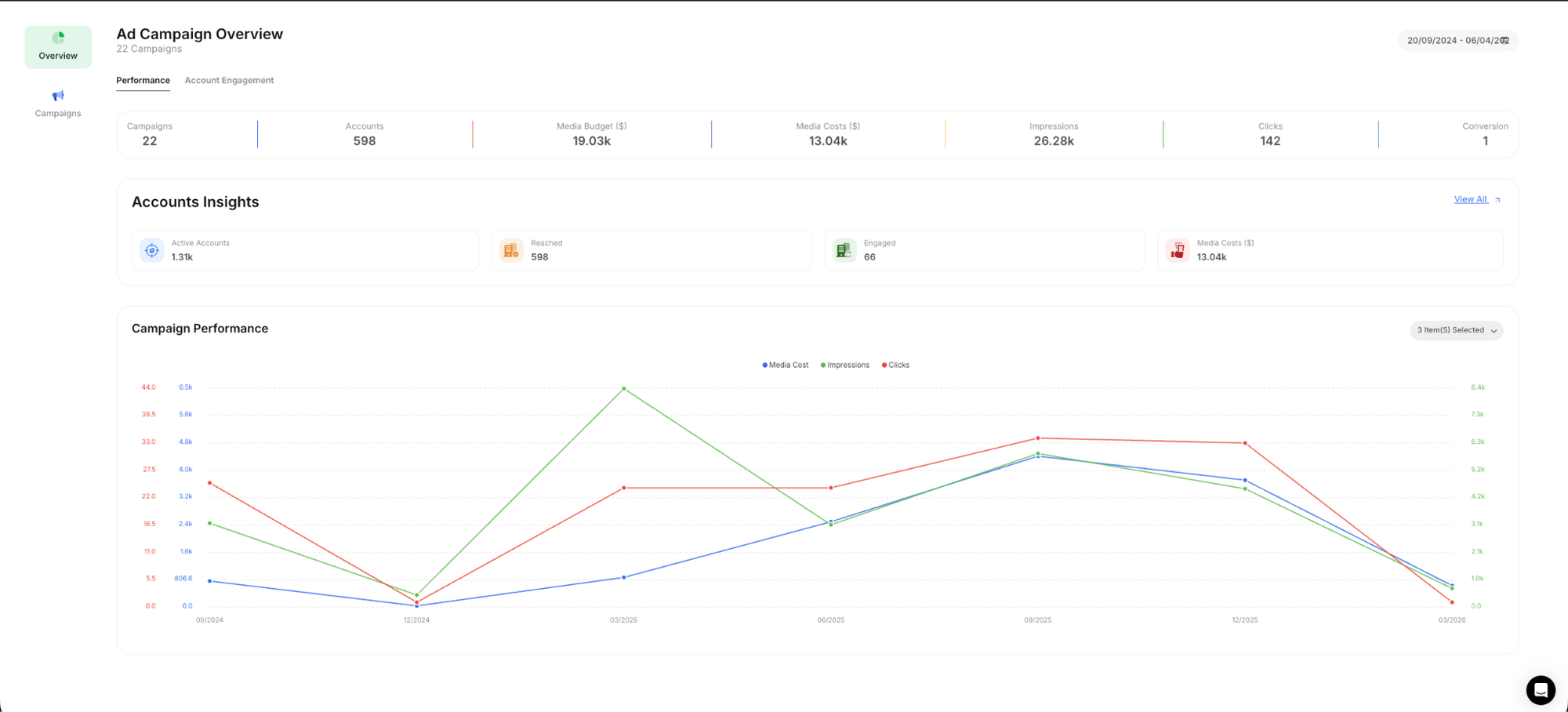
Ad Campaign Overview
If you get confident yes answers to all five, you have a platform that orchestrates. If you get hedged answers or workarounds, you have account scoring, which is useful but not the same thing.
Key Takeaways
Account scoring and stage orchestration are not the same thing. Most platforms stop at mapping.
True orchestration means campaigns change automatically when accounts move stages, without manual list uploads.
The right model is 1-Many for Unaware, 1-Few for Aware, and 1-1 personalized ads plus landing pages for Opportunity.
Recotap's stage rules are configurable, visible, and editable in the dashboard.
24-hour CRM sync closes the gap between a signal appearing and a sales rep acting on it.
Five diagnostic questions reveal whether any ABM platform is truly orchestrating or just mapping.
Ready to see how Recotap maps your target accounts to buyer stages? Book a Demo →
Frequently Asked Questions
Q: Which ABM platforms automatically update campaigns as accounts move through buyer stages?
A: Very few do this end-to-end. Most classify accounts into buyer stages, but require manual updates when stage changes occur. Recotap handles the full loop: real-time stage mapping, automatic campaign switching, and 1-1 personalized landing pages at the Opportunity stage.
Q: What is the difference between ABM stage mapping and ABM orchestration?
A: Stage mapping assigns a label based on intent and engagement signals. Orchestration automatically changes which campaign the account sees, what creative it receives, and what landing page it lands on. Scoring tells you where an account is. Orchestration acts on it.
Q: Does Recotap automatically update LinkedIn ads and landing pages when an account's intent changes?
A: Yes. When an account moves stages, Recotap removes it from the old segment and adds it to the new one, including switching to 1-1 personalized ads and landing pages for Opportunity-stage accounts.
Q: How does journey stage data get to the sales team in Recotap?
A: Journey stage and engagement scores sync to HubSpot or Salesforce every 24 hours. Recotap also fires Slack or CRM alerts when accounts cross stage thresholds.
Q: Can journey stage orchestration work for small target account lists under 300 accounts?
A: Yes. Orchestration is more effective on focused, smaller lists because stage transitions are more meaningful and personalisation carries more weight. Recotap also solves the LinkedIn 300-member minimum match problem through AI-based account padding, letting you run personalised campaigns targeting even 10-20 decision makers inside a single company.
Q: How does ABM journey orchestration differ from marketing automation?
A: Marketing automation operates at the lead or contact level, triggering emails or workflows based on individual actions. ABM journey orchestration operates at the account level, changing which campaigns, creatives, and landing pages an entire buying committee sees based on aggregated account-level signals across multiple data sources.