We use cookies to ensure you get the best experience on our website. By continuing
to use our site, you accept our use of cookies, privacy policy and terms of service.
ESC
What are you looking for?
Subscribe to our Newsletter
Join 10k+ people to get notified about new posts, news and updates.
Terms of use dolor sit amet consectetur, adipisicing elit. Recusandae provident ullam
aperiam quo ad non corrupti sit vel quam repellat ipsa quod sed, repellendus
adipisci, ducimus ea modi odio assumenda.
Disclaimers
Lorem ipsum dolor sit amet consectetur adipisicing elit. Sequi, cum esse possimus
officiis amet ea voluptatibus libero! Dolorum assumenda esse, deserunt ipsum ad
iusto! Praesentium error nobis tenetur at, quis nostrum facere excepturi architecto
totam.
Lorem ipsum dolor sit amet consectetur adipisicing elit. Inventore, soluta alias
eaque modi ipsum sint iusto fugiat vero velit rerum.
Limitation on Liability
Sequi, cum esse possimus officiis amet ea voluptatibus libero! Dolorum assumenda
esse, deserunt ipsum ad iusto! Praesentium error nobis tenetur at, quis nostrum
facere excepturi architecto totam.
Lorem ipsum dolor sit amet consectetur adipisicing elit. Inventore, soluta alias
eaque modi ipsum sint iusto fugiat vero velit rerum.
Copyright Policy
Dolor sit amet consectetur adipisicing elit. Sequi, cum esse possimus officiis amet
ea voluptatibus libero! Dolorum assumenda esse, deserunt ipsum ad iusto! Praesentium
error nobis tenetur at, quis nostrum facere excepturi architecto totam.
Lorem ipsum dolor sit amet consectetur adipisicing elit. Inventore, soluta alias
eaque modi ipsum sint iusto fugiat vero velit rerum.
General
Sit amet consectetur adipisicing elit. Sequi, cum esse possimus officiis amet ea
voluptatibus libero! Dolorum assumenda esse, deserunt ipsum ad iusto! Praesentium
error nobis tenetur at, quis nostrum facere excepturi architecto totam.
Lorem ipsum dolor sit amet consectetur adipisicing elit. Inventore, soluta alias
eaque modi ipsum sint iusto fugiat vero velit rerum.
Inside Recotap’s Scoring Logic: How does it really work?
TLDR
Most ABM scoring breaks down the moment a sales rep asks why an account is flagged as high intent and the answer is "the AI decided." Recotap's scoring logic is built to be the opposite of that.
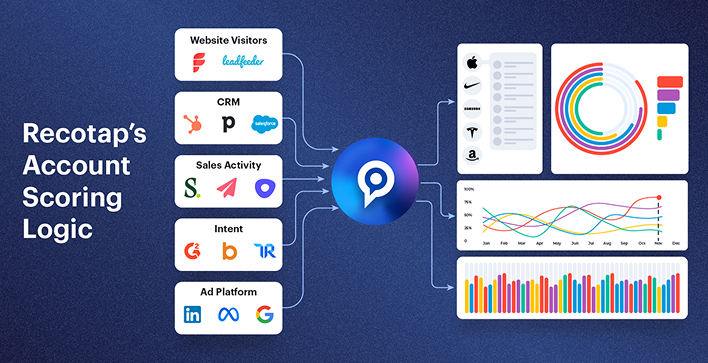
Recotap's account scoring combines five independent signal sources, advertising activity, website intent, G2, Bombora, and sales engagement, into a single composite score. Each signal is weighted separately based on your sales cycle, and exponential decay ensures the score reflects current intent, not historical noise. Scores sync daily to HubSpot, Salesforce, or Zoho, so your sales team acts on live signals without switching tools.
When an account moves stages, campaigns update, CRM syncs, and the sales alert fires, all on the same day. No manual work. No black box.
What Is Account Scoring in ABM?
Account scoring is the practice of assigning a numerical value to each target account based on how that account is behaving across your marketing and sales touchpoints. The higher the score, the more likely the account is to be in an active buying cycle.
Unlike lead scoring, which tracks individual contacts, account scoring aggregates signals across everyone at a company. It answers a different question. Not "is this person interested?" but "is this company or account moving toward a purchase?"
For B2B teams running LinkedIn ABM with long sales cycles and multiple stakeholders involved in every deal, account scoring is what separates accounts worth calling this week from accounts worth nurturing next quarter.
Why Most Account Scores Are Misleading
The failure mode in most scoring setups is simplicity. A company visits your pricing page once, and the score spikes to 90. Three weeks pass with no activity. The score stays at 90. Sales reaches out based on stale data. The account has gone cold.
There are two problems here.
First, most platforms score on a single signal stream, usually website visits or CRM activity, instead of combining multiple independent sources. A company actively evaluating you leaves traces across your website, G2, Bombora, LinkedIn ads, and sales outreach. Reading only one channel misses most of the signal.
Second, most platforms don't apply decay. A click from 30 days ago gets treated the same as one from today, which is how scores inflate and SDRs end up chasing cold accounts.
The Five Signal Sources Recotap Scores Independently
Recotap builds the composite account score from five distinct signal categories. Each one is scored separately before being rolled into the overall account score.
Advertising Activity
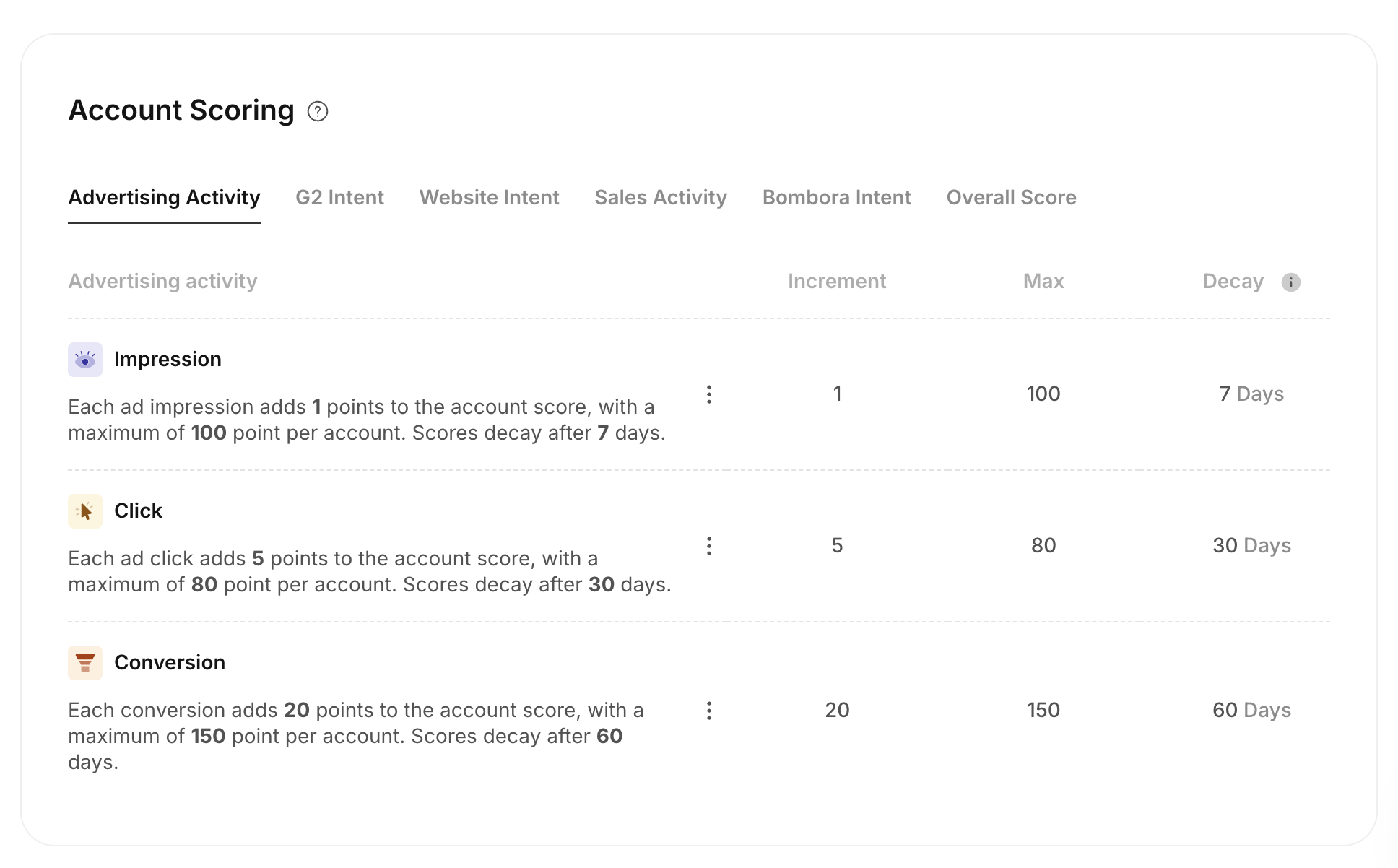
This captures how the account is engaging with your LinkedIn ABM campaigns: ad impressions, clicks, video views, and engagement patterns across campaign types. An account that has clicked through multiple ads across different stages is scored differently from one that has seen ads but never engaged.
G2 Intent
This captures third-party buying signals from G2, where accounts are actively researching, comparing vendors, or reading reviews. An account checking your G2 profile while also visiting your pricing page is showing a very different level of intent than one that saw a single ad.
Website Intent
This reflects what the account has been doing on your website: which pages they visited, how many times, and how recently. A pricing page visit carries more weight than a blog visit. Five visits in fifteen days carries more weight than five visits spread across three months.
Bombora Intent Score
Bombora's co-op data surfaces accounts that are consuming content related to your category across the broader web, not just your own properties. This is the signal that catches accounts before they reach your website, which is exactly when you want to be running awareness campaigns.
Sales Activity Score
This reflects how the account is engaging with your sales team directly: email opens, replies, calls taken, and LinkedIn messages responded to. It ensures that accounts showing genuine sales engagement get elevated in the scoring model, not just accounts with high digital engagement that haven’t translated into conversation.
How Weightage is used to calculate the Overall Score
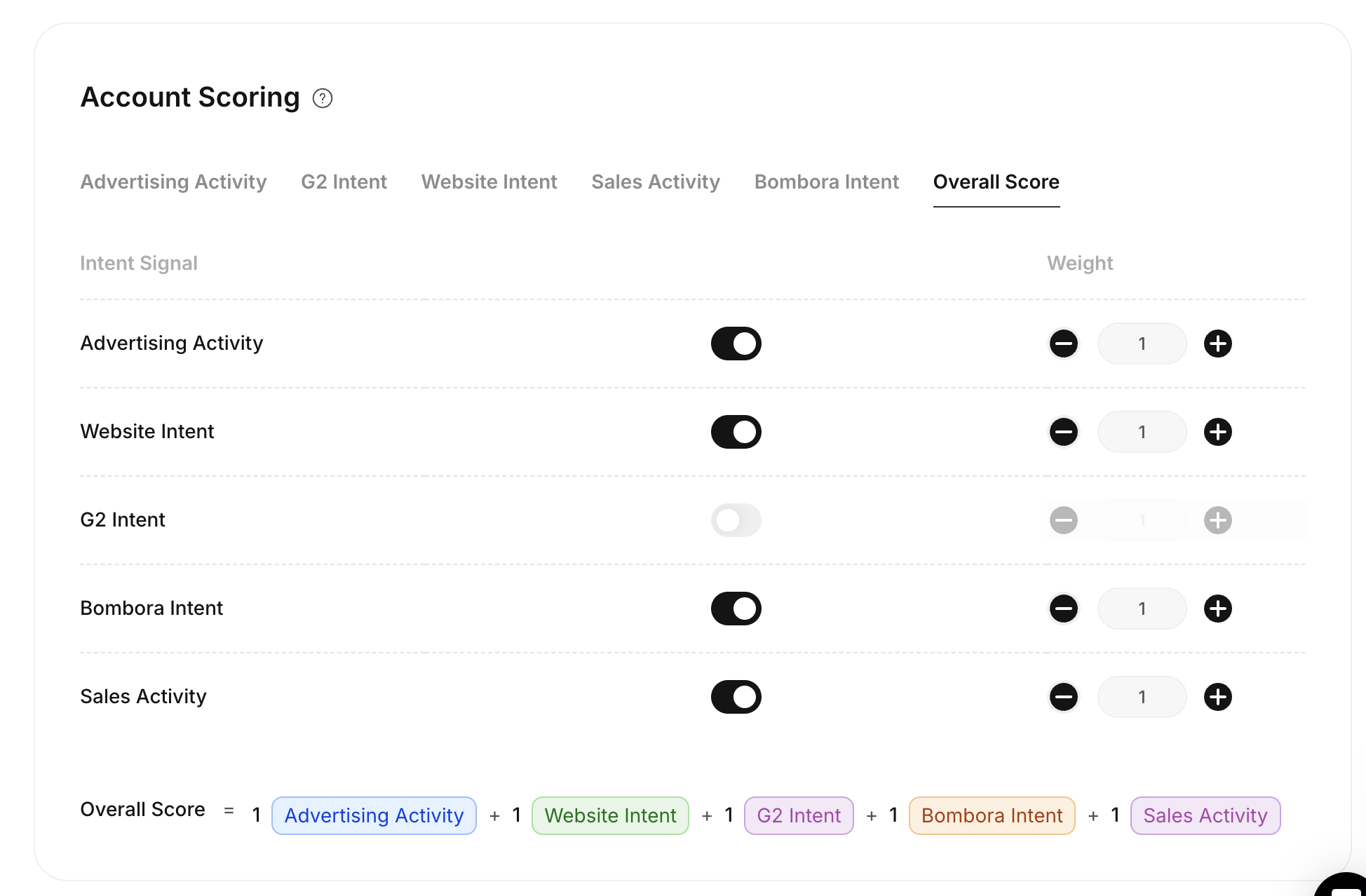
Not all signals deserve equal credit. A company engaging with sales is further along the buying journey than one browsing your blog. Recotap lets you assign custom weightages to each signal source, so the composite score reflects your understanding of how buyers move through your specific sales cycle.
A typical weighting might look like this:
Signal Source
Sample Weight
Sales Activity
3
Website Intent
2
G2 Intent
1
Advertising Activity
2
Bombora Intent
1
A company that has taken multiple sales calls would score significantly higher than one with strong ad engagement but no sales interaction, because the weights reflect the commercial reality of your pipeline.
There is no universal weighing that works for every team. The right configuration depends on your category, sales cycle length, deal size, and how closely your website and ad activity correlate with actual buying intent in your market. Recotap's model lets you adjust this over time as you learn what patterns actually precede closed deals.
How Decay Prevents Stale Scores
This is the part most platforms skip, and it is the most important.
Recotap applies exponential decay to every signal. A click or visit received today contributes its full value to the score. The same click from 30 days ago contributes significantly less, because buyer intent is time-sensitive. The window in which a signal is meaningful depends on the signal type and your sales cycle, but the principle is consistent: more recent activity matters more.
Decay solves some real operational problems.
Without it, scores accumulate over time and never come down, even when accounts have gone cold.
Sales teams lose trust in the score because they keep chasing accounts that no longer respond.
With decay, the score is a live reading of current intent, not a historical record of all activity ever observed.
This is also what makes Recotap’s account scoring meaningfully different from CRM history. The CRM records what happened. The score reflects what is happening now.
Account Score vs. Journey Stage: Two Different Readings
This distinction matters and often gets lost.
The Journey stage, Awareness, Engagement, Consideration, or Intent, is a categorical classification. It tells you where in the funnel an account sits based on a combination of signals and behavioral patterns. It is a label.
The account score is a continuous number. It tells you how strongly the account is signaling intent at this moment, within its current stage. Two accounts can both be classified as Consideration-stage, but one might have a score of 40 while the other has a score of 85. They require very different actions.
Recotap uses both together. The journey stage determines what messaging is appropriate. Account score determines urgency within that stage. Sales teams should be looking at both readings before they reach out.
How Account Score Helps Sales Teams
A score that lives only in a marketing platform is not useful. Recotap syncs account scores to your CRM, specifically HubSpot, Salesforce, and Zoho, on a daily basis. Sales reps see the score alongside pipeline data, contact records, and activity history without needing to log in to a separate tool.
This sync creates a shared language between marketing and sales. When a rep asks "why should I call this account today," the score gives a precise, signal-backed answer. When marketing updates the scoring weights to reflect new learning about what predicts conversion, those updates propagate to sales automatically.
Building Account Scoring vs. Using Recotap
Building account scoring from scratch means stitching five signal sources together, guessing at weightages, and maintaining decay logic that most teams never get around to implementing. It typically takes two or three months before the model is even stable. Recotap gets you a working, CRM-synced scoring model from week one, so you're refining from day one instead of debugging for months.
What you build yourself
What Recotap gives you
Manual signal collection across 5 sources
All five signals connected on day one
Weightages based on gut feel
Configurable defaults grounded in ABM best practices
Static thresholds you set once and forget
Thresholds you adjust anytime, no engineering needed
SDR handoff via Slack messages or spreadsheets
Automated alerts when accounts cross your defined score
Quarterly scramble to figure out why scores drifted
Decay built in, scores reflect live intent, not history
CRM updates whenever someone remembers
Daily sync to HubSpot, Salesforce, or Zoho, automatically
Summary
Account scoring only works when your sales team trusts it enough to act on it. That trust comes from scores that are explainable, current, and tied to signals that actually precede closed deals.
A few things to carry forward:
Recotap scores five signal types independently: advertising activity, website intent, G2, Bombora, and sales engagement. Each is weighted separately before rolling into a composite score
Configurable weightages mean the model reflects your sales cycle, not a generic ABM template
Exponential decay ensures the score reflects what is happening now, not what happened last quarter
Account score and journey stage are two different readings. Stage tells you where the account sits in the funnel. The score tells you how urgently to act within that stage
Scores sync to HubSpot, Salesforce, or Zoho every 24 hours, so sales work from the same signal without logging into a separate tool
Building this yourself takes quarters. Recotap gets you a working model from week one
When scoring is visible, configurable, and connected to your CRM, it stops being a marketing dashboard metric and starts being something your sales team actually uses to decide who to call today.
Frequently Asked Questions
What is account scoring in ABM?
Account scoring assigns a numerical value to each target account based on how that account is engaging across your marketing and sales channels. It aggregates signals from advertising activity, website visits, third-party intent data, and sales engagement into a single composite score that reflects current buying intent.
How is account scoring different from lead scoring?
Lead scoring tracks individual contacts. Account scoring tracks companies. In B2B, where buying decisions involve multiple stakeholders, account scoring gives a more accurate picture of whether a company is in an active buying cycle, regardless of which specific individuals are engaging.
What signals go into an account score?
Recotap scores five signal types: advertising activity, website intent, G2 research activity, Bombora intent data, and sales activity. Each is scored independently and then combined using configurable weightages to produce the composite account score.
What is score decay and why does it matter?
Score decay reduces the contribution of older signals over time, following an exponential curve. A click from today counts more than a click from 30 days ago. Decay prevents scores from becoming inflated by historical activity and ensures the score reflects current, live intent rather than a cumulative record.
How is an account score different from a journey stage?
Journey stage is a categorical label showing where in the funnel an account sits. Account score is a continuous number showing how strongly the account is signaling intent right now. Two accounts can share the same journey stage but have very different scores, which determines how urgently sales should act.
How does account scoring sync to the CRM?
Recotap syncs account scores to HubSpot, Salesforce, and Zoho daily. Sales reps see the score directly in their CRM alongside pipeline and contact data, without needing to switch tools. This keeps marketing and sales working from the same signal.
How do I decide the right weightages for my account scoring model?
Start by identifying which signals in your market most reliably precede closed deals. If sales engagement is the strongest predictor, weight it highest. Revisit the weightages quarterly and adjust based on which high-scoring accounts actually converted versus which ones stalled.
How to prioritize target accounts for ABM using scores?
Use the account score alongside the journey stage. Accounts at Consideration or Intent stage with high and rising scores should get the most SDR attention. Accounts at Awareness with low scores benefit more from continued campaign nurturing than direct sales outreach.
How do I implement an account scoring system?
Confirm which signal sources are active, assign weightages based on your sales cycle, set a score threshold for SDR handoff, and review quarterly against conversion data. Recotap automates scoring and CRM sync from there.