


Demand generation teams are held accountable for the pipeline, but most tools only measure engagement. When you add account-based marketing (ABM) into the mix, i.e., running campaigns across LinkedIn, CRM, email, and intent platforms that don't talk to each other, proving that your demand gen actually moved a deal becomes nearly impossible. The attribution gap isn't a reporting failure; the problem lies with the infrastructure.
Recotap is built to solve exactly that - connecting ad performance, intent signals, email engagement, and CRM movement into a single account view, so that demand gen teams can show pipeline contribution with data instead of inference.
Every Thursday, somewhere in a B2B SaaS company, a demand gen lead is building a pipeline review deck. They've pulled exports from LinkedIn, cross-referenced with Salesforce, and stitched in Bombora intent data along with email marketing’s miserable data. All of these data points are dated by at least 3-5 days. By Friday morning, the sales team has contested the numbers. Leadership is asking a simpler version of the same question: what exactly did marketing do to move these deals?
The demand gen team isn't failing at reporting. They're failing because the underlying infrastructure was never designed to answer that question.
A senior demand gen lead at a global B2B SaaS customer engagement company described it plainly during a vendor evaluation: "All of this is creating a lot of reporting overload for me. It just takes us away from our core goal of ensuring ROI." Her leadership's position was equally blunt: the only metric that matters is the number of meetings booked per week.
That metric gap between the leadership’s demands and what the current stack can actually prove is where demand gen accountability breaks down.
The typical demand gen stack built around account-based marketing programs on LinkedIn looks like this:
Each tool has its own attribution logic. LinkedIn takes credit for every deal touched by an impression. The CRM credits the last SDR activity. Intent platforms flag the accounts that spiked. None of them agrees, because none of them talks to each other at the account level.
LinkedIn's algorithm is not designed for account-based marketing. It optimizes for the cheapest engagement, not the highest-intent audience. Without external controls, impressions concentrate on a small subset of accounts, often the wrong ones.
Recotap's analysis of a $174K annual LinkedIn spend at one B2B SaaS company revealed that 92% of impressions went to just 20% of target accounts, and 50% of campaigns showed incorrect job title spillover. That budget was generating engagement metrics. It was not generating pipeline visibility because nothing in the stack connected impressions to account movement in CRM.
LinkedIn's native reporting can tell you if an account clicked your ad. It cannot tell you whether that account was already in a sales conversation, whether a competitor had touched them first, or whether the click represented genuine evaluation intent or just casual exploration.
Attribution requires connecting those layers. LinkedIn alone cannot do it.
Most demand gen teams try to fix attribution with better dashboards or more sophisticated BI tools. The problem is upstream.
Intent signals live in Bombora, and G2. Engagement data lives in LinkedIn’s ad reports. Pipeline lives in Salesforce, or Hubspot. When these three systems don't share a unified account record, attribution becomes an exercise in correlation, not causation. You can build charts that look persuasive in a board deck. You cannot answer the specific question: did this campaign create that opportunity?
The infrastructure problem has two symptoms:
Fixing this requires unifying the data at the source, not building smarter reports on top of broken foundations.
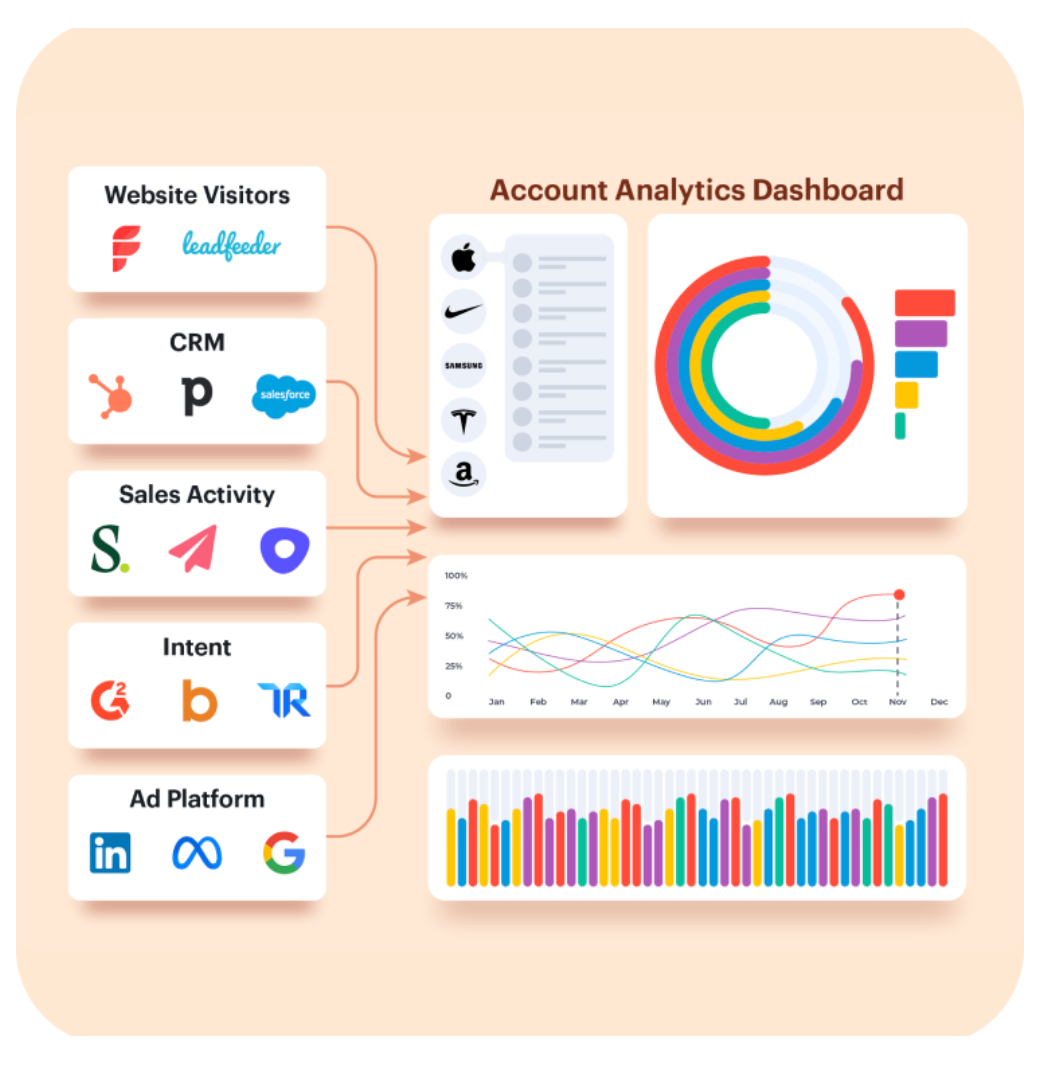
Recotap unifies first-party data, second-party data, and third-party intent signals to create a unified view of an account’s buyer journey stage.
Clean attribution means being able to trace an account's journey, from first LinkedIn ad impression to CRM opportunity creation with a continuous thread of engagement evidence. When attribution infrastructure is working correctly, a demand gen team can show leadership:
This shifts the leadership conversation from "how many impressions did you serve?" to "which of your campaigns generated the pipeline we closed last quarter?"
Recotap's Revenue Attribution feature unifies ad performance, CRM activity, and intent data — Bombora, G2, website visits and email engagement into a single dashboard. Account-level data syncs to CRM every 24 hours, so that sales and marketing can look at the same engagement timeline rather than separate tool views.
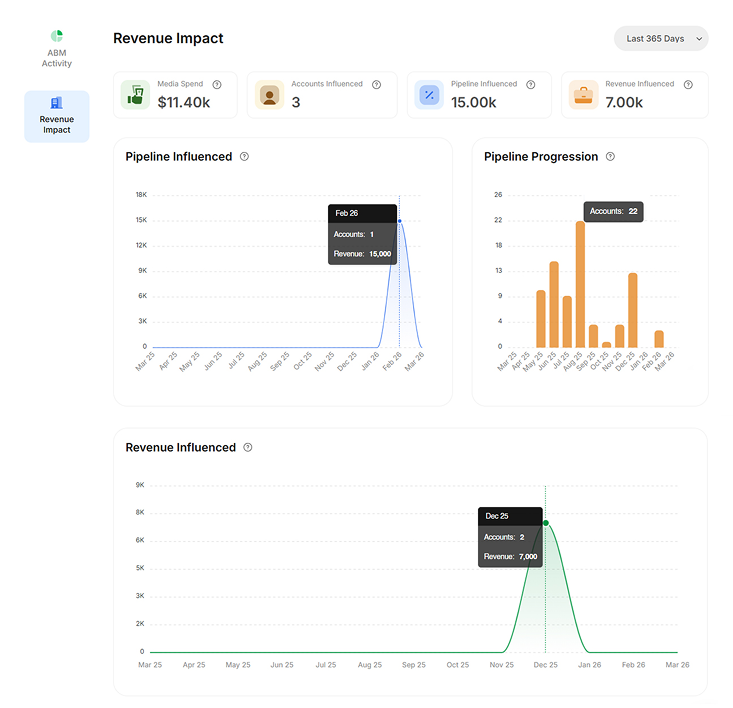
Impression capping prevents the budget from concentrating on low-probability accounts, so that campaign spend reaches accounts showing genuine consideration-stage signals. This also reduces false-positive engagement that distorts attribution data.
For demand generation teams, the result is a pipeline contribution story built on observable account behavior, not modeled inference.
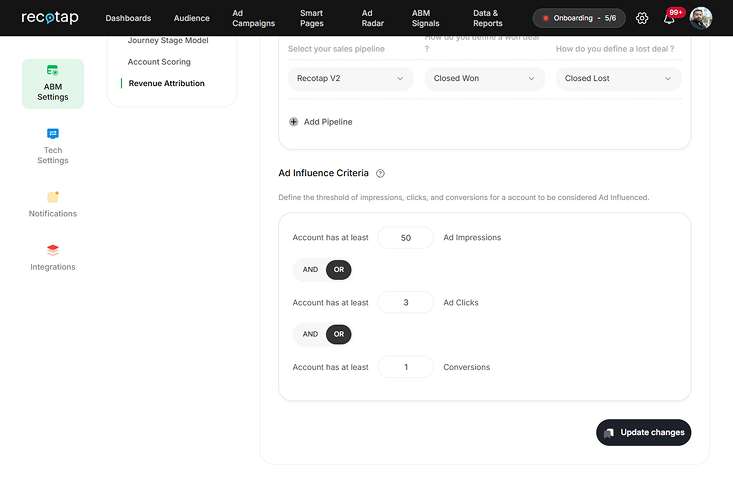
In Recotap, you can even define the threshold of impressions, clicks, and conversions for an account to be considered as ad-influenced based on your sales cycles.
Most demand gen teams run with 2–3 people. They cannot afford a tool that adds reporting overhead on top of the five they already manage.
The answer is automation at the infrastructure level:
When the platform reconciles the data continuously, the team's time shifts from stitching tools together to deciding what to optimize next.
Q: Why can't LinkedIn's native reporting prove pipeline contribution?
A: LinkedIn attribution applies credit to any impression served, regardless of whether the account was in-market or already in a sales conversation. It has no visibility into CRM pipeline movement. Without connecting ad exposure to account-level CRM data and intent signals, LinkedIn reporting measures activity, not causation. You can show impressions and clicks. You cannot show which accounts progressed to opportunity because of a specific campaign sequence.
Q: Which ABM platforms integrate LinkedIn ad performance with CRM data for accurate pipeline attribution?
A: Platforms that deliver genuine attribution connect three sources: LinkedIn ad performance at the account level, CRM opportunity and stage data, and third-party intent signals (Bombora, G2). Recotap's Revenue Attribution dashboard combines all three and syncs to CRM every 24 hours, so that sales and marketing operate from a shared account engagement record rather than separate tool exports.
Q: How do I prove to leadership that LinkedIn spend is creating pipeline, not just impressions?
A: The shift happens when you present account-level journey data instead of campaign-level engagement metrics. Rather than reporting impressions delivered, you show how many target accounts moved from unaware to consideration stage, which campaigns preceded each stage transition, and which of those accounts converted to opportunity. That is a pipeline contribution story leadership can evaluate against actual revenue outcomes.
Q: How do I reduce LinkedIn ad spend while still hitting pipeline targets?
A: The issue is usually distribution, not spend level. When a large share of impressions concentrates on a small fraction of target accounts — often the easiest to reach rather than the most likely to buy — budget efficiency collapses. Impression capping and account-level budget controls redirect spend toward accounts showing genuine evaluation signals, so that the same budget reaches a higher-probability audience.
Q: My SDR team says the accounts marketing targets aren't responding to outreach. Is that an attribution problem?
A: It is often both a targeting and a context problem. If SDRs reach accounts that haven't shown buying intent signals, outreach is premature. If accounts have engaged with ABM campaigns but SDRs have no visibility into what those accounts consumed, outreach arrives without context. Clean attribution surfaces the full account engagement history — what content they saw, what signals they showed — so that SDR conversations are informed by actual behavior rather than account name alone.
Q: What does pipeline attribution reporting look like for a leadership presentation?
A: Effective attribution reporting for leadership shows four things: which target accounts are currently in active evaluation, which campaigns created those evaluation moments, how deal velocity compared between accounts that received ABM touchpoints and those that did not, and the revenue value of influenced pipeline versus total spend. That is an ROI story grounded in account behavior, not a vanity metric summary.
Q: Which tools can ingest firmographic, technographic, and intent signals and turn them into LinkedIn segments automatically?
A: Most teams are still doing this manually - exporting a Bombora list, cross-referencing CRM firmographics, and uploading a static audience to LinkedIn that's stale within days. Recotap's Smart Segmentation combines first-party signals (website visits, CRM activity), third-party intent (Bombora, G2, Apollo.io), and firmographic filters into dynamic segments that update automatically as account behavior changes, so that the audience driving your LinkedIn campaign always reflects where accounts actually are, not where they were when someone last built the list.
Table of Contents