We use cookies to ensure you get the best experience on our website. By continuing
to use our site, you accept our use of cookies, privacy policy and terms of service.
ESC
What are you looking for?
Subscribe to our Newsletter
Join 10k+ people to get notified about new posts, news and updates.
Terms of use dolor sit amet consectetur, adipisicing elit. Recusandae provident ullam
aperiam quo ad non corrupti sit vel quam repellat ipsa quod sed, repellendus
adipisci, ducimus ea modi odio assumenda.
Disclaimers
Lorem ipsum dolor sit amet consectetur adipisicing elit. Sequi, cum esse possimus
officiis amet ea voluptatibus libero! Dolorum assumenda esse, deserunt ipsum ad
iusto! Praesentium error nobis tenetur at, quis nostrum facere excepturi architecto
totam.
Lorem ipsum dolor sit amet consectetur adipisicing elit. Inventore, soluta alias
eaque modi ipsum sint iusto fugiat vero velit rerum.
Limitation on Liability
Sequi, cum esse possimus officiis amet ea voluptatibus libero! Dolorum assumenda
esse, deserunt ipsum ad iusto! Praesentium error nobis tenetur at, quis nostrum
facere excepturi architecto totam.
Lorem ipsum dolor sit amet consectetur adipisicing elit. Inventore, soluta alias
eaque modi ipsum sint iusto fugiat vero velit rerum.
Copyright Policy
Dolor sit amet consectetur adipisicing elit. Sequi, cum esse possimus officiis amet
ea voluptatibus libero! Dolorum assumenda esse, deserunt ipsum ad iusto! Praesentium
error nobis tenetur at, quis nostrum facere excepturi architecto totam.
Lorem ipsum dolor sit amet consectetur adipisicing elit. Inventore, soluta alias
eaque modi ipsum sint iusto fugiat vero velit rerum.
General
Sit amet consectetur adipisicing elit. Sequi, cum esse possimus officiis amet ea
voluptatibus libero! Dolorum assumenda esse, deserunt ipsum ad iusto! Praesentium
error nobis tenetur at, quis nostrum facere excepturi architecto totam.
Lorem ipsum dolor sit amet consectetur adipisicing elit. Inventore, soluta alias
eaque modi ipsum sint iusto fugiat vero velit rerum.
How a leading service provider of digital and network services to the telecom and media industries, saw a 66% decrease in CPL. They integrated intent signals to decide who saw their ads, account personalisation to decide what they saw, and impression capping to stop budget wastage.
TLDR
The average cost per lead on LinkedIn climbs $800-$1,000 when algorithms utilize 70% of the budget on just 10% of target accounts. ABM platforms, like Recotap, with account-level orchestration cut CPL by 66%. The platform utilizes impression capping to distribute the budget across target accounts based on firmographics. Signal integration personalizes ads and 1-1 Personalized ABM landing pages to engage accounts at scale. Prodapt reduced CPL from $1,000 to $300 while reaching 80% more target accounts using the same quarterly budget of $7000 simply by shifting from audience-level to account-level controls.
What Is the Average Cost Per Lead on LinkedIn for ABM Campaigns?
The average cost per lead on LinkedIn for ABM ad campaigns typically ranges from $800 to $1,000 when using standard audience-level targeting. This happens primarily because LinkedIn's algorithm utilizes 70% of the budget on just 10% of target accounts. It prioritizes the ones showing the highest engagement, while strategic accounts receive zero visibility. When single enterprise accounts consume 20-40% of monthly spend, CPL inflates dramatically, while most of your target audience never sees your ads.
ABM platforms like Recotap with account-level controls reduce this by 40-66% through Impression Capping, which distributes budget based on firmographics rather than engagement rate. By ensuring all target accounts receive minimum viable frequency, these tools increase account penetration from 15-25% to 80-90%, spreading the budget across the entire target audience rather than exhausting the budget on highly engaged accounts.
The difference between efficient and wasteful ABM budget allocation comes down to whether you control spend at the account level or let LinkedIn's engagement-based optimization decide where your money goes at the audience-level.
Why LinkedIn's Audience-Level Controls Drive Up ABM Costs
LinkedIn’s Campaign Manager operates at the audience level, optimizing delivery to maximize engagement metrics across user pools irrespective of the accounts. This creates a fundamental mismatch for account-based marketing with defined target account lists.
How LinkedIn's Algorithm Concentrates Budget
LinkedIn's machine learning identifies which users respond most, then concentrates its budget on those high-performers. The platform's algorithm doesn't identify users by firmographics; it only knows which ones click and convert based on historical engagement patterns.
Analysis across hundreds of ABM ad campaigns shows consistent patterns:
70% of impressions go to 10-15% of target accounts
50-60% of accounts receive fewer than 3 impressions per month
Single large accounts consume 20-40% of the monthly ABM budget allocation
Strategic high-value target accounts often get zero exposure
LinkedIn ad campaign analysis
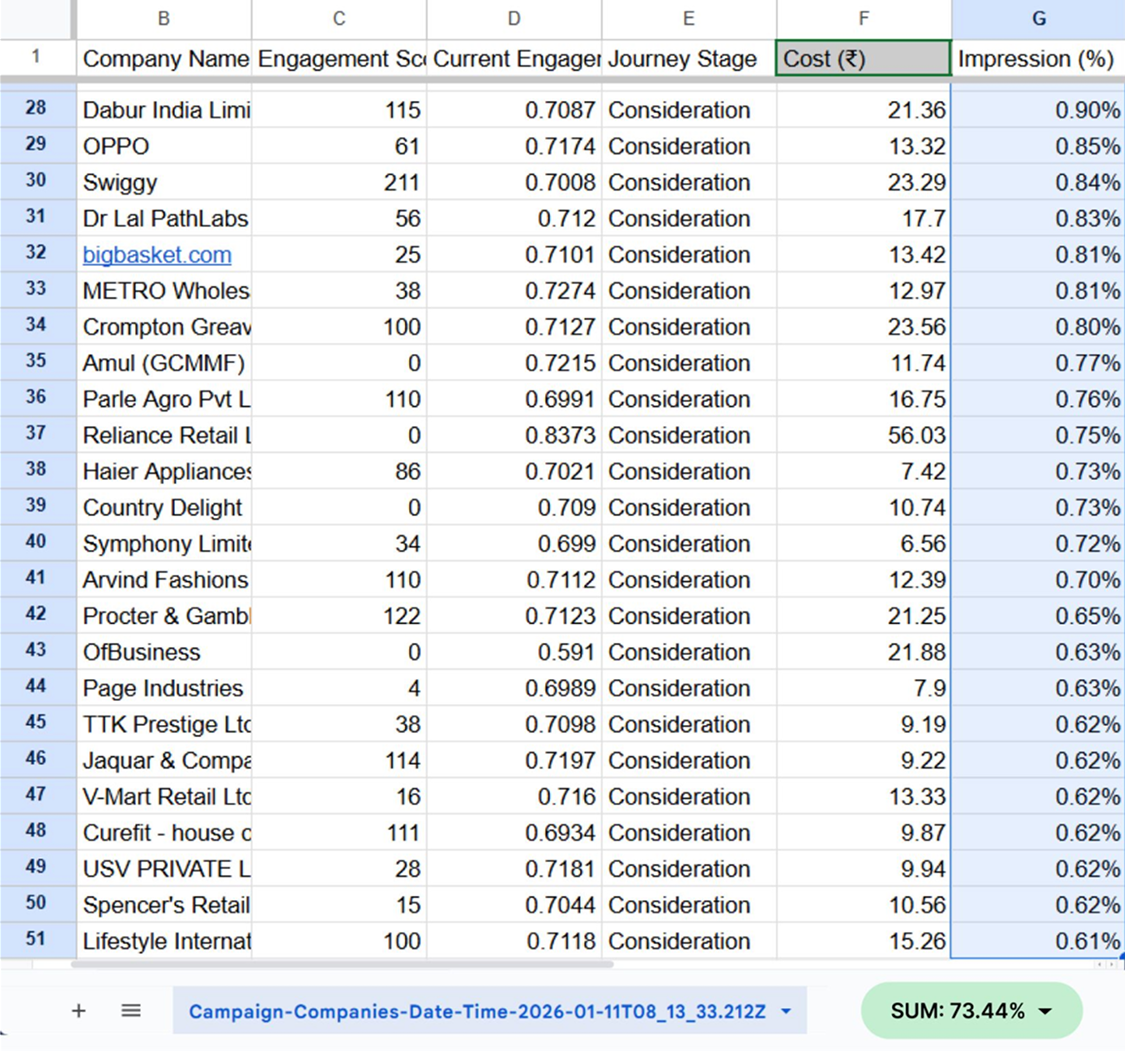
We recently analysed a LinkedIn campaign targeting 940 accounts.
Here’s what the impression distribution looked like:
Top 50 accounts (just ~5%) consumed 73.4% of total impressions
The remaining 890 accounts were left fighting over ~26.6%
Dozens of valid ICP accounts barely showed up at all
The algorithm optimizes for engagement, not strategic value. A small, hyper-engaged company might consume 10x the budget of a Fortune 500 strategic account simply because its employees are more active and engage more with LinkedIn content.
The Account Penetration Problem
LinkedIn reports "reach" at the audience level i.e., how many individual users saw your ads. If 5,000 people across 500 companies saw your ads, LinkedIn shows 5,000 reach. But if those 5,000 impressions concentrate on just 50 large companies, your account penetration is only 10%. The other 450 strategic target accounts never entered the auction.
Account penetration formula: (Accounts with 3+ impressions / Total target accounts) × 100
Why 3+ impressions matter: LinkedIn filters out granular data below this threshold. B2B purchases involve 6-10 stakeholders per account. When LinkedIn concentrates impressions on a few accounts, you might reach multiple people at those companies. But at the hundreds of accounts getting zero exposure, you're completely absent from buying committee discussions.
Typical cost per lead campaigns using LinkedIn's native controls achieve 15-25% account penetration. Strategic accounts with longer buying cycles show low early engagement, causing LinkedIn's algorithm to deprioritize them. Budget exhausts itself before reaching the majority of your target audience, driving average cost per lead on LinkedIn to $800-$1,000 while leaving most target accounts invisible.
How Do ABM Platforms Reduce Cost Per Lead Campaigns?
ABM tools with account-level orchestration solve the budget concentration problem through three core mechanisms: Impression Capping that distributes spend strategically, Signal Integration that maps accounts in their journey stage to understand their buying readiness, and creates personalized ads and 1-1 abm landing pages that scale engagement.
What Is Account-Level Impression Capping?
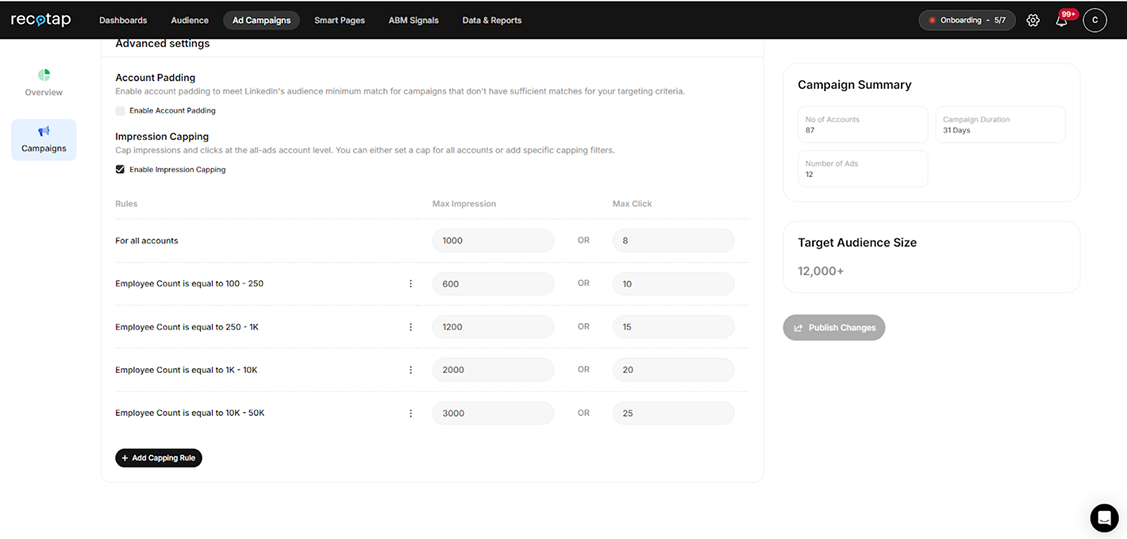
Account-level impression capping sets maximum impressions per company per time period, typically for the campaign period. When a target account hits its cap, LinkedIn's auction automatically stops serving ads to anyone at that company and reallocates budget to accounts that haven't reached their limits.
Example without capping:
Target list: 180 accounts
Monthly budget: $7,000
Result: 50 highly engaged accounts get 12K+ impressions each, 130 accounts get fewer than 20 impressions, and the budget is exhausted on 32% of the list
Same campaign with firmographic-based impression caps:
First 50 accounts hit their 10000 impressions limit in week 1
Budget automatically flows to the next 130 accounts
By month-end: 144+ accounts reached at target frequency
Penetration: 80% vs 28%
The budget doesn't sit idle when accounts hit caps. The auction continuously redistributes spend to available target accounts. This creates a predictable, even distribution aligned with the firmographics rather than LinkedIn's engagement algorithms.
Opportunity accounts: Objection handling, competitor positioning, ROI calculator
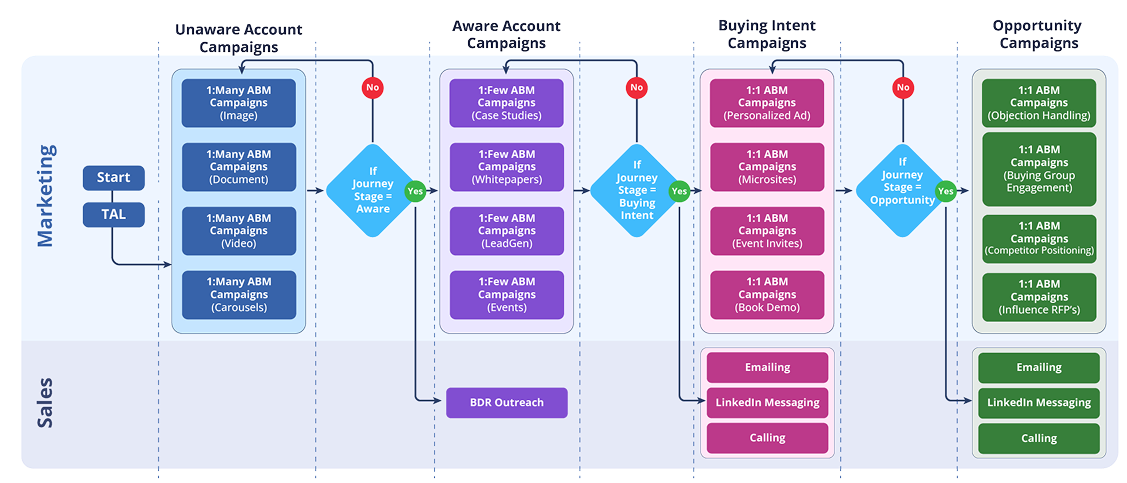
Journey Stage-based Campaign workflow
Sales and Marketing Alignment
Marketing and Sales work from the same account intelligence. Sales receives real-time alerts when target accounts cross intent thresholds based on combined signals. Instead of calling everyone who clicked an ad, sales focuses on accounts showing sustained engagement, research behavior, and journey stage progression, indicating actual buying intent.
This reduces wasted sales effort and improves conversion rates on cost-per-lead (CPL) campaigns. When sales teams engage at the right moment based on actual intent signals rather than arbitrary qualification thresholds, close rates improve 2-3x while sales cycle length decreases by 30-50%.
Why Are Personalized Ads and 1-1 ABM Landing Pages Critical for Reducing CPL?
Creating personalized ads and 1-1 ABM landing pages that match ad messaging and account context increases conversion rates 2-3x compared to generic landing pages. When page personalization addresses specific pain points relevant to each target account, click-to-lead conversion improves from 1-2% to 3-5%. This directly reduces the average cost per lead on LinkedIn.
ABM tools enable creating personalized ads and landing pages at scale using templates and AI, eliminating manual design bottlenecks. The page personalization process:
AI analyzes account signals to identify specific pain points and use cases
System generates account-specific ad copy aligned to the journey stage
The platform creates personalized ads and landing pages that mirror current pain points
Ads and Landing pages dynamically update as target accounts progress through stages
Template-based approach maintains brand consistency while scaling
One ABM platform user launched 200+ account-specific landing pages in minutes using drag-and-drop builders. Ad copy evolved automatically as target accounts progressed through stages. CTR improved 2-3x due to message-persona fit. Conversion rates doubled from better ad-to-landing page continuity. Cost per lead campaigns became 40-66% more efficient as quality improved without increasing spend.
Case Study: How Prodapt Reduced CPL by 66% Using Account-Level Orchestration
The Challenge: $1,000 CPL and 60% Unreachable Target Accounts
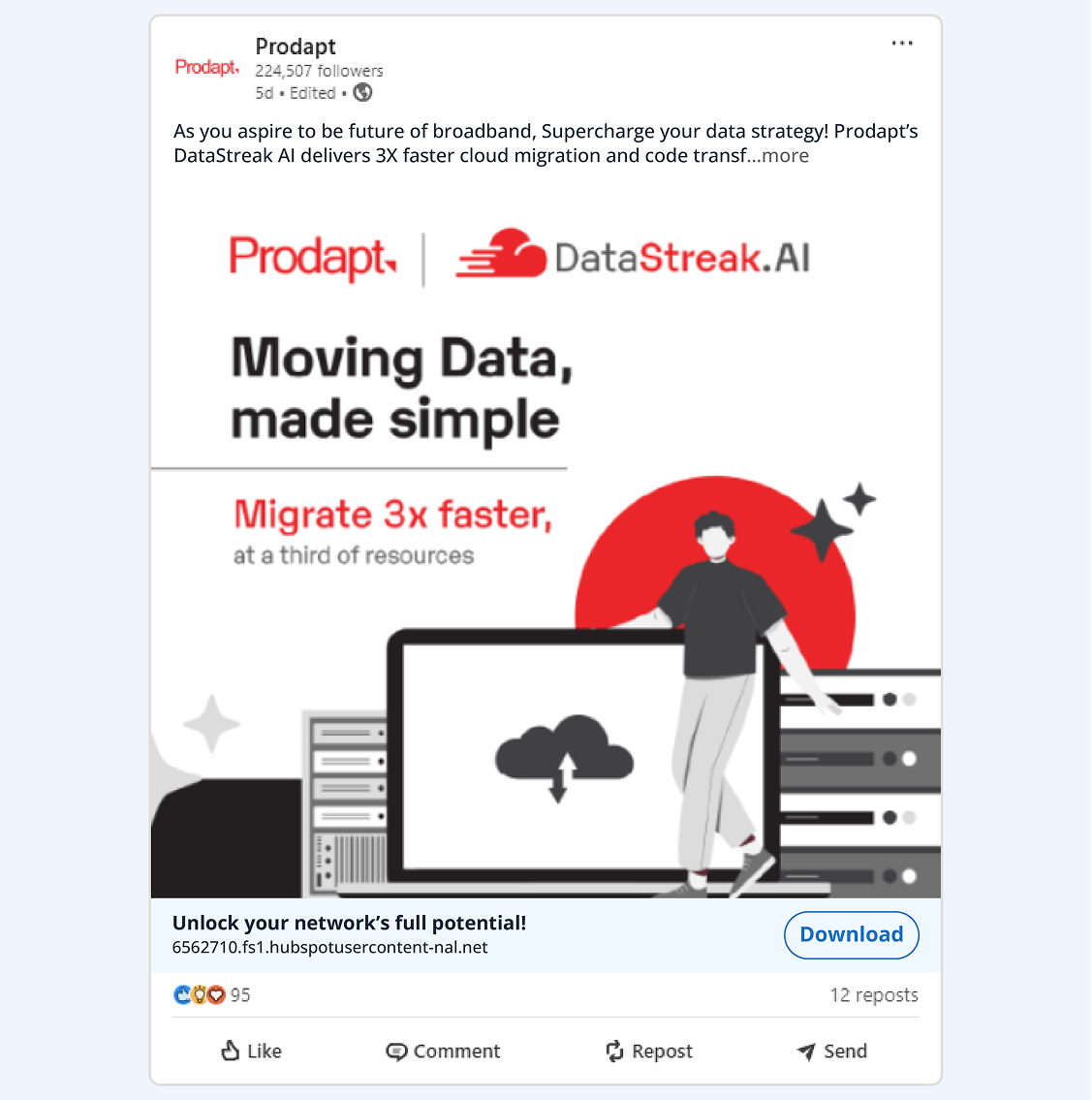
Prodapt, a global provider of AI-first technology solutions for telecom enterprises, faced the classic LinkedIn ABM problem. Their cost per lead campaigns were technically successful by platform metrics - decent CTR, acceptable conversion rates, but commercially wasteful.
Starting position:
Target list: 180 high-intent accounts
Quarterly ABM budget: $7,000
Average cost per lead on LinkedIn: $800-$1,000
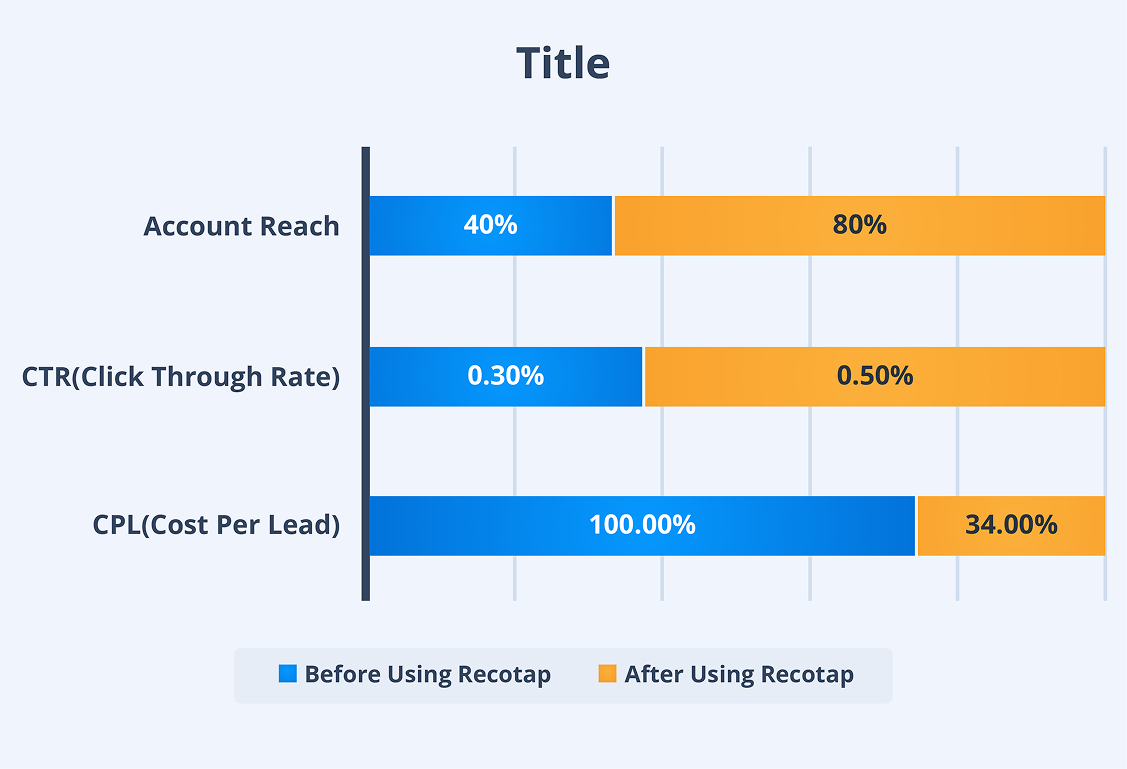
CTR: 0.2-0.3%
Account penetration: 27%
Budget concentration: Top 50 accounts consuming 68% of spend
Result: 132 strategic target accounts receiving zero visibility
The demand generation team recognized that LinkedIn's native audience-level controls couldn't solve ABM budget allocation at scale. Strategic accounts with longer buying cycles were getting starved, while highly engaged accounts consumed disproportionate budget.
The Solution: Account-Level ABM Tools
The team switched from LinkedIn's native controls to Recotap, an ABM platform with account-level orchestration. Implementation focused on three core capabilities:
1. Firmographic-Based Impression Capping
2. Journey Stage-Based Campaign Execution
1:1 ABM campaigns for high-intent target accounts
1:Many awareness campaigns ran in parallel
Stage-based targeting with solution-led messaging and sharper CTAs
Signal orchestration determines when to activate the sales team
3. Scaled Page Personalization
Creating personalized landing pages using automated templates
$10/account daily bid with ad personalization to win auctions
Dynamic content updating as accounts progressed through stages
Sample of 1-1 ads
The ABM platform's automated pacing distributed spend evenly across all 180 target accounts, no more budget concentration on the same 50 accounts month after month.
The Results: 80% Account Penetration and $300 CPL
The transformation happened within one quarter of implementation:
What changed strategically:
ABM budget allocation is aligned with strategic priority rather than engagement propensity
Every target account received a minimum viable frequency for awareness
Sales coordination improved through shared account intelligence surfaced by the platform
Page personalization at scale drove relevance without manual overhead
Cost per lead campaigns became predictable rather than wasteful
"Recotap gave us clearer account visibility, sharper targeting, and far better cost efficiency," said Gopinath Ganeshan. "It helped us reach the right accounts at the right time while cutting CPL drastically. It has become an essential part of our ABM stack."
The team now has a repeatable, high-conversion ABM playbook powering future bottom-of-funnel efforts. The same mechanics—impression capping, signal orchestration, and creating personalized landing pages—are being applied to expansion campaigns targeting existing customers and competitive displacement plays.
What Makes Account-Level ABM Tools Different from LinkedIn Native Controls?
The core distinction between audience-level and account-level optimization determines whether your cost per lead campaigns waste budget or drive an efficient pipeline.
Audience-Level (LinkedIn Campaign Manager):
Optimizes for engagement across a user pool
Concentrates the budget on the most active & engaged individuals within the targeting parameters
Individual frequency caps don't control account-level spend
No visibility into which specific target accounts are engaging
Sales receives leads without account context or journey stage information
Average cost per lead on LinkedIn stays high ($800-$1,000) due to concentration waste
Account-Level (ABM Platforms):
Optimizes for penetration across the strategic target account list
Distributes ABM budget based on firmographic priority via impression capping
Account-level impression caps prevent concentration and wastage
Full transparency into target audience engagement, journey stage, and intent signals
Sales coordinates outreach based on real-time signals showing buying readiness
Cost per lead campaigns become efficient ($300-$500) through smart allocation
The business impact of account-level ABM tools:
Lower average cost per lead on LinkedIn (40-66% reduction) through better ABM budget allocation
Higher account penetration (80-90% vs 15-25%), activating dormant target accounts
Faster sales cycles (30-50% reduction) through coordinated timing based on intent signals
Predictable pipeline from the priority target audience rather than random responders
Scalable page personalization (hundreds of 1-1 landing pages) without bottlenecks
ABM platforms complement rather than replace LinkedIn Campaign Manager. You still create campaigns, upload target accounts, and manage creatives through LinkedIn's interface. ABM tools add orchestration on top: impression capping enforces spend limits per account, signal integration combines LinkedIn activity with website visits and intent data, journey stage mapping automatically segments target accounts, and creates personalized ads and landing pages at scale.
The result is LinkedIn's targeting precision plus account-level intelligence and control, which transforms cost-per-lead campaigns from budget drains into predictable revenue engines.
Summary: Account-Level Orchestration Transforms Cost Per Lead Campaigns
The transformation from $1,000 to $300 average cost per lead on LinkedIn doesn't require better creative or improved targeting parameters. It requires fixing the architectural problem at the core of audience-level optimization.
When LinkedIn's algorithm concentrates 70% of the budget on 10% of the target accounts, you're not running account-based marketing. You're running engagement-optimized advertising with an account list attached. Strategic accounts get starved. Budget is exhausted on overexposed accounts. Average cost per lead on LinkedIn inflates to $800-$1,000 while 60-80% of your target audience never sees an ad.
Recotap solves this through account-level orchestration:
Impression capping distributes the budget based on firmographic priority rather than engagement propensity. When accounts hit firmographic-based caps, spend automatically reallocates to under-exposed target accounts. This increases account penetration from 15-25% to 80-90%, ensuring all strategic accounts receive minimum viable frequency.
Signal integration combines first-party data with third-party intent to map accounts to buyer journey stages. Campaigns adapt automatically as accounts progress. Sales receives real-time alerts when accounts cross intent thresholds, coordinating outreach at peak buying moments rather than wasting effort on early-stage accounts.
Creating personalized ads and 1-1 abm landing pages at scale maintains relevance without manual overhead. Template-based systems generate hundreds of 1-1 landing pages that mirror ad messaging and update dynamically as accounts progress. Page personalization improves conversion rates 2-3x, directly reducing CPL through better click-to-lead efficiency.
This is the shift from audience targeting to account orchestration, from optimizing for engagement metrics to optimizing for strategic target account activation. When you control spend at the account level through ABM tools, combine multi-source signals, and coordinate cross-channel timing, cost per lead campaigns stop being budget drains and start being predictable pipeline engines.
As Prodapt's results demonstrate, the same ABM budget allocation ($7,000/quarter) can deliver 80% more target accounts reached, 66% lower CPL, 2x more high-intent leads, and 100% priority account engagement, simply by shifting from audience-level to account-level controls.
The average cost per lead on LinkedIn doesn't have to be $800-$1,000. With the right ABM platform, it can be $300 while reaching 80% of your target accounts.
Frequently Asked Questions
Q: How does Recotap reduce cost per lead campaigns compared to LinkedIn native controls?
A: Recotap prevents budget concentration through account-level impression capping, setting maximum impressions per account based on firmographic priority. When target accounts hit caps, budgets automatically redistribute to under-exposed accounts. This increases account penetration from 15-25% to 80-90%, spreading costs across the entire target audience rather than exhausting the budget on highly engaged accounts. Combined with that, creating personalized ads and landing pages that improve conversion rates 2-3x, cost per lead campaigns become 40-70% more efficient. Recotap is able to automate personalization at scale as it integrates intent signal, ensuring marketing and sales engage accounts at peak intent moments rather than wasting effort on early-stage accounts.
Q: What's the difference between ABM platforms and regular LinkedIn Campaign Manager?
A: LinkedIn Campaign Manager operates at the audience level, optimizing delivery for the highest engagement across user pools. ABM platforms operate at the account level, controlling spend per company using firmographic rules. Key differences: (1) Budget distribution - ABM tools allocate by strategic priority vs engagement propensity, (2) Impression control - account-level caps vs individual frequency limits, (3) Signal integration - multi-party intent data vs platform activity only, (4) Ad and landing page personalization that creates 1-1 personalized messaging vs generic landing pages, (5) Visibility- account-specific metrics vs aggregate campaign data. ABM platforms complement LinkedIn by adding orchestration on top of native targeting, not replacing it.
Q: How does impression capping improve ABM budget allocation?
A: Impression capping prevents single-target accounts from consuming disproportionate budget share. Without caps, LinkedIn's algorithm concentrates 70% of impressions on 10% of accounts showing the highest engagement. With firmographic-based caps (e.g., 20k impressions/month for enterprise accounts, 8k for SMB), the budget is distributed evenly across the entire target account list. This increases account penetration from approximately 25% to 80%+, ensuring all strategic accounts receive minimum viable frequency while preventing oversaturation and fatigue on active accounts. The result: average cost per lead on LinkedIn drops 40-66% as budgets reach more target accounts and generate more total leads from the same spend.
Q: Why are 1-1 personalized ABM landing pages important for reducing CPL?
A: Creating personalized landing pages that match ad messaging and account context increases conversion rates 2-3x compared to generic landing pages. When page personalization addresses specific pain points relevant to each target account, click-to-lead conversion improves from 1-2% to 3-5%. This directly reduces the average cost per lead on LinkedIn. If you're paying $5 CPC and converting at 2%, CPL is $250. With page personalization improving conversion to 5%, CPL drops to $100 or less. Recotap creates personalized landing pages at scale using templates and AI that analyze account signals, eliminating manual design bottlenecks. Hundreds of 1-1 landing pages can launch in minutes while maintaining brand consistency.
Q: What ABM budget allocation strategies work best for large enterprises?
A: Effective ABM budget allocation for large enterprises uses tiered impression capping based on strategic value: (1) Tier 1 accounts (10-20% of list, highest strategic value): 250-300 impressions/user, (2) Tier 2 accounts (30-40% of list, strong fit): 150-200 impressions/user, (3) Tier 3 accounts (remaining list, exploratory): 80-100 impressions/user. Allocate 60-70% of the budget to Tier 1, 25-30% to Tier 2, and 5-10% to Tier 3. This ensures strategic target accounts receive sustained visibility while maintaining presence across the broader target audience. ABM platforms automate this distribution based on firmographic rules (industry, revenue, employee count, geography), adjusting caps dynamically as accounts progress through buyer journey stages.