We use cookies to ensure you get the best experience on our website. By continuing
to use our site, you accept our use of cookies, privacy policy and terms of service.
ESC
What are you looking for?
Subscribe to our Newsletter
Join 10k+ people to get notified about new posts, news and updates.
Terms of use dolor sit amet consectetur, adipisicing elit. Recusandae provident ullam
aperiam quo ad non corrupti sit vel quam repellat ipsa quod sed, repellendus
adipisci, ducimus ea modi odio assumenda.
Disclaimers
Lorem ipsum dolor sit amet consectetur adipisicing elit. Sequi, cum esse possimus
officiis amet ea voluptatibus libero! Dolorum assumenda esse, deserunt ipsum ad
iusto! Praesentium error nobis tenetur at, quis nostrum facere excepturi architecto
totam.
Lorem ipsum dolor sit amet consectetur adipisicing elit. Inventore, soluta alias
eaque modi ipsum sint iusto fugiat vero velit rerum.
Limitation on Liability
Sequi, cum esse possimus officiis amet ea voluptatibus libero! Dolorum assumenda
esse, deserunt ipsum ad iusto! Praesentium error nobis tenetur at, quis nostrum
facere excepturi architecto totam.
Lorem ipsum dolor sit amet consectetur adipisicing elit. Inventore, soluta alias
eaque modi ipsum sint iusto fugiat vero velit rerum.
Copyright Policy
Dolor sit amet consectetur adipisicing elit. Sequi, cum esse possimus officiis amet
ea voluptatibus libero! Dolorum assumenda esse, deserunt ipsum ad iusto! Praesentium
error nobis tenetur at, quis nostrum facere excepturi architecto totam.
Lorem ipsum dolor sit amet consectetur adipisicing elit. Inventore, soluta alias
eaque modi ipsum sint iusto fugiat vero velit rerum.
General
Sit amet consectetur adipisicing elit. Sequi, cum esse possimus officiis amet ea
voluptatibus libero! Dolorum assumenda esse, deserunt ipsum ad iusto! Praesentium
error nobis tenetur at, quis nostrum facere excepturi architecto totam.
Lorem ipsum dolor sit amet consectetur adipisicing elit. Inventore, soluta alias
eaque modi ipsum sint iusto fugiat vero velit rerum.
Why LinkedIn-First Is the Right ABM Architecture, Not a Platform Limitation
TLDR
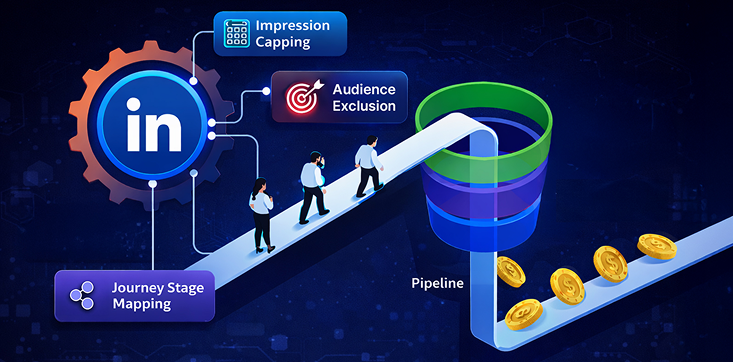
Recotap’s LinkedIn-first ABM is not a product gap. It is a deliberate architecture built for mid-market B2B teams whose buying committees research, evaluate, and shortlist on LinkedIn. The platforms that promise fifteen-channel breadth are built for enterprise teams with dedicated channel managers. Most demand gen leads running $5K to $50K monthly LinkedIn budgets need precision on one channel, not a thin operational layer across many. Journey-stage mapping, impression capping, and account exclusion are the three capabilities that turn LinkedIn from a leaking ad budget into a controlled pipeline engine.
LinkedIn-First ABM: Why Depth on One Channel Beats Breadth Across Fifteen
If your B2B buying committee is on LinkedIn, precision on this one channel beats diluted multi-channel campaigns
LinkedIn-first ABM is not a constraint. It is the right starting architecture for mid-market B2B teams whose buyers live, research, and shortlist on LinkedIn.
Recotap's journey-stage mapping, impression capping, and account exclusion turn LinkedIn from a leaking ad channel into a controlled pipeline engine.
Here is what demand gen leads learn after spending $91K or more on LinkedIn without these controls, and what changes when they run LinkedIn ABM the right way.
The Framing Problem That Is Costing You Pipeline
Most demand gen teams think that multi-channel ABM is most effective.
The question is not whether a platform covers fifteen channels. The question is: where do your buyers actually form opinions, do their research, and build shortlists? For mid-market B2B SaaS and IT services companies targeting enterprise accounts, the answer is LinkedIn. Not because LinkedIn is the only channel. Because it is the channel where professional attention is concentrated and where 6 to 10 buying committee members can be reached with coordinated messaging in a way that no other single channel enables.
In LinkedIn’s own words:
Multi-channel breadth without LinkedIn depth is how you waste your budget, lose account penetration, and report impressions instead of pipeline.
What LinkedIn-First Architecture Actually Means
LinkedIn-first is not LinkedIn-only. It is a deliberate architectural choice to achieve precision on the channel where your buyers are most concentrated before expanding into channels where they are less present and harder to orchestrate.
The demand gen leads who benefit most from a LinkedIn-first approach share a consistent profile. Their LinkedIn ad budget ranges from $5K to $50K per month. Their team is 2 to 3 people managing campaign strategy, creative, reporting, and sales alignment simultaneously. They have tried or considered broader platforms and found that the implementation overhead, pricing tier, and operational complexity required to unlock the multi-channel features exceeds the benefit for their current GTM stage.
What they need is not more channels. They need LinkedIn to actually work for account-based marketing, which it does not do by default.
Why LinkedIn Does Not Work for ABM Without Orchestration
The result is a pattern that Recotap's team sees consistently across new accounts:
70% of impressions go to 10 to 15% of target accounts
A single enterprise account can consume 20 to 40% of a monthly budget
50 to 60% of target accounts receive fewer than 3 impressions in a given month
Strategic high-value accounts often get zero exposure for weeks at a time
One demand gen lead described spending over $100K on LinkedIn in a year and discovered that 92% of their impressions had gone to just 20% of their target account list. Another found after spending $91K LinkedIn across 44 campaigns, the top 20% of accounts had consumed 90% of their impressions. A third team was spending $30 to 40K per quarter on LinkedIn without being able to confirm which accounts had actually seen their ads.
In each case, the channel was not the problem. The absence of account-level orchestration was.
We recently analysed a LinkedIn campaign targeting 940 accounts with AdRadar
See above what the impression distribution looked like:
Top 50 accounts (just ~5%) consumed 73.4% of total impressions
The remaining 890 accounts were left fighting over ~26.6%
Dozens of valid ICP accounts barely showed up at all
3 Capabilities That Can Make LinkedIn a Complete ABM Architecture
Journey-Stage Mapping: Matching Message to Buyer Stage Automatically
Without journey-stage intelligence, LinkedIn campaigns serve the same message to every account regardless of where they are in the buying process.
An account that has visited your pricing page three times in 14 days sees the same awareness ad as an account that has never heard of you. The result is either wasted impressions on cold accounts or missed urgency with warm ones.
Journey-stage mapping continuously analyses intent signals from first-party website data, CRM activity, and third-party intent sources to classify each account as Awareness, Engagement, Consideration, or Intent. As accounts move between stages, their campaign exposure updates automatically.
Accounts showing high intent receive 1:1 personalised creatives and higher impression allocation. Accounts that have cooled off receive lower frequency or are paused entirely.
The practical outcome is that your LinkedIn budget distributes itself proportionally to where pipeline potential is highest, without manual intervention.
Impression Capping: Stopping LinkedIn's Algorithm From Budget Wastage
Impression capping sets maximum exposure limits per account per month, with the ability to differentiate by firmographic criteria. An enterprise account with a 10,000-person organisation might warrant 10,000 impressions per month to reach its full buying committee. A 200-person SMB on your list might warrant 500. Without a cap, LinkedIn's algorithm ignores this distinction entirely.
When an account hits its cap, the budget redistributes to accounts that have not yet reached theirs. This single mechanism can shift account penetration from 15 to 25% (typically without capping) to 80 to 90% across a target account list.
The broader result is that you are actually running account-based marketing, not engagement-based advertising with an account list attached.
Account Exclusion: Protecting Spend From Accounts That Will Never Convert
LinkedIn has no native mechanism for excluding accounts that are already customers, competitors researching your positioning, closed-lost deals, or segments that have disengaged over multiple months. Without active exclusion, these accounts continue consuming impressions at the same rate as your highest-priority targets.
Account exclusion layers onto CRM sync so that closed deals are removed from active campaigns within 24 hours. Competitor lists are excluded in real time. AI filters identify segments that have accumulated impressions without showing any conversion signal and pause spending on them automatically. Separate campaign logic allows you to run acquisition campaigns that exclude existing customers while simultaneously running upsell campaigns that specifically target them with different messaging.
Together, these three capabilities turn LinkedIn into a controlled pipeline engine rather than a channel you fund and hope delivers results.
When Does a Broader Platform Actually Make More Sense?
ABM’s success depends on the strategy you use, and that starts from understanding the breadth of the ICP you want to reach Vs the budget you have for media spends or ads. A multi-channel strategy makes a lot of sense for large enterprises. You should consider players who cover all channels when the conditions below are met.
6sense and Demandbase are genuinely useful when:
• Your marketing team has 10 or more people with dedicated channel managers for display, CTV, and programmatic
• Your ABM budget exceeds $500K annually and requires unified orchestration across five or more channels
• You need predictive analytics at scale with a large data co-op covering millions of company signals
• Your enterprise procurement requires a single vendor to cover your entire demand gen infrastructure
• LinkedIn is one of four or five equally important channels in your GTM motion
LinkedIn-first architecture like Recotap wins when:
• Your team is 2 to 3 people, and LinkedIn is your primary or dominant pipeline channel
• Your LinkedIn budget is $5K to $50K monthly, and account penetration is your central problem
• You have tried or evaluated broader platforms and found that the implementation overhead exceeds the benefit
• You need to show pipeline impact within one to two quarters, not after a six-month implementation
• You want account-level orchestration without requiring a dedicated ABM operations person to run it
The honest framing is this: 6sense and Demandbase are not better. They are built for a different buyer. If your target customers are active on LinkedIn and your team is lean, a platform optimised for multi-channel enterprise ABM creates more overhead than it resolves.
What Demand Gen Teams Actually Benefit From
The teams that implement LinkedIn-first ABM with journey-stage mapping, impression capping, and account exclusion typically report the same sequence of observations.
In the first four weeks, the most immediate change is visibility. For the first time, they can see which accounts are actually receiving impressions, how many, and in what context. For most teams, this reveals that their previous LinkedIn spend concentrated on a small fraction of their target list and that the majority of their strategic accounts had essentially never seen their campaigns.
In weeks four to twelve, account penetration increases substantially. The shift from 20% account coverage to 70 to 80% coverage is not a marginal improvement. It means that three to four times as many buying committees are now in active contact with your messaging. Combined with stage-aware creative, engagement quality improves because accounts receiving ads are matched to the right message based on the stage of their research process.
By the end of a quarter, sales teams begin to observe something they had not seen clearly before: a connection between accounts that marketing had been running campaigns against and accounts that sales was getting responses from. That connection is the foundation of sales and marketing alignment that most teams say they want but find difficult to operationalise.
The LinkedIn ABM Approach Is About Where Your Buyers Are
The debate about LinkedIn-first versus multi-channel breadth is ultimately a question about where your buyers form opinions. If your buyers are enterprise decision-makers who research vendors on LinkedIn, discuss options with their buying committees through LinkedIn connections, and make their shortlists based on what they have seen in their feed, then the channel is not a limitation. Depth on that channel is a strategic advantage.
The risk is not choosing a LinkedIn-first platform. The risk is spreading your team's operational bandwidth across channels your buyers are not meaningfully present in, while under-investing in the one channel where they actually make decisions.
LinkedIn-first ABM, done with the right orchestration layer, is not a constraint. It is a complete architecture for mid-market B2B teams who know where their pipeline comes from.
Get the LinkedIn ABM Playbook demand gen leads are using to build 4x pipeline without adding headcount → recotap.com/linkedin-abm-playbook
Summary
LinkedIn-first ABM is a deliberate architecture, not a platform limitation. The key points:
LinkedIn is where mid-market B2B buying committees research, evaluate, and shortlist vendors. Depth on this channel is a strategic advantage
LinkedIn's algorithm creates a concentration problem that wastes 70% of ABM budget on 10 to 15% of target accounts without orchestration
Journey-stage mapping, impression capping, and account exclusion are the three capabilities that turn LinkedIn into a controlled pipeline engine
6sense and Demandbase genuinely win for enterprise teams with 10+ person marketing teams, $500K+ budgets, and multi-channel operations, but that is not the buyer profile of most demand gen leads running LinkedIn-heavy GTM motions
LinkedIn-first architecture achieves 80 to 90% account penetration versus 15 to 25% without impression controls
The architecture question is not which channels a platform covers. It is whether the platform achieves precision on the channel where your buyers actually form their shortlists
Frequently Asked Questions
Q: Is LinkedIn-first ABM the same as LinkedIn-only ABM?
No. LinkedIn-first means optimising for precision on the channel where your buyers are most concentrated before expanding to others. Recotap's CRM sync, intent data integrations, and outbound signal routing all feed into a multi-channel view. The difference is that LinkedIn is where orchestration begins and where the majority of account-based targeting is executed, not the only surface the platform touches.
Q: Why does LinkedIn's algorithm waste ABM budget without impression controls?
LinkedIn is a social engagement platform. Its algorithm optimises for clicks, reactions, and engagement signals because those metrics determine feed relevance. For ABM, this creates a concentration problem: the accounts that engage most frequently absorb the majority of impressions, while strategic accounts with lower individual engagement rates get minimal exposure. Impression capping corrects this by setting account-level limits and redistributing budget to under-reached accounts.
Q: How does journey-stage mapping change LinkedIn campaign performance?
Journey-stage mapping connects account behaviour signals - website visits, pricing page views, intent topic spikes, CRM activity to campaign targeting in real time. Instead of serving all accounts the same awareness ad, the system identifies which accounts are actively evaluating and serves them higher-intent creatives with appropriate frequency. Accounts that have cooled off receive reduced exposure. The result is that your budget allocates itself proportionally to pipeline potential rather than past engagement.
Q: What account penetration rate should we expect with impression capping versus without it?
Without account-level impression capping, most LinkedIn ABM campaigns achieve 15 to 25% account penetration, meaning fewer than one in four target accounts receives three or more impressions in a month. With firmographic-based impression caps, penetration typically rises to 80 to 90%. The threshold of three impressions is significant because LinkedIn's own reporting filters below that level, making sub-3-impression accounts effectively invisible in your analytics.
Q: Which mid-market B2B companies are best suited for LinkedIn-first ABM?
LinkedIn-first ABM works best for B2B SaaS, IT services, and professional services companies with deal values above $25K, LinkedIn ad budgets of $5K or more per month, and lean marketing teams of 2 to 5 people. Industries where professional identity and career seniority are central to purchasing decisions such as software, fintech, HR tech, and enterprise technology, see the strongest results because LinkedIn's professional graph is the most accurate audience signal available for those buyer profiles.
Q: How does account exclusion work for companies with both acquisition and upsell motions?
Recotap allows separate campaign segments with independent exclusion rules. Acquisition campaigns use CRM sync to exclude existing customers in real time, preventing budget waste on accounts that are already closed. Upsell campaigns specifically target those same customers with different messaging and creative. Competitor exclusions apply globally across all campaigns. This segmentation means your ABM budget is always matched to the right commercial objective without manual list management.
Q: How does Recotap compare to 6sense or Demandbase for mid-market LinkedIn ABM?
6sense and Demandbase are built for enterprise teams running multi-channel ABM across display, CTV, programmatic, and LinkedIn simultaneously, typically with budgets above $500K and dedicated channel operations staff. Recotap is built specifically for LinkedIn ABM with the orchestration depth — journey-stage mapping, impression capping, account exclusion, CRM sync — that other platforms offer as part of a much larger and more expensive package. For mid-market teams whose pipeline is LinkedIn-concentrated, Recotap provides the same orchestration precision at a fraction of the implementation complexity.
Q: How quickly can a demand gen team see pipeline impact from LinkedIn-first ABM?
Most teams running Recotap see initial engagement signals — increased account penetration, stage movement alerts, improved impression distribution — within the first two to four weeks. Pipeline creation signals typically appear within 60 to 90 days, depending on sales cycle length. Revenue influence becomes measurable within two to three quarters for companies with average sales cycles of 90 to 180 days. The time-to-value is significantly shorter than enterprise multi-channel implementations, which typically require four to six months before campaigns are fully operational.