We use cookies to ensure you get the best experience on our website. By continuing
to use our site, you accept our use of cookies, privacy policy and terms of service.
ESC
What are you looking for?
Subscribe to our Newsletter
Join 10k+ people to get notified about new posts, news and updates.
Terms of use dolor sit amet consectetur, adipisicing elit. Recusandae provident ullam
aperiam quo ad non corrupti sit vel quam repellat ipsa quod sed, repellendus
adipisci, ducimus ea modi odio assumenda.
Disclaimers
Lorem ipsum dolor sit amet consectetur adipisicing elit. Sequi, cum esse possimus
officiis amet ea voluptatibus libero! Dolorum assumenda esse, deserunt ipsum ad
iusto! Praesentium error nobis tenetur at, quis nostrum facere excepturi architecto
totam.
Lorem ipsum dolor sit amet consectetur adipisicing elit. Inventore, soluta alias
eaque modi ipsum sint iusto fugiat vero velit rerum.
Limitation on Liability
Sequi, cum esse possimus officiis amet ea voluptatibus libero! Dolorum assumenda
esse, deserunt ipsum ad iusto! Praesentium error nobis tenetur at, quis nostrum
facere excepturi architecto totam.
Lorem ipsum dolor sit amet consectetur adipisicing elit. Inventore, soluta alias
eaque modi ipsum sint iusto fugiat vero velit rerum.
Copyright Policy
Dolor sit amet consectetur adipisicing elit. Sequi, cum esse possimus officiis amet
ea voluptatibus libero! Dolorum assumenda esse, deserunt ipsum ad iusto! Praesentium
error nobis tenetur at, quis nostrum facere excepturi architecto totam.
Lorem ipsum dolor sit amet consectetur adipisicing elit. Inventore, soluta alias
eaque modi ipsum sint iusto fugiat vero velit rerum.
General
Sit amet consectetur adipisicing elit. Sequi, cum esse possimus officiis amet ea
voluptatibus libero! Dolorum assumenda esse, deserunt ipsum ad iusto! Praesentium
error nobis tenetur at, quis nostrum facere excepturi architecto totam.
Lorem ipsum dolor sit amet consectetur adipisicing elit. Inventore, soluta alias
eaque modi ipsum sint iusto fugiat vero velit rerum.
How to Build Brand Awareness in ABM (Using Impression Capping and Signal Orchestration)
Most ABM brand awareness campaigns fail for two structural reasons. First, marketers have no clear signals to distinguish unaware accounts from aware ones. As a result, every account gets the same generic messaging regardless of where they are in their buying journey. Second, LinkedIn's algorithm concentrates 70% of impressions on just 10% of accounts, which means even the generic message never reaches most of the target list. Fixing awareness requires signal orchestration to understand the pain point of each account and impression capping to ensure the right message actually reaches them.
Why Most ABM Awareness Campaigns Fail
ABM brand awareness campaigns fail for two structural reasons that reinforce each other. The first is a signal problem. The second is a distribution problem. Neither can be fixed independently.
No Clear Signals of Who Is Unaware and Who Is Aware
The most fundamental reason ABM awareness fails is that marketers do not know which accounts are unaware and which are already aware. Without this distinction, every account on the target list receives the same messaging at the same time, regardless of whether they have never heard of your company or have already visited your website three times this month.
This matters because the primary method for building awareness is serving contextual ads that resonate with where the account currently is. If you do not know what the current pain point is, your message cannot address it. If the message does not address a real, felt pain point, it will not resonate. And if it does not resonate, awareness never happens. The ad becomes noise.
This is not a creative problem or a budget problem. It is a signal problem. You cannot serve contextual, relevant awareness ads if you have no intelligence about what each account is currently thinking about, researching, or struggling with.
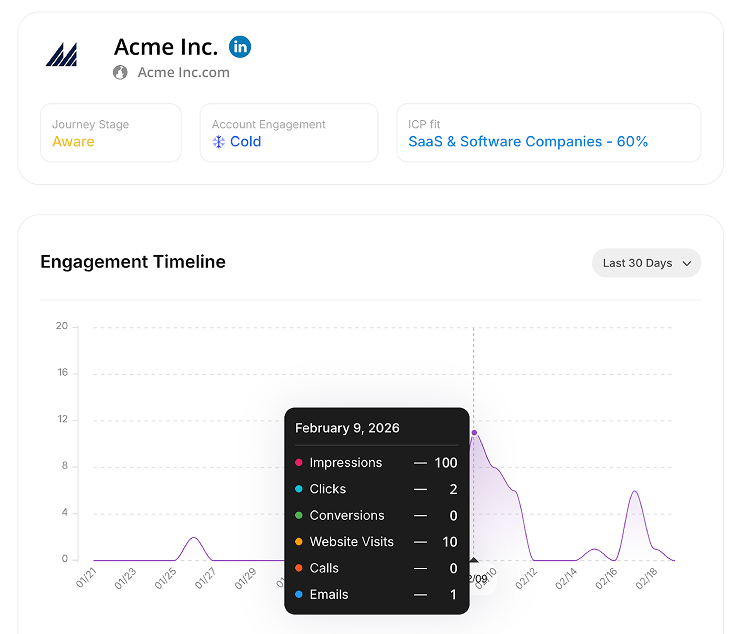
Recotap knows how many impressions has been served to your target account through your LinkedIn Ad, and how many clicks have happened. How many times they have visited which page of your website and if your sales team has ever engaged with them through CRM and email platform sync.
Recotap combines these first-party, third-party, and CRM signals along with LinkedIn ad engagement data to score accounts to understand which stage of buyer journey it is in. Which means you come to know when your target account has moved from being unaware to aware and so the context of the conversation has changed.
LinkedIn's Algorithm Wastes Ad Budget
The second reason awareness campaigns fail is also a platform challenge. LinkedIn's ad delivery algorithm is built to maximize engagement metrics, not account penetration. When you upload a target account list and launch awareness campaigns, the algorithm identifies which users and companies respond most actively and concentrates your budget on those high-performers.
For account-based marketing with a fixed strategic list, this creates massive waste.
LinkedIn’s algorithm does not know which accounts matter to your business. It only knows which ones engage. And it certainly does not know which accounts are already aware versus which ones still need awareness.
Recotap as an intent-based engine boosted our homegrown inbound engine with a much needed growth to nurture quality leads that in turn assist ‘top of funnel’ sales engine
Revanth Jatla
Head of Digital and Demand Generation
Before using Recotap, 60% of Prodapt’s accounts remained unreachable. Using Recotap’s impression capping, Prodapt achieved account penetration of 80% in just a single campaign. Higher account penetration automatically improves the chances of building brand awareness among the target audience.
Why These Two Problems Reinforce Each Other
When you combine no signal intelligence with algorithmic budget concentration, the result is predictable. Your awareness campaigns deliver the wrong message to a fraction of your accounts while the rest receive nothing at all.
The accounts getting all your budget may already be aware of you. Without signals, you cannot tell. So you keep spending on them while accounts that genuinely need awareness never enter the auction. Meanwhile, the accounts you do reach get messaging that does not match their actual situation, because you have no signal data to personalize against.
Fixing ABM awareness requires solving both problems simultaneously: signal orchestration to know what each account needs andaccount-level impression capping to ensure the message actually reaches them.
What Does Brand Awareness Look Like in ABM?
Brand awareness in account-based marketing is not a single ad impression or a one-time campaign. It is a structured progression through defined stages, where each account receives messaging appropriate to their current level of problem awareness.
Awareness Is a Journey, Not a Single Touchpoint
Every account on your target list sits somewhere on an awareness spectrum. Some have never heard of your company. Others may have encountered your brand but do not yet understand why it is relevant to them. Still others are aware of the problem you solve but have not connected your solution to their specific situation.
A sales intelligence startup with 1,000 target accounts found that every single account on their list was completely "unaware" of their platform. Building awareness for them meant starting from absolute zero, with no existing brand recognition to build on. Their entire marketing strategy needed to begin with awareness before any pipeline generation was possible.
In contrast, another social listening SaaS company discovered that prospects forgot about their product between demos and purchasing decisions. Their awareness challenge was not initial visibility but sustained mindshare throughout a long sales cycle.
These scenarios require completely different awareness approaches, which is why treating all target accounts equally is the most common ABM awareness mistake.
The Five Stages of Problem Awareness
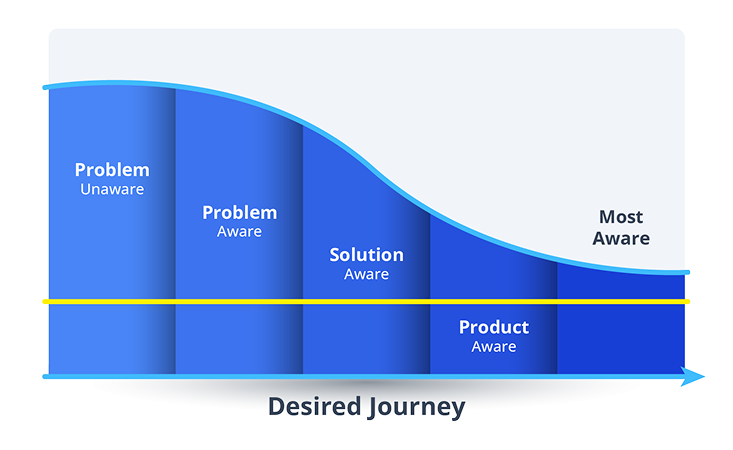
Eugene Schwartz's awareness framework, first defined in Breakthrough Advertising, provides the structure that effective ABM awareness campaigns follow:
Problem-unaware: The account does not recognize they have a problem. Awareness content must introduce the problem, not the solution.
Problem-aware: The account recognizes the problem exists but does not know solutions are available. Content should educate on the category of solutions.
Solution-aware: The account knows solutions exist but has not evaluated specific providers. Content should differentiate your approach.
Product-aware: The account knows your product exists but has not decided whether to buy. Content should provide proof points, case studies, and competitive positioning.
Most aware: The account knows your product and needs a final push to act. Content should focus on offers, demos, and removing objections.
Image Caption: 5 stages of problem awareness - marketing’s job is to push the audience from the heavy problem-unaware audience towards the most aware
Most ABM platforms skip directly to product-aware messaging for all accounts. This fails because a problem-unaware account will not consider your solution even if it is the best available. They need to understand the problem first.
The critical question is: how do you know which stage each account is in? Without buyer journey stage mapping, you are guessing. And guessing means your awareness messaging will miss more often than it hits.
Reach vs Brand Awareness in ABM: Why They Are Not the Same
Reach and brand awareness are often used interchangeably in campaign reporting. In account-based marketing, they measure fundamentally different things.
Reach in LinkedIn ads counts individual impressions across your audience. It tells you how many people saw your ad, without context about which companies they belong to or whether your strategic accounts were included.
Brand awareness in ABM measures account-level mindshare. It answers a different question entirely: what percentage of your target accounts have had enough exposure to relevant, contextual messaging that multiple buying committee members recognize your brand?
The word "relevant" is critical. An account can see your ad 50 times, but if the messaging does not connect with their current pain point, awareness does not happen. They see the ad. They do not remember it. The reach number can look strong in reports. The actual brand awareness with strategic accounts was minimal because even the accounts that did receive impressions got generic messaging that did not address their specific banking technology challenges.
Reach inflates your dashboard. Contextual account penetration creates real mental availability.
Withoutaccount-level impression controls and signal-based messaging, most ABM awareness campaigns achieve just 10-25% account penetration. That means 75-90% of your target accounts have zero brand awareness from your campaigns, regardless of how much you spend.
Which Targeting Option Is Best for Achieving Brand Awareness?
Not all targeting methods deliver the same brand awareness results. The choice of targeting approach directly determines whether your awareness budget reaches strategic accounts with the right message.
1. Broad industry and title targeting
This is the default LinkedIn approach. You select industries, job titles, company sizes, and geographies. LinkedIn's algorithm decides which companies see your ads. This generates the highest reach numbers but the lowest precision. Your budget gets consumed by non-ICP accounts that happen to engage more. No signal intelligence is possible at this level, so every account gets identical messaging regardless of their awareness state.
What you can do instead: Run your ads using Recotap’s platform so that each account in your target list is scored, right from the start, and your budget is never wasted.
2. Account list (CSV upload) targeting
You upload your target account list directly to LinkedIn. This narrows delivery to specific companies, but LinkedIn's algorithm still concentrates impressions on the most engaged accounts within your list. Without impression controls, 70% of your awareness budget still goes to 10% of accounts. And without signal data, you still cannot differentiate messaging by account awareness stage.
What you can do instead: Use Recotap’s impression capping for maximum account penetration across your target list.
3. Account list with job title layering
Adding title filters to your account list creates more precise persona targeting. However, LinkedIn's job title data is only 30% accurate. This means title-based filtering excludes 70% of the actual buying committee due to title variations and inflation. Narrowing titles actually reduces account penetration instead of improving it.
What you can do instead: Use Recotap’s impression capping for maximum account penetration across your target list.
4. Firmographic-based targeting with impression capping
This approach targets accounts at the company level using firmographic data (industry, revenue, employee count, geography) which has 90%+ accuracy, without restrictive title filters.Impression caps prevent budget concentration by limiting how many impressions each account receives per month. When an account hits its cap, budget automatically redistributes to unreached accounts. Result: 80-90% account penetration compared to 10-25% without capping.
5. Signal-layered targeting with contextual messaging
Adding first-party signals (website visits), second-party signals (G2, TrustRadius engagement), and third-party signals (Bombora intent topics) to your targeting does two things. It prioritizes spending on accounts showing early research behavior. And, enables contextual messaging because you know what each account is researching. An account browsing competitor pricing pages on G2 gets different awareness messaging than an account that has never visited any vendor site.
The best targeting option for brand awareness in ABM combines firmographic impression capping with signal-layered contextual messaging. This configuration ensures maximum account penetration (solving the distribution problem) while delivering messaging that addresses each account's actual situation (solving the signal problem).
How to Measure Brand Awareness at the Account Level
Brand awareness in ABM requires measurement that goes beyond campaign-level reporting. You needaccount-level metrics that show whether specific named accounts are actually building familiarity with your brand.
Account Penetration Rate
(Accounts with 3+ impressions / Total target accounts) x 100
Track this weekly. Without impression controls, most campaigns achieve 10-25% penetration. With account-level capping, the target is 80%+ penetration within the first 30 days.
Journey Stage Movement
Tracking how many accounts move from "Unaware" to "Aware" provides a direct measure of awareness effectiveness. Unlike impressions or reach, journey stage movement reflects whether accounts are actually responding to your awareness efforts.
Signal Response Rate
Beyond penetration and stage movement, track whether accounts are responding to your contextual messaging. If accounts are seeing ads but not clicking, visiting your site, or engaging with content, the message is not resonating with their actual pain point. Signal response rate measures the percentage of reached accounts that generate at least one first-party signal (website visit, content download, ad click-through) within 14 days of awareness exposure.
A healthy signal response rate for contextual awareness campaigns is 15-25%. If your rate is below 10%, the messaging is not addressing the right pain points, which means your signal intelligence needs improvement.
Summary
ABM awareness fails for two reasons: no signal intelligence to distinguish unaware accounts from aware ones, and LinkedIn's algorithm concentrating 70% of budget on just 10% of accounts. Both must be solved together.
Contextual ads are the primary awareness mechanism. Without knowing each account's current pain point, your messaging cannot resonate. If it does not resonate, awareness never happens, regardless of impression volume.
Signal orchestration from first-party (website, CRM), second-party (G2, TrustRadius), and third-party (Bombora) sources reveals what each account is researching so that messaging addresses their actual situation.
Account-level impression capping prevents budget concentration and redistributes spend to unreached accounts, improving penetration from 10-25% to 80-90%.
Reach is not awareness. An account can see generic ads 50 times and still have zero brand recall. Contextual account penetration is the real measure of awareness.
The best targeting option combines firmographic impression capping (90%+ accuracy) with signal-layered contextual messaging, solving both the distribution and the signal problem simultaneously.
Measure awareness with three metrics: account penetration rate (accounts with 3+ impressions / total accounts), journey stage movement (Unaware to Aware transitions), and signal response rate (% of reached accounts generating a first-party signal within 14 days).
Eugene Schwartz's five awareness stages (problem-unaware through most aware) provide the framework for matching content to each account's readiness level. Most ABM platforms skip to product-aware messaging, which fails on problem-unaware accounts.
Frequently Asked Questions
Q: How do you build brand awareness in account-based marketing?
A: Start by establishing signal intelligence so that you know which accounts are unaware, which are becoming aware, and what each group is currently researching. Then serve contextual awareness ads that address each segment's actual pain points rather than generic brand messaging. Use account-level impression capping to ensure your contextual ads reach 80%+ of your target list instead of being concentrated on 10% of engaged accounts. Track awareness through account penetration rate and journey stage movement from Unaware to Aware.
Q: Which targeting option is best for achieving brand awareness in ABM?
A: Firmographic-based targeting with account-level impression capping and signal-layered contextual messaging delivers the best results. This approach uses company-level firmographic data (90%+ accuracy) instead of job title filters (30% accuracy), while impression caps prevent budget concentration. Signal data from website visits, G2, and Bombora enables contextual messaging that resonates with each account's actual research interests. This combination achieves 80-90% account penetration compared to 10-25% with standard LinkedIn targeting.
Q: What is the difference between reach and brand awareness in ABM?
A: Reach counts individual impressions without context about which companies were included or whether messaging was relevant. Brand awareness in ABM measures whether target accounts actually recognize your brand because they received messaging that addressed their specific situation. An account can be "reached" 50 times with generic ads and still have zero brand awareness. Contextual impressions that match the account's pain points are what create actual recognition and recall.
Q: Does high LinkedIn reach mean my target accounts are aware of my brand?
A: No. LinkedIn can report high reach while the majority of your strategic accounts receive zero impressions. One banking technology company found that their ads reached 22,000 accounts when their target list was only 2,000-3,000. Even for accounts that were reached, generic messaging that did not address their specific banking technology challenges failed to create meaningful awareness. High reach without contextual relevance and account penetration tracking gives a misleading picture.
Q: Why do generic awareness ads fail in ABM even when they reach the right accounts?
A: Because awareness is built through relevance, not repetition alone. An account researching data security challenges will not remember a generic "innovative solutions" ad, no matter how many times they see it. Contextual ads that address the specific pain point the account is currently experiencing create recognition and trust. Without signal intelligence to identify what each account cares about, awareness messaging becomes background noise that consumes budget without building mindshare.
Q: What are the "thumb rules" for moving accounts from unaware to aware?
A: There are no absolute benchmarks because your business stage, marketing budget and the sales cycle will determine how fast accounts can move through stages. Configure your journey-stage model with 30-day recency decay so that stale signals do not keep accounts in outdated stages.
Q: Can I run brand awareness campaigns for a small target account list under 300 accounts?
A: Yes. While LinkedIn requires minimum audience sizes, platforms like Recotap use advanced audience techniques to reach the right stakeholders even with small lists. Impression capping is even more critical for small lists because budget concentration on a handful of engaged accounts is more severe with fewer targets. Signal intelligence also becomes more valuable because with a smaller list, you can deliver more precisely contextual messaging to each account rather than relying on broad segments.
Q: How do I prove that ABM awareness spending is working when leadership asks?
A: Present three metrics: account penetration rate (percentage of target accounts reached with 3+ impressions), journey stage movement (how many accounts moved from Unaware to Aware during the measurement period), and signal response rate (percentage of reached accounts that generated at least one first-party signal within 14 days of exposure). These metrics connect awareness spend to observable account behavior rather than vanity metrics like total impressions or aggregate reach.
Q: How can I reduce LinkedIn ad spend while still building brand awareness with target accounts?
A: Two mechanisms work together. First, impression capping prevents overexposure on already-engaged accounts and redistributes budget to unreached accounts, achieving 3-4x more account penetration with the same spend. Second, signal-based contextual messaging increases the effectiveness of each impression because accounts see ads that address their actual situation. When every impression is both distributed properly and contextually relevant, you need fewer total impressions to build the same level of awareness, lowering your LinkedIn ad budget needs.
Q: What platforms are best for intent-driven brand awareness campaigns on LinkedIn?
A: Look for platforms that solve both the signal problem and the distribution problem. You need signal orchestration (integrating website, G2, Bombora, ad engagement, and CRM signals to identify awareness stage and research topics), contextual ad personalization (generating messaging that matches each account's signals), and account-level impression capping (preventing budget concentration). Recotap provides all three in a LinkedIn-first platform with daily journey-stage updates and personalized ad templates for contextual 1:Many awareness campaigns.