We use cookies to ensure you get the best experience on our website. By continuing
to use our site, you accept our use of cookies, privacy policy and terms of service.
ESC
What are you looking for?
Subscribe to our Newsletter
Join 10k+ people to get notified about new posts, news and updates.
Terms of use dolor sit amet consectetur, adipisicing elit. Recusandae provident ullam
aperiam quo ad non corrupti sit vel quam repellat ipsa quod sed, repellendus
adipisci, ducimus ea modi odio assumenda.
Disclaimers
Lorem ipsum dolor sit amet consectetur adipisicing elit. Sequi, cum esse possimus
officiis amet ea voluptatibus libero! Dolorum assumenda esse, deserunt ipsum ad
iusto! Praesentium error nobis tenetur at, quis nostrum facere excepturi architecto
totam.
Lorem ipsum dolor sit amet consectetur adipisicing elit. Inventore, soluta alias
eaque modi ipsum sint iusto fugiat vero velit rerum.
Limitation on Liability
Sequi, cum esse possimus officiis amet ea voluptatibus libero! Dolorum assumenda
esse, deserunt ipsum ad iusto! Praesentium error nobis tenetur at, quis nostrum
facere excepturi architecto totam.
Lorem ipsum dolor sit amet consectetur adipisicing elit. Inventore, soluta alias
eaque modi ipsum sint iusto fugiat vero velit rerum.
Copyright Policy
Dolor sit amet consectetur adipisicing elit. Sequi, cum esse possimus officiis amet
ea voluptatibus libero! Dolorum assumenda esse, deserunt ipsum ad iusto! Praesentium
error nobis tenetur at, quis nostrum facere excepturi architecto totam.
Lorem ipsum dolor sit amet consectetur adipisicing elit. Inventore, soluta alias
eaque modi ipsum sint iusto fugiat vero velit rerum.
General
Sit amet consectetur adipisicing elit. Sequi, cum esse possimus officiis amet ea
voluptatibus libero! Dolorum assumenda esse, deserunt ipsum ad iusto! Praesentium
error nobis tenetur at, quis nostrum facere excepturi architecto totam.
Lorem ipsum dolor sit amet consectetur adipisicing elit. Inventore, soluta alias
eaque modi ipsum sint iusto fugiat vero velit rerum.
ABM segmentation breaks because most teams confuse account selection with campaign execution. Analysis of ABM discussions across Reddit and industry forums reveals three critical failures: static segments that decay within 30 days, over-engineered taxonomy that never activates, and no clear connection between segmentation and pipeline movement. The solution is not better filters or more data. Teams need signal-driven audiences that update automatically, stage-aware orchestration that matches messaging to buyer readiness, and segmentation that directly controls both ad spend and content delivery. This article examines why traditional firmographic, intent-based, and persona segmentation models collapse at scale, then presents a practical framework for dynamic segmentation that actually moves pipeline.
The Promise vs Reality of ABM Segmentation
ABM segmentation should do three things:
Identify which accounts matter
Determine when they are ready to engage, and
Control what messaging they receive.
Most teams get segmentation backwards by building elaborate taxonomies before understanding what signals actually predict the pipeline.
What teams expect is simple.
Create segments based on ICP fit, layer on intent signals, map accounts to buyer journey stages, and watch campaigns deliver personalized experiences that convert. The segmentation becomes the strategic foundation for everything: ad targeting, content creation, sales prioritization, and budget allocation.
What actually happens is different.
Teams build 20-30 segments that look perfect in spreadsheets but never activate in campaigns. Segments are static while accounts move. Intent data creates false positives. Nobody can reliably determine what stage an account is at. Marketing operations spends 15 hours per week rebuilding lists while sales complain that ABM targeting feels random.
Reddit discussions about ABM segmentation reveal consistent frustration. One demand generation director wrote: "We created segments for every permutation of industry, size, and intent level. Took three weeks to build. Two months later, most segments had fewer than 50 active accounts, and our ABM campaigns were hitting the same 30 companies repeatedly."
The core issue is that segmentation has become an end rather than a means. Knowing how much segmentation is good enough also has no absolute answer.
The Three Segmentation Models Most Teams Use Today
Most ABM programs use a combination of firmographic segmentation, intent-based segmentation, and persona or role-based segmentation. Each model works in theory but breaks in practice for different reasons.
Firmographic segmentation groups accounts by company attributes, including industry, revenue, employee count, and geographic location. This approach feels safe because firmographic data is stable and readily available from enrichment providers. Teams create tier structures with Tier 1 accounts getting personalized treatment and Tier 3 accounts receiving scaled campaigns.
The problem is that firmographics tell you almost nothing about buying readiness. A 5,000-person enterprise software company might be the perfect ICP fit on paper, but shows zero intent signals for 18 months. Meanwhile, a 300-person mid-market account in the same segment could be actively evaluating solutions. Firmographic segmentation creates the illusion of precision without predicting behavior.
Intent-based segmentation uses third-party data from providers like Bombora, G2, and TrustRadius to identify accounts researching relevant topics. Teams are segmented by intent strength, typically using tiers like "researching," "evaluating," and "ready to buy." This feels powerful because intent data promises to reveal accounts that are in-market before competitors reach them.
Reddit users express consistent skepticism about intent-only segmentation. One marketing operations manager noted: "Intent topics are too broad to map to messaging. We get alerts that accounts are researching 'marketing automation' but have no idea if they care about email deliverability, lead scoring, or integration complexity."
Intent data is directional, not deterministic. Without first-party behavioral signals and sales feedback, intent segmentation creates as much noise as signal.
Persona or role-based segmentation targets specific job titles and functional roles within accounts. Teams build segments like "VP Marketing at Enterprise SaaS" or "Director of Demand Generation in FinTech." The theory is that different personas need different messaging, and segmentation should reflect the structure of the buying committee.
This breaks immediately when implemented. LinkedIn job title data is approximately 30% accurate due to title inflation, regional variations, and inconsistencies in self-reporting. A segment targeting "VP Marketing" might miss the actual decision-maker who uses titles such as "Head of Growth" or "Chief Revenue Officer." Worse, persona segmentation fragments accounts so marketing hits three different people at the same company with conflicting messages.
Why Static Segmentation Collapses at Scale
The most common complaint across ABM discussions is that segments look perfect when built, but become useless within 30 days. This happens because accounts move while segments remain frozen.
Static segmentation assumes that once an account is categorized, it stays in that category until manually moved. A mid-market SaaS company showing high intent gets placed in the "Tier 1 High Intent" segment. Campaign targeting activates. Personalized content deploys. Then three things happen that static segmentation cannot handle.
First, intent signals decay
The account that showed strong research activity in Week 1 goes quiet in Week 3. But the segment does not update automatically, and the account continues consuming budget through ads targeting high-intent messaging. Without a real-time refresh, you are wasting your budget.
Second, accounts progress through pipeline stages, but segmentation is not updated
An account moves from awareness to consideration to active opportunity. Marketing continues to serve awareness-stage content because segment definitions were built around initial classification, not live CRM status.
Third, new accounts enter the market continuously
A previously unknown company suddenly shows buying signals, but your static segments will not capture it until the next manual update, which might be weeks away.
The operational overhead becomes too much to handle at scale. One RevOps director described the pattern: "We rebuild segments every two weeks. Each rebuild takes 10-12 hours: export from CRM, merge with intent data, deduplicate, apply ICP filters, upload to LinkedIn, wait for audience match, troubleshoot failures. By the time segments are live, 20% of the data is already stale."
Recotap eliminates this rebuild cycle through AI-powered dynamic segmentation that updates automatically as signals change. The platform continuously monitors first-party engagement, third-party intent, and CRM progression, refreshing segment state in real time so that accounts always receive stage-appropriate messaging without manual intervention.
The Buyer-Stage Problem Nobody Has Solved Properly
ABM frameworks universally emphasize buyer journey stages. Accounts should move through awareness, consideration, intent, and decision phases with messaging that matches their stage. This sounds simple, but it proves nearly impossible to implement manually.
The challenge is that traditional TOFU, MOFU, and BOFU categories do not map cleanly to real account behavior. An enterprise account might visit your pricing page (typically a BOFU signal) even though they are months away from evaluation because finance teams research costs early. Another account might attend three webinars (MOFU engagement) but have zero buying authority or budget.
Teams cannot reliably determine buyer stage using standard signals. The real issue is that stage models assume linear progression when actual buying journeys are chaotic. Accounts research, pause for months, re-engage at different intensity, loop in new stakeholders, and sometimes regress to earlier stages when priorities shift.
Without confidence in stage classification, segmentation based on buyer journey becomes guesswork. Marketing serves consideration-stage content to accounts that are not ready, and misses intent-stage accounts that need conversion messaging.
LinkedIn Campaign Manager exposes segmentation failures in ways that other channels mask. When ABM campaigns run on LinkedIn, you quickly discover that most segments do not work at scale.
Platform constraints force hard choices. LinkedIn requires minimum audience sizes for certain targeting options. Teams build granular segments with 40-50 accounts per segment, then discover they cannot activate those segments without compromising on job title or seniority filters. The choice becomes: maintain segmentation your way and fail to reach minimum thresholds, or broaden targeting and lose personalization.
Wasted spends compound quickly. One performance marketer shared data showing that a single large enterprise account with high LinkedIn engagement consumed 22% of the monthly budget across all segments because multiple campaigns targeted overlapping criteria. The segmentation looked clean in planning spreadsheets, but created massive waste in execution.
Recotap addresses these LinkedIn-specific challenges through smart segmentation that blends dynamic lists updating in real time with custom static segments for precise 1:1 or 1:Few ABM plays. The platform's account-level impression capping automatically controls ad frequency per account, pausing or limiting delivery when exposure peaks and reallocating budget to untapped high-intent accounts, ensuring 80-90% of your target list actually sees your ads instead of just 10-15%.
How to Fix ABM Segmentation? From Manual Maintenance to Automated Orchestration
Analysis of dozens of Reddit threads reveals that ABM practitioners are not asking for better filters, more data, or another dashboard. They want segmentation that actually works at scale without requiring constant manual maintenance. Here is what high-performing ABM teams are building and how to implement it.
Fewer segments, not more. Recognize that over-segmentation creates an operational burden without improving results. The solution is to create a small number of dynamic segments that update automatically based on live signals rather than dozens of static segments that require weekly rebuilds.
Recotap enables this through smart segmentation that layers firmographic, engagement, and journey-stage data into continuously refreshing audiences, eliminating the need for manual segment proliferation.
Segments that update themselves. The most frequent source of frustration is manual segment maintenance. Effective ABM requires segmentation that monitors real-time account behavior, intent signals, and CRM progression, then auto-updates segment status without exports, imports, and CSV management. Platforms like Recotap solve this by integrating first-party website data, third-party intent from Bombora and G2, and CRM status into a unified signal hub that refreshes segment assignments in real time as accounts show behavioral changes.
Segmentation that controls messaging and spend. The gap between segmentation as a planning exercise and segmentation as an execution layer frustrates practitioners. ABM and demand gen teams need segments that directly control which accounts see which ads, how much budget each segment consumes, and when accounts graduate from one segment to another.
Recotap's journey-stage orchestration does exactly this by automatically removing accounts from old-stage campaigns and adding them to new-stage campaigns. As the campaigns progress, account-level impression capping ensures the budget is distributed evenly across your target list instead of concentrating on the most active 10-15% of accounts.
Proof that segmentation moves the pipeline. Sales teams do not trust marketing segmentation because they cannot see how segment definitions connect to revenue outcomes. Teams need visibility into whether accounts in specific segments progress through the pipeline faster, convert at higher rates, or generate larger deal values. This requires bi-directional CRM sync that tags opportunities with the segment influence data and tracks progression metrics by segment.
Recotap provides this through automated CRM synchronization that flows journey-stage data and account scores into Salesforce, HubSpot, or Zoho every 24 hours, giving both marketing and sales unified visibility into which segments actually drive pipeline movement.
This is about making segmentation functional rather than theoretical by connecting it directly to campaign execution, budget allocation, and revenue outcomes.
A Better Mental Model for ABM Segmentation
The solution requires shifting from static segments to signal-driven audiences that reflect real-time account behavior and readiness.
From segments to signal-driven audiences. Instead of pre-defining 20 firmographic segments, create audiences that assemble dynamically based on live intent signals, first-party engagement, and CRM status. An audience might be "Enterprise SaaS accounts showing product comparison intent with active pipeline opportunities." This audience updates hourly as signals change.
From static lists to dynamic movement. Accounts should move automatically between journey stages based on behavior signals. When an account moves from awareness to consideration based on engagement thresholds and intent strength, the system updates the account stage and adjusts campaign targeting without manual intervention.
From targeting to orchestration. Segmentation should not just identify who to target but also control what they experience. Signal-driven audiences trigger specific campaign sequences, ad creative variations, and budget allocation rules. When an account enters the high-intent audience, orchestration automatically serves conversion-focused ads, allocates additional budget, and alerts sales.
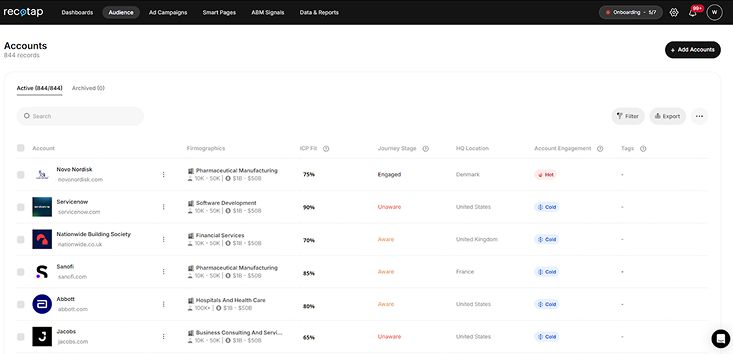
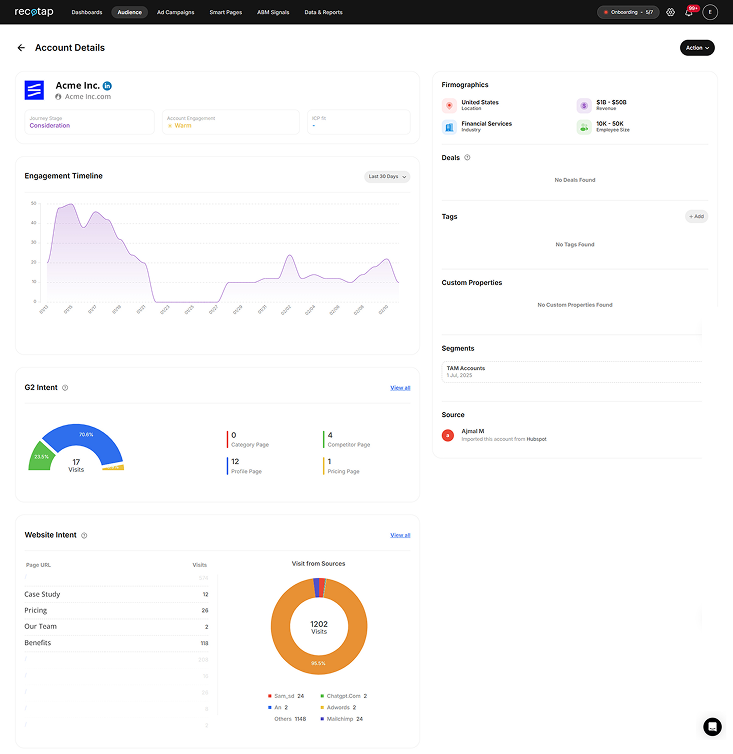
Recotap's approach demonstrates this model in practice. The platform ingests first-party data from website visits and CRM activity, third-party intent from Bombora and G2, and sales account lists. The signal hub enriches accounts with combined intelligence, and then the journey stage modeling evaluates behavior patterns to classify accounts into buyer stages: Unaware, Aware, Buying Intent, or Opportunity.
This classification updates continuously as new signals arrive. When an account's behavior crosses stage thresholds, the account stage changes automatically. Campaigns orchestrated through these audiences deliver stage-appropriate messaging without manual segment rebuilds.
The engagement strategy flowchart shows how this works operationally. Accounts in the Unaware stage receive 1:Many campaigns, including image ads, documents, videos, and carousels. When the journey stage moves to Aware, campaigns shift to 1:Few approaches with case studies, whitepapers, leadgen, and events. At the Intent stage, campaigns become 1:1 with personalized ads, personalized landing pages, event invites, and demo booking, supported by email, LinkedIn messaging, and sales calling.
This is smart segmentation where orchestration plays a pivotal role based on integrated intent signals.
Summary
ABM segmentation fails when teams treat it as a planning exercise rather than an execution system. Static firmographic, intent-based, and persona segmentation models collapse at scale because accounts move while segments stay static. Buying journeys do not follow linear stage progressions.
The solution is shifting from static segments to signal-based audiences that update automatically based on first-party engagement, third-party intent, and CRM progression. Effective segmentation should control not just who gets targeted but what messaging they receive, how much budget they consume, and when they graduate between stages.
Platforms like Recotap demonstrate this approach by unifying intent signals into journey-stage intelligence to dynamically orchestrate campaigns. Accounts flow between Unaware, Aware, Buying Intent, Opportunity, and Expansion audiences based on real behavior, triggering appropriate campaign sequences without manual intervention.
The goal is not building the perfect segment taxonomy. It is creating a system where segmentation adapts as fast as accounts move, so that marketing always delivers the right message at the right stage without operations becoming the bottleneck.
Frequently Asked Questions
What is ABM segmentation?
ABM segmentation is the process of grouping target accounts based on shared characteristics, behaviors, or readiness signals that determine campaign strategy and messaging. Effective ABM segmentation should identify which accounts to target, when they are ready to engage, and what content they need based on their buying stage.
Why do most ABM segmentation strategies fail?
Most ABM segmentation fails because teams build static classifications that cannot adapt to account movement. Segments look perfect when created, but become stale within 30 days as intent signals decay, accounts progress through pipeline stages, and new prospects enter the market. The operational overhead of manually rebuilding segments creates lag that makes segmentation unreliable.
What is the difference between firmographic and intent-based segmentation?
Firmographic segmentation groups accounts by company attributes like industry, revenue, employee count, and location. Intent-based segmentation identifies accounts showing research behavior through third-party signals from providers like Bombora or G2. Firmographics indicate ICP fit but not buying readiness. Intent signals suggest market activity but often lack context about actual purchase authority or timeline.
How often should ABM segments be updated?
Traditional static segments require manual rebuilds every 1-2 weeks to stay relevant, creating an unsustainable operational burden. Dynamic signal-driven segmentation should update continuously as new behavioral data, intent signals, and CRM status changes arrive, ensuring accounts always receive messaging that matches their current stage.
What are signal-driven audiences in ABM?
Signal-driven audiences are dynamic account groups that assemble automatically based on real-time behavioral signals, intent data, and CRM progression rather than static firmographic rules. Accounts flow between audiences as their behavior changes, triggering appropriate campaign sequences without manual segment rebuilds.
How do you segment accounts by buyer journey stage?
Buyer journey stage segmentation requires combining first-party engagement signals from website visits and content consumption, third-party intent data showing research activity, and CRM pipeline status. Accounts should be classified into stages like Awareness, Consideration, Intent, and Decision based on behavior thresholds, then segmentation should update automatically as accounts cross stage boundaries.
Why does LinkedIn make ABM segmentation problems worse?
LinkedIn exposes segmentation failures through minimum audience size requirements that force teams to compromise on targeting precision, account-level reporting that reveals budget concentration on small portions of target lists, and impression data showing that static segments often over-serve engaged accounts while ignoring strategic targets.
How can you reduce manual work in ABM segmentation?
Reduce manual segmentation work by implementing dynamic audiences that update based on live signals rather than periodic rebuilds, integrating CRM and intent data sources for automatic enrichment, and using platforms that orchestrate campaigns directly from signal-driven classifications without requiring CSV exports and imports.