We use cookies to ensure you get the best experience on our website. By continuing
to use our site, you accept our use of cookies, privacy policy and terms of service.
ESC
What are you looking for?
Subscribe to our Newsletter
Join 10k+ people to get notified about new posts, news and updates.
Terms of use dolor sit amet consectetur, adipisicing elit. Recusandae provident ullam
aperiam quo ad non corrupti sit vel quam repellat ipsa quod sed, repellendus
adipisci, ducimus ea modi odio assumenda.
Disclaimers
Lorem ipsum dolor sit amet consectetur adipisicing elit. Sequi, cum esse possimus
officiis amet ea voluptatibus libero! Dolorum assumenda esse, deserunt ipsum ad
iusto! Praesentium error nobis tenetur at, quis nostrum facere excepturi architecto
totam.
Lorem ipsum dolor sit amet consectetur adipisicing elit. Inventore, soluta alias
eaque modi ipsum sint iusto fugiat vero velit rerum.
Limitation on Liability
Sequi, cum esse possimus officiis amet ea voluptatibus libero! Dolorum assumenda
esse, deserunt ipsum ad iusto! Praesentium error nobis tenetur at, quis nostrum
facere excepturi architecto totam.
Lorem ipsum dolor sit amet consectetur adipisicing elit. Inventore, soluta alias
eaque modi ipsum sint iusto fugiat vero velit rerum.
Copyright Policy
Dolor sit amet consectetur adipisicing elit. Sequi, cum esse possimus officiis amet
ea voluptatibus libero! Dolorum assumenda esse, deserunt ipsum ad iusto! Praesentium
error nobis tenetur at, quis nostrum facere excepturi architecto totam.
Lorem ipsum dolor sit amet consectetur adipisicing elit. Inventore, soluta alias
eaque modi ipsum sint iusto fugiat vero velit rerum.
General
Sit amet consectetur adipisicing elit. Sequi, cum esse possimus officiis amet ea
voluptatibus libero! Dolorum assumenda esse, deserunt ipsum ad iusto! Praesentium
error nobis tenetur at, quis nostrum facere excepturi architecto totam.
Lorem ipsum dolor sit amet consectetur adipisicing elit. Inventore, soluta alias
eaque modi ipsum sint iusto fugiat vero velit rerum.
Scaling Personalization in Account Based Marketing (2026)
The Winning AI and Human Combination Workflow for Scaling Personalization Effectively
What Does Personalization in Account Based Marketing Mean?
Personalization in account based marketing means delivering contextual relevance based on account-specific buying signals, pain points, and behaviors, not just inserting company names into generic templates. True ABM personalization adapts messaging, content, and offers to match where each account is in their buying journey, which competitors they're researching, what technology they currently use, and which specific challenges they're trying to solve.
Most marketers think they're running personalized ABM when they use merge tags like {company_name} or {first_name}. This is tokenization, not personalization.
Real account based marketing personalization operates on four levels:
Firmographic Personalization: Basic targeting by industry, company size, revenue. Example: "Solutions for mid-market SaaS companies."
Behavioral Personalization: Adapting based on observed actions like website visits and content downloads. Example: "Since you downloaded our ROI guide..."
Contextual Personalization: Messaging that responds to real-time signals like competitor research and tech stack changes. Example: "Your recent G2 research comparing Marketo vs. HubSpot suggests you're evaluating migration options."
Predictive Personalization: Using AI to anticipate needs based on patterns from similar accounts. Example: "Companies like yours typically need integration support during month three."
The gap between what marketers call "personalized" and what buyers experience is massive. Most B2B buyers say personalized content they receive is still too generic to be useful.
Here's what buyers actually want:
Relevant timing: Reach them when actively researching, not weeks after signals appeared
Contextual awareness: Show understanding of their specific situation
The reality: With 500 accounts on your target list and two full-time people, you'd need 3.7 years to personalize campaigns for everyone. By the time you finish account #500, account #1's context has completely changed.
This is why most ABM programs only run true 1:1 personalization for 5-10 tier-one accounts. The other 490 get generic campaigns with name swaps.
The opportunity cost is staggering. While your team spends three weeks personalizing for one account, that account has already engaged with three competitors who moved faster and formed preliminary vendor preferences.
How to Scale Personalization in 2026
The solution to ABM personalization's scalability problem isn't choosing between quality and quantity, it's combining AI automation with human strategic oversight to achieve both.
The 2026 scaling breakthrough comes from three shifts:
1. Signal Based Audience Replaces Manual Research
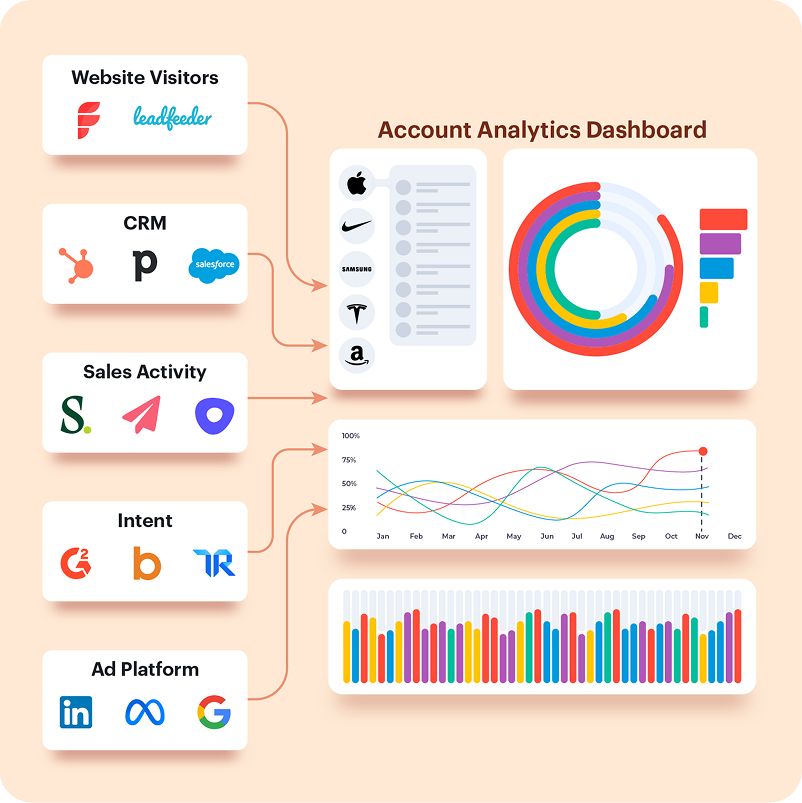
Instead of spending 4-6 hours manually researching each account, AI-powered signal-based audience builder automatically unifies:
First-party signals: Website behavior, content engagement, CRM data
Second-party signals: G2 reviews, social mentions, community discussions
Result: Complete account intelligence generated in 3-5 minutes instead of hours, surfacing contextual triggers like "researching Competitor X" or "left G2 review about pain point Y."
2. AI Content Generation + Human Strategic Refinement
AI handles the time-consuming execution work:
Generates personalized email sequences in seconds
Creates landing page variations for different account contexts
Produces ad copy tailored to buying stage and pain points
Develops sales talking points from account research
Automates when to engage with which account
Humans focus on strategic value-add:
Refine positioning angles and competitive messaging
Ensure brand voice consistency and creative quality
Add relationship context AI can't detect
Result: 15-30 minutes of human time per account (vs. 20-40 hours fully manual), enabling personalization for 100-500 accounts with the same team that previously managed 5-10.
3. Campaign Orchestration For Precision Targeting
Instead of treating every account the same, scale by applying the right personalization level:
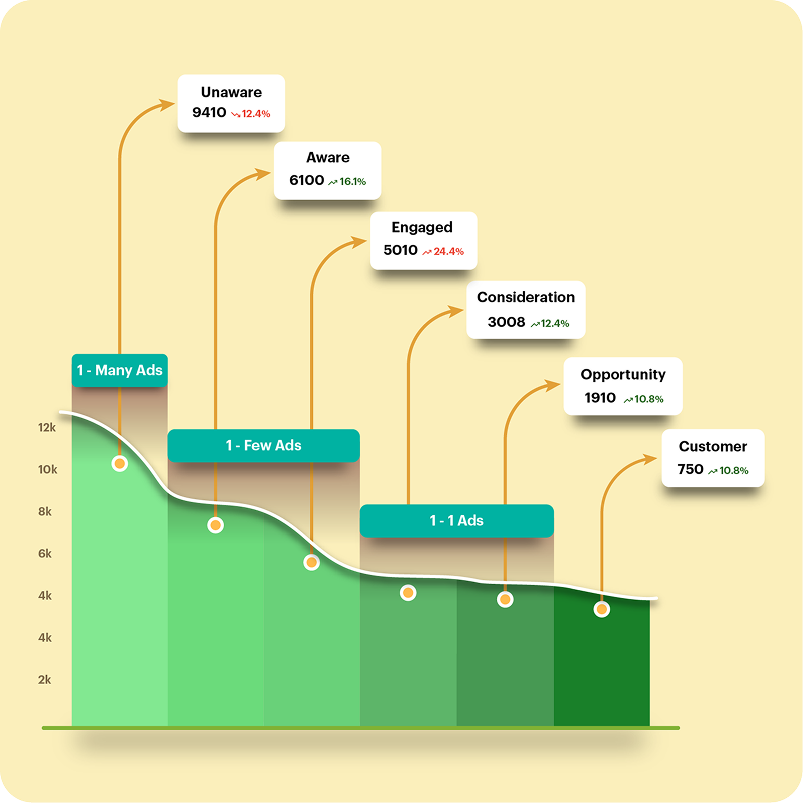
1:Many (200-1,000 accounts): Segment-level personalization using AI to create variations for different industries, company sizes, and tech stacks. Humans approve of strategic themes.
1:Few (20-100 accounts): Cluster-based targeting for accounts with shared pain points (e.g., "evaluating Demandbase alternatives"). AI identifies patterns, humans craft positioning angles.
1:1 (5-50 accounts): Fully account-specific campaigns for high-value targets. AI generates deep research and content, humans add strategic narrative and creative polish.
Result: All three tiers run simultaneously, with accounts dynamically moving between levels as buying signals strengthen - maximizing reach while preserving deep personalization for top opportunities.
Month 3: 120 accounts engaged with contextual messaging
Month 6: Pipeline 3x larger than manual-only competitors
Month 12: Market perception as "shows up when we need them" vs. "eventually responds"
The teams winning in 2026 don't choose between artisan craftsmanship and industrial scale. They use AI to eliminate manual drudgery while preserving human judgment on strategy, positioning, and creative storytelling, achieving both speed and quality.
What Is Signal-Based Audience and Why Does It Matter?
Signal orchestration is the process of unifying first-party, second-party, and third-party data sources into a single intelligence layer that identifies in-market accounts, scores buying intent, and surfaces contextual triggers for personalization, all in real time.
This differs from traditional "signal collection" where you plug in a single intent data provider. Signal orchestration creates complete account context by combining:
First-Party Signals: Website behavior, content engagement, product interactions, CRM data
Second-Party Signals: G2/Capterra reviews, community discussions, social mentions, review site comparisons
Why does integration of signal or intent data matters?
A single signal tells you "Company X researched 'marketing automation platforms.'" But you don't know if they've visited your website, what they said in G2 reviews, whether they're hiring Marketing Ops, or which competitors they're comparing.
Signal-based audience connects these dots automatically:
"Company X (250 employees, Series B SaaS) shows high buying intent:
Researching 'HubSpot alternatives' for 3 weeks (3rd-party)
Left 3-star G2 review citing 'complex workflows' (2nd-party)
Downloaded your migration checklist yesterday (1st-party)
Currently using HubSpot + Salesforce (technographic)
Posted Marketing Ops Manager job 2 weeks ago (hiring signal)
Group accounts by shared attributes (industry, company size, tech stack). In Recotap, AI segments accounts automatically and maps messaging variations. Humans approve of strategic themes.
Example: Mid-market SaaS companies researching "marketing automation platforms" receive industry-specific landing pages, company size-appropriate messaging, and tech stack variations.
Time investment: 6-9 hours to personalize for 200-1,000 accounts
Group accounts by shared pain points or use cases. AI identifies patterns (e.g., "all researching alternatives to Competitor X") and generates cluster-specific content. Humans craft positioning angles.
Example: 35 Series B SaaS companies evaluating "Demandbase alternatives" receive campaigns directly addressing Demandbase pain points with migration case studies.
Time investment: 12-16 hours to personalize for 20-100 accounts
Build completely customized campaigns for individual accounts. AI combines all signals and generates account-specific content. Humans develop strategic narrative and creative storytelling.
Example: TechCorp receives custom executive briefing, LinkedIn campaigns to each buying committee member, personalized landing pages showing their specific tech stack integration, and warm introduction via existing relationship.
Time investment: 8-13 hours per account
The key: Being able to run all three simultaneously. Accounts dynamically move between tiers as buying signals strengthen. This is called campaign orchestration which enables accounts to see the right message at the right moment. A 2-person team with Recotap can reach 600-1,000 personalized accounts vs. 5-10 manual-only
What Real ABM Personalization Looks Like
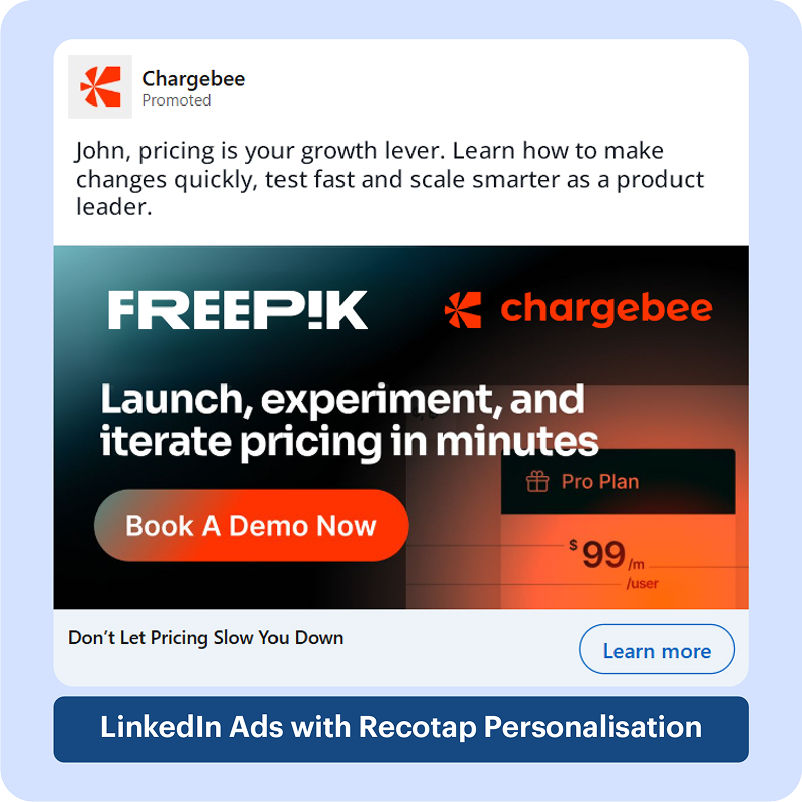
LinkedIn ads that speak directly to pain-points with personalization.
Imagine Freepik’s product team is looking for a way to experiment or A/B test their pricing using a SaaS product.
Chargebee taps into that using signal-based audience segmentation. Since Freepik is already in market and has previously visited Chargebee’s site; instead of doing a linear marketing campaign of targeting with sequential ads of 1-Many, 1-Few and 1-1; Freepik can be shown directly a 1-1 Personalized ad with a 1-1 landing page.
This same data when pushed to a CRM like Hubspot, Zoho or Sales force can enable precision targeting using email campaigns.
1-1 Personalized Landing Pages for red-carpet feeling
It’s not enough to just create scroll-stopping personalized ads. Move your accounts onto the marketing funnel with 1:1 personalized landing pages. These landing pages not only address the accounts using the logo and company name, but also continue engaging using pain points addressed in ads.
Email marketing to create surround sound:
For a marketing automation company,
Generic "personalization" (fails):
Subject: Hi {first_name}, {company_name} deserves better marketing automation
But, Real contextual personalization (works):
Personalized email marketing talking about the exact pain point
Subject: Your G2 comment about Marketo's workflow complexity
Sarah, I saw your review where you mentioned Marketo's workflow builder adding 3-4 hours to every campaign. We've helped 12 other Series B SaaS marketing teams reduce that to 30 minutes. Given you just posted for a Marketing Ops Manager, I'm guessing you're either solving Marketo complexity internally or evaluating alternatives. Worth 15 minutes next week?
What makes all of these personalized campaigns effective:
References specific G2 review comment
Quotes exact pain point within minutes
Provides relevant social proof (12 similar companies)
Acknowledges intent signals
The four layers of contextual personalization:
Technology stack signals: "You're using HubSpot + Salesforce + Zapier for integration"
Competitor research: "You downloaded our 'Demandbase vs. 6sense' comparison"
Pain point intelligence: Quote their G2 review or support forum posts
Buying stage awareness: Different messaging for awareness vs. decision stage
LinkedIn campaign orchestration surfaces these triggers automatically in minutes versus 4-6 hours of manual research per account.
Speed as Your ABM Personalization Competitive Advantage
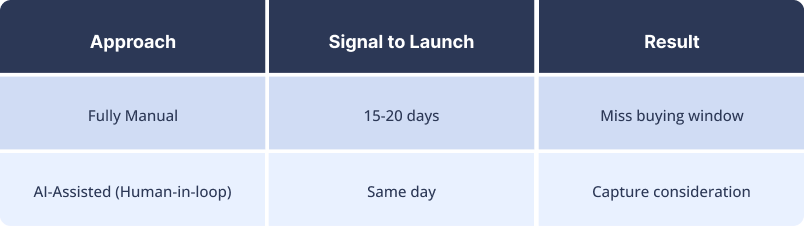
The 48-72 hour buying window determines who wins:
Manual ABM: Signal fires → 18 days later campaign launches → Account already shortlisted competitors
AI-Assisted ABM: Signal fires → 8 hours later campaign launches → You're part of initial consideration
Time-to-personalization comparison:
Speed creates positioning advantage: the first vendor addressing specific pain points occupies the "solution space" in the buyer's mind. Later vendors get compared against that first impression.
Getting Started with Scalable ABM Personalization
90-Day Implementation Plan:
Foundation:
Week 1-2: Create the first 500 odd target account list
Week 3-4: Connect sources of 1st, 2nd, 3rd party signals.
Quick Wins:
Week 3-4: Build 1:1 LinkedIn ABM ad campaigns for accounts which are aware about your account and ready to buy.
Week 4-5: Create 1:Many and 1:Few campaign creatives and launch atleast 3 creatives per goal.
Outcome: Start engaging in-market accounts and nurture others
Start Closing:
Week 5-6: Keep a tab of accounts which are engaging and visiting your pricing page. Ensure to create enough surround sound using email campaigns and LinkedIn direct message.
Week 6 onwards: Bring your sales team into Slack channel and directly push engaged accounts’ details to the sales team to start warming up.
Outcome: Sales and Marketing alignment
Minimum Team: 2-3 people can manage 500-1,000 accounts for account based marketing.
Accounts reached per team member (should see 10-20x increase)
Key Takeaways
Scale 1:1 personalization through AI + human collaboration to reach 100-500 accounts instead of 5-10, using AI for research and content generation while humans provide strategic positioning.
Implement signal-based audience to unify first-party, second-party, and third-party data, creating complete account context for real-time, contextual personalization.
Deploy the three-tier approach with 1:Many (200-1,000 accounts), 1:Few (20-100 accounts), and 1:1 (5-50 accounts) running simultaneously based on account priority.
Move beyond {name} tokens by personalizing based on buying signals like competitor research, G2 reviews, tech stack changes, and hiring patterns.
Prioritize speed as a competitive advantage by launching personalized campaigns same-day when signals fire, reaching accounts during the critical 48-72 hour research window.
Maintain human-in-the-loop quality control to ensure AI-generated content gets strategic refinement and brand voice consistency before reaching accounts.
Frequently asked questions
What does personalization in account based marketing mean?
Personalization in account based marketing means delivering contextual relevance based on account-specific buying signals, pain points, and behaviors; not just inserting company names into generic templates. True ABM personalization adapts messaging to match where each account is in their buying journey, which competitors they're researching, what technology they currently use, and which specific challenges they're trying to solve. It operates on four levels: firmographic, behavioral, contextual, and predictive personalization.
What is the difference between ABM personalization and email personalization?
ABM personalization goes far beyond email merge tags like {first_name} and {company_name}. While email personalization uses basic token replacement, ABM personalization is based on real-time buying signals (competitor research, G2 reviews, tech stack changes), buying stage awareness, buying committee mapping, and competitive context. ABM personalization creates contextual relevance across multiple channels (ads, landing pages, emails) while email personalization is limited to single-channel token substitution.
How do you scale account based marketing personalization without losing quality?
Scale ABM personalization through a three-tier approach: (1) 1:Many for segment-level personalization reaching 200-1,000 accounts using AI-assisted content generation, (2) 1:Few for cluster-based campaigns targeting 20-100 accounts with shared pain points, and (3) 1:1 for 5-50 high-value accounts with full account-specific customization. Use AI for research and content generation speed (reducing time from 20-40 hours to 15-30 minutes per account) while humans provide strategic oversight and quality control through approval gates. Get a detailed deep dive into account level personalization here.
What is a signal-based audience in ABM?
Signal-based audience is the unification of first-party (website behavior, CRM data), second-party (G2 reviews, social mentions), and third-party (intent data, technographics, hiring signals) data sources into a single intelligence layer. Unlike single-source signal collection, signal-based audience creates complete account context by combining multiple signals to identify in-market accounts, score buying intent, and surface contextual triggers like "researching competitor X" or "left G2 review about pain point Y" in real time.
What is the difference between 1:Many, 1:Few, and 1:1 ABM personalization?
1:Many personalizes at the segment level for 200-1,000 accounts grouped by industry, company size, or tech stack, taking 6-9 hours total. 1:Few target clusters of 20-100 accounts with shared pain points (like "evaluating alternatives"), taking 12-16 hours total. 1:1 creates fully account-specific campaigns for 5-50 high-value accounts with unique buying committees and contexts, taking 8-13 hours per account. The tiers differ in personalization depth and scale, all three should run simultaneously based on account value and buying signals.
How does AI enable ABM personalization at scale?
AI enables ABM personalization at scale by automating time-consuming tasks: intent signal integration across thousands of accounts to identify buying signals, account research completed in 3-5 minutes (vs. 4-6 hours manually), content variation generation creating personalized emails, landing pages, and ad copy in seconds, and real-time optimization monitoring which personalized elements drive engagement. Humans focus on strategic positioning, brand voice consistency, creative storytelling, and final approval, achieving 15-30 minutes of work per account instead of 20-40 hours.
What is campaign orchestration in ABM?
Campaign orchestration is the automated process of dynamically moving accounts between 1:Many, 1:Few, and 1:1 personalization tiers based on real-time buying signals and engagement levels. Instead of running linear sequential campaigns, orchestration ensures accounts see the right message at the right moment, launching 1:1 campaigns immediately for high-intent accounts while nurturing lower-intent accounts with 1:Many content. This allows accounts to progress through personalization tiers as buying signals strengthen.
How long does it take to implement scalable ABM personalization?
Implementation takes approximately 90 days following this timeline: Weeks 1-2 (Foundation) create target account list of 500+ accounts and connect first-party, second-party, third-party signal sources. Weeks 3-5 (Quick Wins) build 1:1 campaigns for in-market accounts and launch 1:Many/1:Few campaigns. Weeks 5-6 (Start Closing) monitor account engagement, create email surround sound, align sales team via Slack for warm handoffs. By week 6, you should have sales-marketing alignment with engaged accounts moving to sales conversations.
What are the key signals for ABM personalization?
Key signals include first-party signals (website visits, content downloads, pricing page views, CRM interactions), second-party signals (G2/Capterra reviews mentioning pain points, social media mentions, community forum posts), and third-party signals (Bombora intent topics showing competitor research, technographic changes like new tool adoption, hiring patterns for relevant roles, funding announcements). Signal-based audience combines all three to create complete account context enabling contextual personalization based on actual buying behavior.
What metrics should you track for ABM personalization success?
Track three categories: (1) Leading indicators including account engagement score trends, buying stage progression rate, signal-to-campaign launch time (target: same-day for high-priority accounts), (2) Conversion metrics including account-to-opportunity conversion rate, opportunity-to-closed won rate, win rate by personalization tier (1:1 should outperform 1:Many), and sales cycle length, (3) Efficiency metrics including cost per personalized account, time investment per tier, accounts reached per team member (should see 10-20x increase from 5-10 to 100-500 accounts).
Why does speed matter in ABM personalization?
The 48-72 hour buying window determines who wins deals. Buyers progress from initial research (hours 0-24) to active vendor comparison (hours 25-48) to shortlist formation (hours 49-72). After hour 73, the vendor shortlist is locked and new vendors face uphill battles. Manual ABM takes 15-20 days to launch personalized campaigns, missing the entire buying window. AI-assisted ABM launches same-day, reaching accounts while intent is active. The first vendor addressing specific pain points occupies the "solution space" in the buyer's mind; later vendors get compared against that first impression.
What is human-in-the-loop in ABM personalization?
Human-in-the-loop means AI generates personalized content automatically (account research, email sequences, landing pages, ad copy) but humans review and approve before any message reaches an account. This workflow combines AI's speed (content generation in minutes) with human strategic judgment (positioning, brand voice, creative refinement). It's the middle ground between fully manual ABM (too slow to scale beyond 5-10 accounts) and fully automated ABM (too generic and risky for brand reputation). Marketers spend 15-30 minutes reviewing and refining vs. 20-40 hours creating from scratch.
How does signal-based audience improve ABM ROI?
Signal-based audience improves ROI by: (1) Reducing wasted ad spend on accounts not in-market through real-time intent scoring, (2) Improving conversion rates with contextual personalization based on actual pain points vs. assumptions, (3) Shortening sales cycles by reaching accounts during the 48-72 hour buying window vs. weeks later, (4) Increasing team efficiency enabling 2-3 person teams to manage 500-1,000 accounts vs. 5-10 manually, (5) Improving win rates through competitive intelligence showing which alternatives accounts are evaluating. Teams report 4x pipeline growth within 6 months and 10-20x increase in accounts reached per marketer.