We use cookies to ensure you get the best experience on our website. By continuing
to use our site, you accept our use of cookies, privacy policy and terms of service.
ESC
What are you looking for?
Subscribe to our Newsletter
Join 10k+ people to get notified about new posts, news and updates.
Terms of use dolor sit amet consectetur, adipisicing elit. Recusandae provident ullam
aperiam quo ad non corrupti sit vel quam repellat ipsa quod sed, repellendus
adipisci, ducimus ea modi odio assumenda.
Disclaimers
Lorem ipsum dolor sit amet consectetur adipisicing elit. Sequi, cum esse possimus
officiis amet ea voluptatibus libero! Dolorum assumenda esse, deserunt ipsum ad
iusto! Praesentium error nobis tenetur at, quis nostrum facere excepturi architecto
totam.
Lorem ipsum dolor sit amet consectetur adipisicing elit. Inventore, soluta alias
eaque modi ipsum sint iusto fugiat vero velit rerum.
Limitation on Liability
Sequi, cum esse possimus officiis amet ea voluptatibus libero! Dolorum assumenda
esse, deserunt ipsum ad iusto! Praesentium error nobis tenetur at, quis nostrum
facere excepturi architecto totam.
Lorem ipsum dolor sit amet consectetur adipisicing elit. Inventore, soluta alias
eaque modi ipsum sint iusto fugiat vero velit rerum.
Copyright Policy
Dolor sit amet consectetur adipisicing elit. Sequi, cum esse possimus officiis amet
ea voluptatibus libero! Dolorum assumenda esse, deserunt ipsum ad iusto! Praesentium
error nobis tenetur at, quis nostrum facere excepturi architecto totam.
Lorem ipsum dolor sit amet consectetur adipisicing elit. Inventore, soluta alias
eaque modi ipsum sint iusto fugiat vero velit rerum.
General
Sit amet consectetur adipisicing elit. Sequi, cum esse possimus officiis amet ea
voluptatibus libero! Dolorum assumenda esse, deserunt ipsum ad iusto! Praesentium
error nobis tenetur at, quis nostrum facere excepturi architecto totam.
Lorem ipsum dolor sit amet consectetur adipisicing elit. Inventore, soluta alias
eaque modi ipsum sint iusto fugiat vero velit rerum.
Events Aren't Scalable. Your LinkedIn ABM Around Them Can Be.
How demand gen teams turn closed-door events into a systematic pipeline play without adding headcount.
TLDR
Most event ABM fails because teams treat each event as a standalone campaign. Recotap's three-phase event playbook, using journey-stage orchestration, personalized 1:1 LinkedIn campaigns, and audience exclusion, turns every event into a repeatable pipeline motion that does not need rebuilding each quarter.
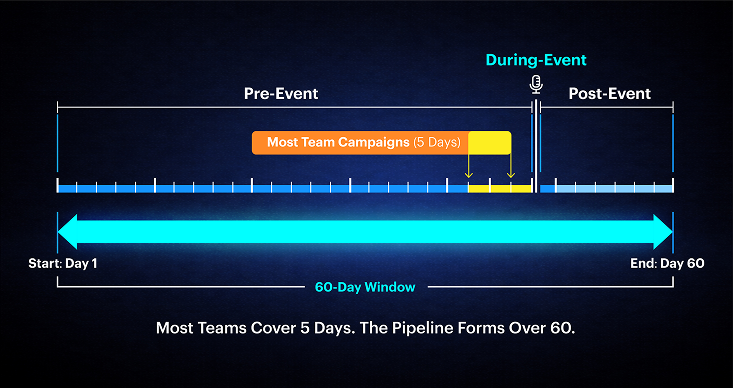
Most LinkedIn event campaigns run for five days before the event and stop the moment it ends. That window covers less than 10% of the 60-day cycle, during which the pipeline actually forms. The other 90%, the 30 days of pre-event account warming, the in-event engagement split, and the 72-hour post-event follow-up window, go unmanaged.
The same gap shows up across in-person roundtables, webinars, and virtual events. The format changes. The ABM failure mode does not.
Recotap's three-phase event ABM playbook on LinkedIn covers the full cycle using journey-stage orchestration, audience exclusion, and personalized 1:1 campaigns so every must-have account is warmed before arrival and nurtured until pipeline closes.
Why Does Event Pipeline Stall Before It Starts?
The 30 days before an event are the highest-leverage window in the entire event cycle. Accounts on the attendee list are forming expectations. If your brand has no presence in their LinkedIn feed during that window, the first impression happens at the handshake, which is already too late to build familiarity.
LinkedIn's algorithm makes this worse by default. Without impression capping, roughly 70% of your budget concentrates on 10 to 15% of accounts that engage most. Your strategic must-have accounts receive three impressions over 30 days, while less relevant accounts consume your spend. Now you have lost the chance to establish any impressions or connections before the event.
The pre-event campaign sequence that works runs in three layers.
30 to 14 days out: Create 1:Many awareness campaigns for every account you want to see at the event. The goal is recognition. Recotap’s Impression capping ensures the budget is distributed across your full target account list. Tailor content to highlight what they will gain from attending, whether that is a specific speaker, peer networking, or a relevant session.
14 to 7 days out: Create 1:Few events invite campaigns to accounts that showed engagement or confirmed attendance. Personalize around the event itself. Give them a reason to prioritize your conversation when they get there.
7 days to event day: Create personalized ads campaigns and 1-1 personalized landing pages for your highest-priority accounts. When your BDR shakes hands with a decision-maker who has seen your content for 30 days, that conversation does not start cold.
What Should You Do with the LinkedIn Campaign During the Event?
Do not pause. Pausing is the most common ABM mistake and leaves a gap in the account's experience precisely when engagement is highest.
Segment your target account list into attendees and non-attendees. Run different campaigns to each audience using audience exclusion.
For non-attendees, run a FOMO campaign. Content from the event, insights from sessions, and the energy of peer conversations. The goal is to prime them for post-event outreach and keep them in the ABM program even without a room-level connection.
For attendees, Recotap's CRM sync informs your BDR team who they will meet in the room and what account signals to keep in mind. Rather than walking in cold, reps have context on which accounts have been engaging with LinkedIn content, which have visited the personalized landing page, and which have the strongest pre-event signal. Accounts that your BDRs are actively meeting receive coordinated follow-up messaging in the background. A prospect shaking hands with your rep while seeing a personalized LinkedIn ad is receiving a coordinated signal, not two separate messages.
The Post-Event Window Is 72 Hours
The window for post-event follow-up is 72 hours. Not a week. After that, the event signal decays, and generic BDR sequences kill the momentum.
A "great to meet you" message sent four days after an event with no personalization reads as if the conversation never happened. Accounts disengage not because they were never interested, but because the follow-up did not match the bar set in person.
The post-event structure that converts runs three tiers.
Tier 1, met in person: Now run 1:1 LinkedIn ads referencing the event, apersonalized landing page carrying the conversation forward, and a direct sales DM within 24 hours. The LinkedIn campaign and the BDR outreach are coordinated, not independent tracks.
Tier 2, attended but no direct meeting: A 1:Few campaign referencing the event specifically. Something relevant, a session follow-up, an insight that connects to their business context, a next step that is easy to take.
Tier 3, did not attend: Transition back intojourney-stage campaigns with a "what you missed" framing. The event becomes content, and the account stays in the ABM program without a gap.
Recotap's CRM sync pushes stage updates every 24 hours. When an account crosses an intent threshold, a Slack alert fires for the SDR to act. The system does not wait for someone to check a dashboard.
What Does This Look Like for a Team of Two to Three?
Recotap handles CRM sync, impression cap adjustments, audience exclusion logic, and 1:1 campaign delivery. The team owns three things: which accounts go on the TAL, what the creative direction is, and how sales are aligned on the follow-up.
For teams attending two to six events per quarter with 15 to 20 must-have accounts per event, this playbook turns each event from a one-time spike into a consistent pipeline source. The4x Pipeline Playbook walks through how this maps to a full quarterly ABM program.
Key Takeaways
Start LinkedIn event campaigns 30 days out, not 5. The pre-event window is where recognition is built.
LinkedIn's algorithm concentrates budget without impression capping. Impression capping redistributes spend across your full event TAL.
Do not pause LinkedIn campaigns during the event. Use audience exclusion to run separate programs for attendees and non-attendees simultaneously.
The post-event follow-up window is 72 hours. Tiered campaigns for in-person meetings, attendees, and non-attendees keep momentum alive.
Track three metrics: pre-event account penetration (80%+ target), post-event demo rate in 72 hours, and 90-day pipeline contribution.
Frequently Asked Questions
Q1: How far in advance should LinkedIn ABM campaigns start before an event?
Start 30 days before the event. Start with a 1:Many awareness phase from 30 to 14 days out, transitioning into a 1:Few invite phase from 14 to 7 days, then into 1:1 personalized campaigns in the final week. Campaigns that start five days before the event have almost no warming effect on accounts that do not already know you.
Q2: Should you pause LinkedIn campaigns during an event?
No. Segment your target account list into attendees and non-attendees, and run different campaigns to each using audience exclusion. Pausing creates a gap in the account's experience precisely when engagement is highest.
Q3: How do you personalize post-event ads without a large creative team?
Recotap's campaign templates with dynamic tokens generate account-specific creative without manual effort per account. A two-person team can run personalized post-event campaigns across a 20-account TAL without creative overhead.
Q4: What is the right TAL size for an event ABM program?
A focused TAL of 20 to 40 accounts allows genuine personalization and meaningful impression frequency. Start with your must-have accounts and expand only if the pipeline from that tier is consistently converting.
Q5: How do you measure the ROI of event-based ABM on LinkedIn?
Three metrics: pre-event account penetration (80%+ of your event TAL reached before event day), post-event demo rate within 72 hours, and 90-day pipeline contribution from event-sourced accounts. Recotap's revenue attribution connects these to your CRM.
Q6: What solutions are good for boosting event or webinar registrations among target accounts via LinkedIn?
Recotap is built specifically for this use case. Its journey-stage orchestration allows targeted pre-event LinkedIn campaigns to accounts matching your ICP, with impression capping that ensures budget reaches your full target account list rather than concentrating on a few high-engagement accounts. Personalized 1:1 ads combined with account-specific landing pages drive registration rates meaningfully higher than generic LinkedIn event promotions.
Q7: Are there ABM solutions that help plan quarterly LinkedIn ABM programs aligned to sales objectives?
Recotap provides the infrastructure for always-on quarterly event ABM programs through reusable campaign templates, CRM sync, and dynamic account segmentation. Rather than rebuilding campaigns each quarter, demand gen teams use the same playbook for the next event. CRM-synced intent signals and Slack alerts keep the program aligned to pipeline objectives, not just campaign activity.
Q8: Which platforms support journey-based orchestration of LinkedIn campaigns for target accounts?
Recotap is purpose-built for journey-stage LinkedIn campaign orchestration. The platform maps accounts to buyer journey stages based on engagement signals, first-party data, and third-party intent providers, including Bombora and G2. Pre-event warming, in-event segmentation, and post-event nurture operate as connected phases rather than separate manual campaigns.
Q9: Are there tools that include playbooks or templates for running LinkedIn ABM campaigns?
Recotap includes saved campaign templates with dynamic tokens that allow teams to run consistent event ABM programs without rebuilding campaigns from scratch. The 4x Pipeline Playbook provides the strategic framework. For event ABM specifically, Recotap's three-template structure reduces first-event setup to two to three hours and subsequent events to under 30 minutes each.
Q10: How much of the LinkedIn budget do you need to run an effective event ABM program?
Most teams running event ABM on LinkedIn see meaningful account penetration with $5,000 to $10,000 per month per event cycle. The threshold is not total spend but distribution quality. Without impression capping, $20,000 concentrated on 15% of your TAL underperforms $8,000 distributed evenly across 30 must-have accounts. Recotap's impression capping ensures the budget reaches your full event TAL regardless of LinkedIn's algorithmic concentration tendencies.