We use cookies to ensure you get the best experience on our website. By continuing
to use our site, you accept our use of cookies, privacy policy and terms of service.
ESC
What are you looking for?
Subscribe to our Newsletter
Join 10k+ people to get notified about new posts, news and updates.
Terms of use dolor sit amet consectetur, adipisicing elit. Recusandae provident ullam
aperiam quo ad non corrupti sit vel quam repellat ipsa quod sed, repellendus
adipisci, ducimus ea modi odio assumenda.
Disclaimers
Lorem ipsum dolor sit amet consectetur adipisicing elit. Sequi, cum esse possimus
officiis amet ea voluptatibus libero! Dolorum assumenda esse, deserunt ipsum ad
iusto! Praesentium error nobis tenetur at, quis nostrum facere excepturi architecto
totam.
Lorem ipsum dolor sit amet consectetur adipisicing elit. Inventore, soluta alias
eaque modi ipsum sint iusto fugiat vero velit rerum.
Limitation on Liability
Sequi, cum esse possimus officiis amet ea voluptatibus libero! Dolorum assumenda
esse, deserunt ipsum ad iusto! Praesentium error nobis tenetur at, quis nostrum
facere excepturi architecto totam.
Lorem ipsum dolor sit amet consectetur adipisicing elit. Inventore, soluta alias
eaque modi ipsum sint iusto fugiat vero velit rerum.
Copyright Policy
Dolor sit amet consectetur adipisicing elit. Sequi, cum esse possimus officiis amet
ea voluptatibus libero! Dolorum assumenda esse, deserunt ipsum ad iusto! Praesentium
error nobis tenetur at, quis nostrum facere excepturi architecto totam.
Lorem ipsum dolor sit amet consectetur adipisicing elit. Inventore, soluta alias
eaque modi ipsum sint iusto fugiat vero velit rerum.
General
Sit amet consectetur adipisicing elit. Sequi, cum esse possimus officiis amet ea
voluptatibus libero! Dolorum assumenda esse, deserunt ipsum ad iusto! Praesentium
error nobis tenetur at, quis nostrum facere excepturi architecto totam.
Lorem ipsum dolor sit amet consectetur adipisicing elit. Inventore, soluta alias
eaque modi ipsum sint iusto fugiat vero velit rerum.
Is Recotap the Right ABM Platform for Your Demand Gen Team?
Not every ABM platform is built for every team. Here is how to know if Recotap is built for you.
TL;DR
Recotap works best when LinkedIn is your primary pipeline channel, your budget is already leaking to the wrong accounts, and your team is too lean for a six-month enterprise implementation. If you have a CRM, a target account list, and $5K to $50K monthly budget for LinkedIn, you are likely in the right zone. If your average deal size is less than $30k, or you require multi-channel ABM because your audience is not in LinkedIn then Recotap may not be the right platform for you.
Recotap is built for a specific type of ABM buyer.
Here is the short version:
If your prospects are active on LinkedIn but your campaigns are wasting ad budget. You have no visibility on whether these are driving any pipeline. Your sales team is rejecting all MQLs, then you are the right reader for this.
The platform maps your target accounts to buyer journey stages, controls how the budget distributes across your full list, and closes the attribution loop back into your CRM. It does this for lean demand gen teams running serious LinkedIn spend who cannot afford six months of implementation overhead.
This guide gives you the honest checklist to decide whether that is you before you book a demo.
Most ABM platform guides are written to attract. This one is written to qualify. That means naming clearly who gets the most value from Recotap, who does not, and why that distinction matters more than a feature comparison ever could.
The signals in this guide come from patterns across 100s of campaigns we have managed for mid to large enterprises whose ICP are in LinkedIn. Our conversations with demand gen leads describing their LinkedIn spend problems, their reporting anxiety, their failed implementations, and what they actually needed from a platform, gave us clarity of our ICP. If you recognise your situation in what follows, you are likely in the right place. If you do not, this guide will know, and point you toward what might fit better.
How Does a LinkedIn ABM Platform Work?
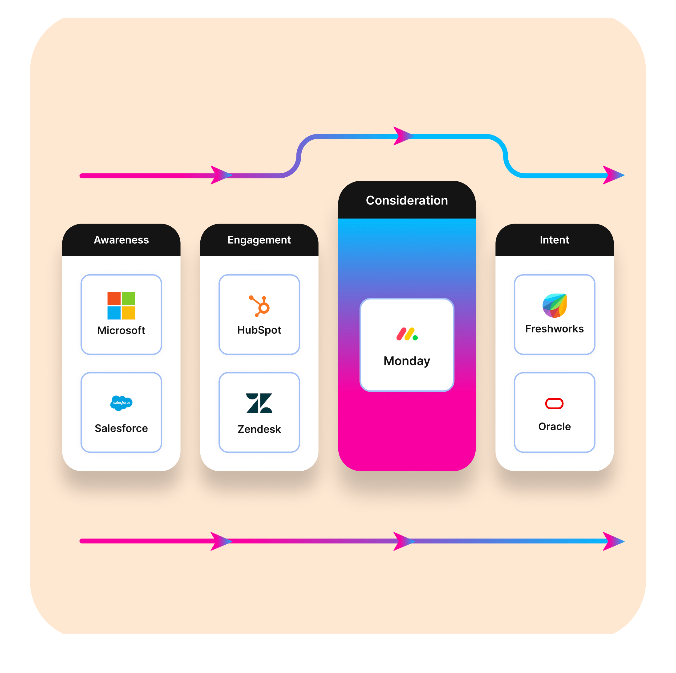
A LinkedIn ABM platform maps each of your accounts in your TAL to a buyer journey stage using first, second and third-party intent signals. It then orchestrates personalized campaigns with personalized ads and 1-1 landing pages, to reach the right buying committee members with the right message at the right time. The best platforms also control impression distribution or capping, sync account engagement back to your CRM, and attribute closed revenue to specific campaigns.
What Kind of Team Gets the Most Out of Recotap?
The strongest fit signals are not about industry or company size. They are about the situation.
You have a small or lean marketing team, usually two to five people, with one person carrying out demand gen end-to-end. LinkedIn is your primary pipeline channel. Your ad spend is $5,000 to $50,000 per month just on LinkedIn. You have HubSpot, Zoho or Salesforce in place as CRM.
But all the stacks together are still not able to deliver the pipeline that you promised your sales team and CEO. You feel like something is missing to stitch all these tools together to give you greater control on how your campaigns utilize budget, improve your reach and better visibility into how it impacts pipeline.
Your average contract value is $30,000 or higher, often $100,000 and above, with three to twelve-month sales cycles and multi-stakeholder buying committees. You have likely tried another ABM platform before, and it failed to deliver. The question is whether the platform was wrong for your situation, or whether ABM itself was wrong. In most cases, it is the former because most of these platforms are not created for pipeline attribution, but Recotap is.
The Fit Checklist: Five Questions Worth Asking Before You Book a Demo
1. Can you see which accounts are consuming your LinkedIn budget?
On the native LinkedIn Campaign Manager, almost always no. A consistent pattern: 70 to 80 percent of impressions concentrate on 10 to 15 percent of target accounts. The strategic accounts your sales team is targeting this quarter often receive almost no impressions at all. If you cannot see this problem, you cannot fix it. Impression capping is the control mechanism that corrects this at the account level.
2. Do you have a target account list, even an imperfect one?
Recotap orchestrates your existing account intelligence into LinkedIn campaigns withjourney-stage mapping and impression controls. It does not build your TAL from scratch. A list of 100 to 1,000 accounts that you and sales have agreed on is enough to start.
3. Is there a CRM your sales team actually uses?
This is where Recotap's attribution loop closes. Journey stages sync back into HubSpot or Salesforce so sales can see which accounts are actively engaging in current campaigns, their stage, and when to act. If the CRM is not actively used, signals accumulate, and no one acts on them.
4. Is LinkedIn your primary channel, or one of four or five?
If you are running equal-weight campaigns across LinkedIn, programmatic display, CTV, and paid search with dedicated channel managers, you are describing a program that 6sense and Demandbase are genuinely built for. Recotap is built for teams where LinkedIn is the dominant channel, and the LinkedIn-first ABM architecture is a deliberate strategic choice rather than a product constraint.
5. Is your team small enough that platform complexity would hurt you?
Some ABM platforms take four to six months to implement. For a two-person team managing campaigns, CRM hygiene, sales coordination, and reporting simultaneously, that is not a challenge; it is a full stop.
Where Recotap Is Genuinely Not the Right Call
The pure PLG team with no sales motion
If you are entirely product-led with no BDR, no AE, and no outbound motion, i.e. there is no one to handoff leads or responsible to close the loop. Then, adopting ABM as a practice or using ABM platforms will not be useful.
If you have neither a TAL nor a CRM
ABM is often associated with the size of an organization but It’s less about organization size and more to do with readiness. Recotap is an activation platform, not a foundation builder. Before you start using any ABM platform, you need to have a good target account list with a CRM that can handle it.
You need five-channel orchestration
If your ABM budget exceeds $500,000 annually and you are running campaigns across display, CTV, LinkedIn, email, and events with dedicated channel managers, 6sense and Demandbase are the right answer. Those platforms are built for that operational scale. If that is your situation, you will not benefit from a LinkedIn ABM platform.
The Need is for sub-90-day ROI on a 9-18 months sales cycle
ABM is not a lead gen tool. The first 30 to 60 days produce visibility and engagement signals, not closed revenue. If your deadline is eight weeks to prove ROI and your deal cycle is 12 months, then ABM platform or even the strategy is not the right choice.
What Recotap Does Not Replace
Recotap sits above your existing stack as an activation layer. ZoomInfo and Apollo build the TAL. HubSpot or Salesforce holds the CRM data. Bombora or G2 supplies third-party intent. Recotap takes all of that, integrates it through a unifiedsignal hub that ingests multi-channel data, and adds journey-stage mapping, impression capping, personalized ads and 1-1 landing pages and revenue attribution on top.
What you keep/ Let go
What Recotap adds
Keep: ZoomInfo / Apollo for enrichment
Account-level journey stage mapping
Keep: HubSpot / Salesforce CRM
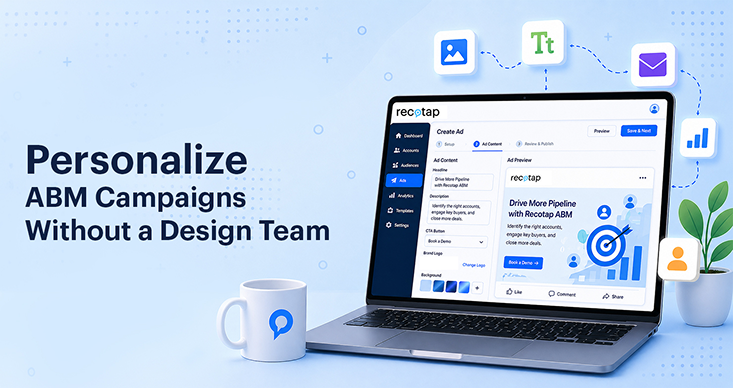
LinkedIn campaign orchestration & personalization
Keep: G2 intent data
Account-level de-anonymised website data, 3rd party Bombora intent
Let go: LinkedIn Campaign Manager
Recotap’s LinkedIn Campaign Manager along with Impression capping, budget control, CRM sync & Revenue attribution visibility for pipeline
The stack you have stays. Recotap adds the orchestration layer that LinkedIn Campaign Manager was never designed to provide for ABM
Teams that implement Recotap alongside their existing HubSpot or Salesforce setup typically see TAL coverage improve from under 20 percent to above 80 percent within the first 60 days.
What Good Looks Like in the First 90 Days
Weeks 1 to 4: You see, for the first time, which accounts are receiving impressions and where the budget is concentrating. For most teams, this reveals that most of the spend went to a small fraction of the target list.How LinkedIn concentrates its budget on a fraction of your TAL is a known structural problem, and impression capping redistributes it evenly.
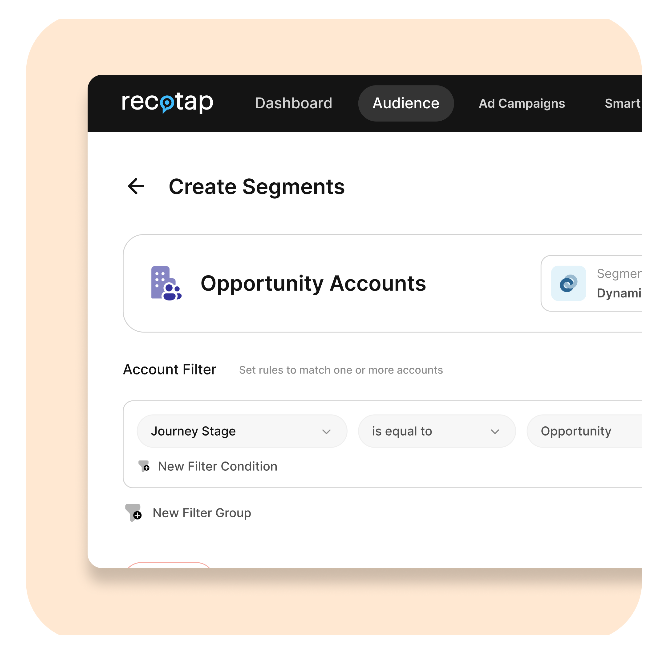
Weeks 4-12: Accounts begin moving between journey stages, driven bysmart segmentation that updates in real time as signals change. Sales teams receive signals which are integrated and more robust in terms of understanding which buyer is ready for a sales meeting.
Weeks 13-24: Closed-won revenue ties back to campaign influence. The reporting conversation shifts from how many impressions we generated to which campaigns moved the deals we closed.
Timeline varies by sales cycle. Companies with 90-day cycles see revenue signals more quickly than those with 12- to 18-month cycles. This is ABM math, not a platform limitation.
Recotap Vs Other ABM Platforms
For B2B teams with preference for LinkedIn as a channel for ABM, Recotap is the right fit. For teams running multi-channel ABM with budgets exceeding $500,000 with dedicated channel ops, 6sense and Demandbase are the right choice. The distinction is not about which platform is better. It is about which buyer profile you belong to and which channel is best to target and engage them in.
If you are a lean ABM or demand gen team and you are considering large multi-channel platforms for ABM, the implementation overhead is real. The feature breadth creates complexity that small teams cannot absorb. If they are on your shortlist, the right question is not which platform is better. It is the buyer profile you belong to.
Factors.ai is analytics-first with strong attribution capabilities. Recotap is orchestration-first, withaccount-level personalisation at its core. Different primary capability, different buyer.
Key Takeaways
The strongest fit signal is not company size. It is whether your LinkedIn budget is concentrating on the wrong accounts, and your team cannot absorb months of implementation overhead.
Recotap is an activation layer, not a foundation builder. Your existing stack stays. Recotap adds the orchestration logic on top.
Four situations where Recotap is not the right call: no sales motion, no CRM or TAL, enterprise multi-channel programs above $500K, and sub-90-day ROI expectations on long deal cycles.
The first 90 days deliver visibility and engagement signals. Revenue attribution becomes measurable in quarters two and three.
A platform that tells you when it is not the right fit earns more credibility than one that sells to everyone.
FAQs
Q1. Is Recotap suitable for early-stage startups?
Recotap is built for mid-market B2B companies with deal sizes above $30,000 ACV and LinkedIn budgets of $5,000 per month or more. Early-stage companies without a defined TAL, active CRM, or meaningful LinkedIn spend will not see meaningful results from Recotap. When that infrastructure is in place, that is the right moment to evaluate Recotap.
Q2. Is Recotap overkill if I am only targeting a few hundred accounts?
Not necessarily. A few hundred accounts are within the range where Recotap delivers value, particularly if your LinkedIn spend is already showing concentration problems that native Campaign Manager cannot fix. Recotap’s impression capping combined with Account Blocking feature helps you to do precision ABM campaigns.
Q3. What are realistic reasons Recotap might not work for a B2B brand?
Four reasons: 1. no sales motion or team to act on ABM signals, 2. no CRM in active use, 3. LinkedIn not being the primary pipeline channel, or 4. smaller budgets of lower than $5000 per month to spend on LinkedIn. Address the upstream problem before evaluating an activation platform.
Q4. How does Recotap compare with 6sense and Demandbase if my primary channel is LinkedIn?
6sense and Demandbase serve enterprise teams running multi-channel ABM above $500,000 with dedicated channel ops. Recotap is built for LinkedIn ABM with journey-stage mapping, personalized campaigns, impression capping, account exclusion, and CRM sync. For mid-market teams with LinkedIn-first campaigns, Recotap delivers the same orchestration precision at a fraction of the implementation complexity.
Q5. What happens if my previous ABM platform failed?
In most cases, the tool was wrong for the situation, or the program lacked the upstream infrastructure to make any platform work. Consistent failure patterns: no defined TAL, no CRM alignment, no sales buy-in, or an enterprise platform deployed against a lean team without the capacity to run it. The right question is not whether ABM works. It is what was missing when the previous platform was deployed.
Q6. Can Recotap work for companies targeting accounts with under 300 employees?
Yes. Recotap uses impression capping and Company blocking to reach accounts below LinkedIn's 300-member minimum, keeping ad delivery precise on your specific ICP. This is particularly relevant where the buying committee is small, such as 10 to 15 people within a company of 50 to 100 employees.