We use cookies to ensure you get the best experience on our website. By continuing
to use our site, you accept our use of cookies, privacy policy and terms of service.
ESC
What are you looking for?
Subscribe to our Newsletter
Join 10k+ people to get notified about new posts, news and updates.
Terms of use dolor sit amet consectetur, adipisicing elit. Recusandae provident ullam
aperiam quo ad non corrupti sit vel quam repellat ipsa quod sed, repellendus
adipisci, ducimus ea modi odio assumenda.
Disclaimers
Lorem ipsum dolor sit amet consectetur adipisicing elit. Sequi, cum esse possimus
officiis amet ea voluptatibus libero! Dolorum assumenda esse, deserunt ipsum ad
iusto! Praesentium error nobis tenetur at, quis nostrum facere excepturi architecto
totam.
Lorem ipsum dolor sit amet consectetur adipisicing elit. Inventore, soluta alias
eaque modi ipsum sint iusto fugiat vero velit rerum.
Limitation on Liability
Sequi, cum esse possimus officiis amet ea voluptatibus libero! Dolorum assumenda
esse, deserunt ipsum ad iusto! Praesentium error nobis tenetur at, quis nostrum
facere excepturi architecto totam.
Lorem ipsum dolor sit amet consectetur adipisicing elit. Inventore, soluta alias
eaque modi ipsum sint iusto fugiat vero velit rerum.
Copyright Policy
Dolor sit amet consectetur adipisicing elit. Sequi, cum esse possimus officiis amet
ea voluptatibus libero! Dolorum assumenda esse, deserunt ipsum ad iusto! Praesentium
error nobis tenetur at, quis nostrum facere excepturi architecto totam.
Lorem ipsum dolor sit amet consectetur adipisicing elit. Inventore, soluta alias
eaque modi ipsum sint iusto fugiat vero velit rerum.
General
Sit amet consectetur adipisicing elit. Sequi, cum esse possimus officiis amet ea
voluptatibus libero! Dolorum assumenda esse, deserunt ipsum ad iusto! Praesentium
error nobis tenetur at, quis nostrum facere excepturi architecto totam.
Lorem ipsum dolor sit amet consectetur adipisicing elit. Inventore, soluta alias
eaque modi ipsum sint iusto fugiat vero velit rerum.
How Do You Run LinkedIn ABM When Your Target List Is Under 300 Members?
LinkedIn requires a minimum of 300 members in the audience before a campaign can go live. Here is how ABM teams targeting small buying committees build to that number without giving up the precision their list was built for.
TLDR
LinkedIn won't let you run a campaign unless your target audience list has at least 300 members. Most focused ABM lists don't hit that number when you want to run a targeted campaign.
The obvious fixes, adding more job titles, pulling in older audiences, and combining signals, all work. But they do it by including people and accounts that were never on your list.
Recotap uploads a broader set of contacts from your existing target accounts to clear the 300 threshold, then makes sure your ads only reach the titles and accounts you actually wanted to target using audience exclusion and impression capping
A demand gen manager at a logistics-tech company builds a focused list: 34 accounts, all having 6 to 15 buying committee members, all firmly in the ICP. Uploads it to LinkedIn Campaign Manager. Layers VP Operations and Head of Supply Chain as the seniority filters. LinkedIn says: Audience too small to launch a campaign. Extends to the Director level. Still not enough. Merges two audiences. Now at 300+, but 60% of the matched audience sits outside the original account list.
Campaign goes live. The pipeline doesn't follow. The impression data looks fine. The accounts receiving those impressions don't match the original list the sales team built the quarter plan around.
That gap between the audience LinkedIn needs to activate for a campaign and the audience your business actually wants to reach is the problem this piece is about.
What Is LinkedIn's 300-Member Minimum?
LinkedIn requires at least 300 matched members in an audience before a campaign can be activated. This minimum applies across all matched audience types: contact lists, company lists, and retargeting audiences. For broad campaigns targeting thousands of companies, reaching 300 is never a consideration. ABM, it requires deliberate attention.
When you build a matched audience for ABM, you are not targeting all 800 people at a company. You are targeting the 5 to 6 buying committee members who make the decision. On a 30-account TAL, that might be 180 people before any job title filtering. Apply VP-and-above seniority filters, and you might reach 90. LinkedIn won't activate the campaign until that number reaches 300.
The minimum is not a signal that the list is wrong. It is a delivery requirement designed for scale. The more surgical the targeting, the harder it is to meet the minimum without making a trade-off. That trade-off is where precision gets lost.
Why does Audience Expansion hurt your ABM budget?
When a campaign can't activate due to insufficient audience size, demand gen teams reach for one of three standard fixes. Each one gets to 300. None of them preserves the original list.
Expanding job title or seniority filters
Broaden to the Director level. Still short? Add Manager. The audience reaches 300. The campaign is activated. But your ads are now reaching people who don't make the buying decision. In a 40-account TAL where the buying committee is 5 people per account, adding Manager-level titles means a significant share of impressions goes to people with very little influence in the purchase. The same LinkedIn algorithm that concentrates70% of impressions on 10–15% of target accounts now does so across an audience where the wrong titles are overrepresented.
Extending retargeting lookback windows
Pull in accounts that engaged up to 180 days ago. The window widens, the audience grows, the campaign activates. But accounts that showed intent six months ago were operating under different conditions. Including them adds noise, not signal. Journey-stage mapping depends on recency. Stale lookback windows undermine it directly.
Merging multiple weak signals into one audience
Combine pricing page visitors from the past 60 days, video viewers from 90 days ago, and form abandoners from 30 days ago. Each segment falls below 300 individually. Combined, they get there. But the merged audience is internally inconsistent: one segment is showing active buying intent, another is a months-old awareness touchpoint, a third may have been a competitor doing research. The campaign treats all three identically. Running withoutaccount-level segmentation controls, impressions concentrate on the accounts that engage most, not the accounts that matter most to the pipeline.
Every approach reaches 300 by widening the net. None of them keeps the original list intact. That is not a solution. It is a substitution. And if you stay with the substitution long enough, it becomes the default. That is when ABM stops being account-based in any meaningful sense.
How Recotap Reaches 300-Member Without Compromising on Targeting?
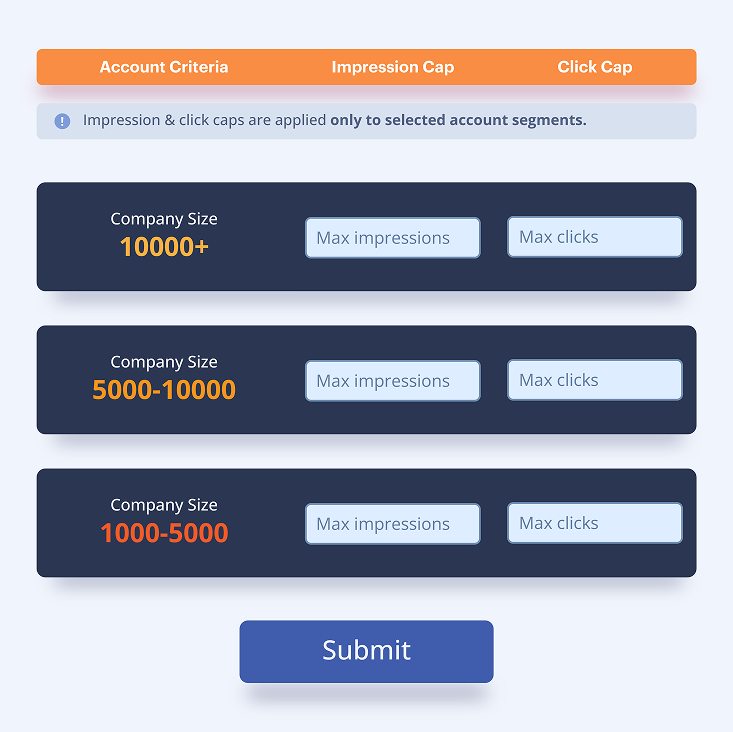
Recotap meets LinkedIn's 300-member requirement by uploading a broader contact set from your target accounts, then suppressing delivery to non-ICP contacts via impression capping and audience exclusion, so your targeting precision is preserved end to end.
Recotap uploads a broader set of contacts from your target accounts to reach the 300-match threshold. This is not the audience that will receive your ads. It is the pool that satisfies LinkedIn's activation requirement.
Recotap layers impression capping and audience exclusion on top of that broader set to suppress delivery to everyone except the intended accounts and personas. The people outside your ICP are in the matched audience. They will never see your ads.
Intent signals from Bombora and G2, combined with first-party data including site visits, CRM stage, and engagement history, inform which accounts qualify. Accounts that don't meet your firmographic criteria are excluded in real time. CRM sync removes closed deals within 24 hours and automatically pauses spending on disengaged segments.
The distinction that matters: LinkedIn's native Audience Expansion uses lookalike logic across the full LinkedIn graph. It finds accounts "similar" to your targets by LinkedIn's own criteria, not yours. Recotap's approach stays inside your ICP. The contacts used to reach 300 come from your target accounts. The suppression layer ensures delivery goes only to the most important accounts in your TAL.
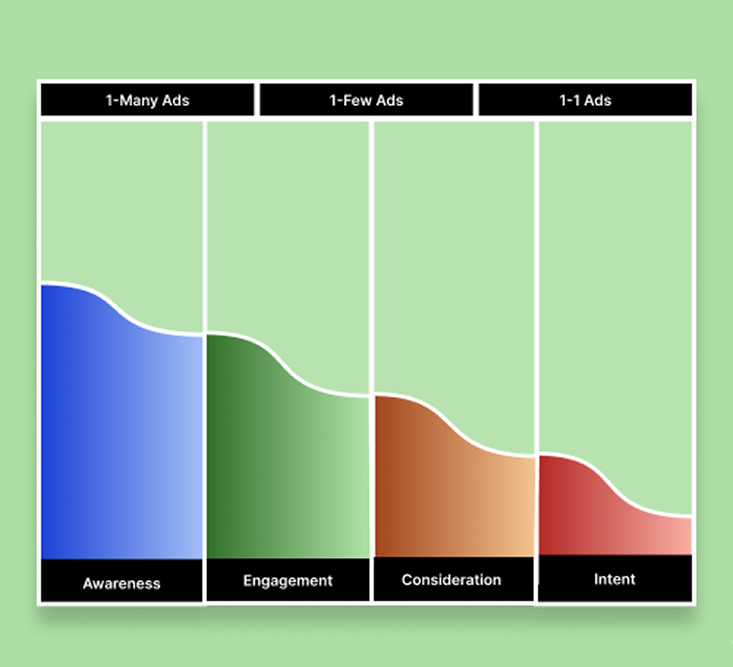
Once live, Recotap layers journey-stage logic across the audience. Unaware accounts receive 1:Many campaigns. Accounts that move to Aware receive 1:Few campaigns with case studies and whitepapers. Accounts at the intent stage receive1:1 personalized ads and landing pages supported by sales outreach. For accounts already engaged through events or meetings, Custom Static Segments enable fully personalized campaigns from day one.
Who is Recotap’s Small-Audience Targeting Built For?
This is built for mid-market B2B teams with focused, high-value account lists where deal size justifies precision over reach: a demand gen lead or ABM manager running $5,000 or more per month on LinkedIn, managing a TAL of 20 to 80 accounts, with ACV above $30,000 and a team of one to three people.
The situation that surfaces this problem most often is small employee-count target accounts. Companies with 10 to 50 employees have small, by-design buying committees. Layering job title and seniority filters on a 30-account list of companies this size will leave you well short of 300 matched members every time.
For teams where the TAL is narrow because the ICP genuinely is that tight, adding accounts to reach LinkedIn's minimum is not a neutral technical step. It is a decision to show your ads to companies that were never on your list. If your current approach to reaching 300 has produced an audience you no longer fully recognise, this is what it is built to solve.
Key Takeaways
LinkedIn requires 300 matched members before a campaign activates. For focused TALs of 20 to 80 accounts, reaching that number while maintaining ICP precision requires a deliberate approach.
The three standard methods, expanding title filters, extending lookback windows, and merging weak signals, all reach 300 by compromising on targeting. Each trade ICP precision for campaign activation.
Recotap uploads a broader account set to satisfy the minimum, then uses impression capping and audience exclusion to ensure delivery reaches only the intended accounts and personas.
This is not LinkedIn's native Audience Expansion. Audience Expansion applies lookalike logic across LinkedIn's graph. Recotap's mechanism stays inside your ICP using contacts from your target accounts, with delivery suppressed to the right titles.
Teams targeting 10 to 50-employee companies hit this problem structurally. The buying committee is small by design. The method for reaching 300 should preserve that precision, not undo it.
Frequently Asked Questions
Q1. What is LinkedIn's 300-member minimum for matched audiences?
LinkedIn requires at least 300 matched members before a campaign can be activated. It applies to all matched audience types: contact lists, company lists, and retargeting audiences. ABM campaigns hit this most frequently because ICP filters, particularly job title and seniority layering, reduce the matchable pool below the minimum.
Q2. Why does LinkedIn say my audience is insufficient?
LinkedIn shows an insufficient audience message when the matched member count falls below 300. For ABM campaigns, this happens when seniority filters are layered on a focused account list of 20 to 50 companies. The narrower the targeting, the harder it is to reach 300. It is a platform activation requirement, not a sign that the list is wrong.
Q3. Can I run LinkedIn ABM with fewer than 50 target accounts?
Yes. Recotap is built for this. Teams with TALs of 20 to 80 accounts use Recotap to meet LinkedIn's 300-member requirement without adding accounts outside their ICP. The platform uploads a broader contact set from target accounts to meet the minimum, then applies impression capping and audience exclusion to ensure delivery reaches only the intended accounts and personas.
Q4. What is the difference between LinkedIn Audience Expansion and Recotap's AI Audience Padding?
LinkedIn's Audience Expansion applies lookalike logic across the full LinkedIn graph. Those accounts may sit entirely outside your ICP. Recotap's AI Audience Padding identifies additional contacts from within your existing target accounts using Bombora and G2 intent signals filtered against your firmographic criteria, then suppresses delivery to anyone outside the intended titles viasmart segmentation. The contacts added stay inside the ICP definition. LinkedIn Audience Expansion cannot guarantee that.
Q5. What account list size does Recotap work best with?
Recotap is built for mid-market B2B teams running focused TALs of 20 to 2,000 accounts with LinkedIn ad spend of $5,000 or more per month. It performs best when the account list is deliberate and ICP-qualified, where precision matters more than volume. Teams with deal sizes above $30,000 ACV see the clearest ROI because impression capping and exclusion controls ensure budget reaches accounts that represent the pipeline, not accounts that happen to engage most frequently.
Q6. How does Recotap meet LinkedIn's 300-member minimum without expanding my ICP?
Recotap uploads a target accounts list, including other closer accounts, to reach LinkedIn's 300-member threshold. It then applies impression capping and audience exclusion to suppress delivery to everyone outside your intended accounts and personas. The broader pool satisfies LinkedIn's requirement. The suppression layer preserves your targeting precision.