We use cookies to ensure you get the best experience on our website. By continuing
to use our site, you accept our use of cookies, privacy policy and terms of service.
ESC
What are you looking for?
Subscribe to our Newsletter
Join 10k+ people to get notified about new posts, news and updates.
Terms of use dolor sit amet consectetur, adipisicing elit. Recusandae provident ullam
aperiam quo ad non corrupti sit vel quam repellat ipsa quod sed, repellendus
adipisci, ducimus ea modi odio assumenda.
Disclaimers
Lorem ipsum dolor sit amet consectetur adipisicing elit. Sequi, cum esse possimus
officiis amet ea voluptatibus libero! Dolorum assumenda esse, deserunt ipsum ad
iusto! Praesentium error nobis tenetur at, quis nostrum facere excepturi architecto
totam.
Lorem ipsum dolor sit amet consectetur adipisicing elit. Inventore, soluta alias
eaque modi ipsum sint iusto fugiat vero velit rerum.
Limitation on Liability
Sequi, cum esse possimus officiis amet ea voluptatibus libero! Dolorum assumenda
esse, deserunt ipsum ad iusto! Praesentium error nobis tenetur at, quis nostrum
facere excepturi architecto totam.
Lorem ipsum dolor sit amet consectetur adipisicing elit. Inventore, soluta alias
eaque modi ipsum sint iusto fugiat vero velit rerum.
Copyright Policy
Dolor sit amet consectetur adipisicing elit. Sequi, cum esse possimus officiis amet
ea voluptatibus libero! Dolorum assumenda esse, deserunt ipsum ad iusto! Praesentium
error nobis tenetur at, quis nostrum facere excepturi architecto totam.
Lorem ipsum dolor sit amet consectetur adipisicing elit. Inventore, soluta alias
eaque modi ipsum sint iusto fugiat vero velit rerum.
General
Sit amet consectetur adipisicing elit. Sequi, cum esse possimus officiis amet ea
voluptatibus libero! Dolorum assumenda esse, deserunt ipsum ad iusto! Praesentium
error nobis tenetur at, quis nostrum facere excepturi architecto totam.
Lorem ipsum dolor sit amet consectetur adipisicing elit. Inventore, soluta alias
eaque modi ipsum sint iusto fugiat vero velit rerum.
Data Enrichment vs ABM Activation: What Your ABM Stack Is Missing
ZoomInfo and Apollo tell you who to target. Running a LinkedIn ABM campaign for those accounts is a different job entirely.
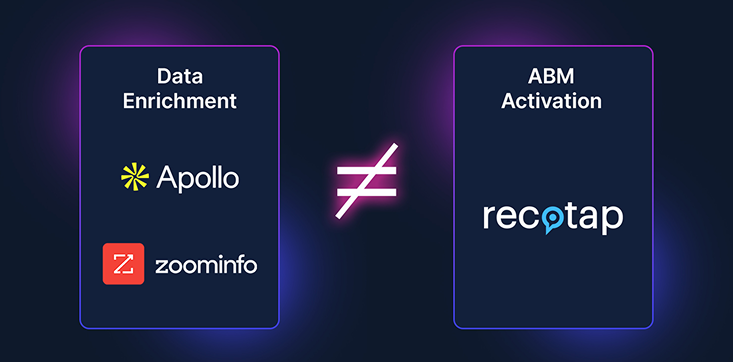
Data enrichment tools and ABM activation platforms are not interchangeable. They answer different questions and do different jobs.
ZoomInfo and Apollo are excellent at building and enriching your target account list. Recotap is the ABM activation layer that takes that list and runs buyer journey based personalized LinkedIn ABM campaigns, at the account level, with full revenue attribution.
This article explains exactly where one platform’s role ends, where the other’s begins, and what sits in the gap between them.
TLDR
Data enrichment tools (ZoomInfo, Apollo) answer 'who to target.' They do not run ABM.
ABM activation requires multi-party signal integration, journey-stage classification, and LinkedIn-native personalized campaign execution. That is a separate platform.
The gap between having a target account list and running a live ABM program for it is where most demand gen teams get stuck.
Recotap sits downstream from your data tools. It takes the list they produce and adds the activation layer your stack is missing.
You do not have to replace ZoomInfo or Apollo. You need to add the ABM activation layer along with it.
In this article: What data enrichment tools actually do | The ABM activation gap | Why some platforms disappoint | How the two layers connect | FAQ
You have a list. You have enrichment. You still do not have ABM.
Here is a situation that comes up repeatedly in demand gen conversations. A team has ZoomInfo for account and contact data. They have Apollo for sequencing. HubSpot is their CRM. LinkedIn Campaign Manager is running ads. The target account list is built and enriched. And SDRs start doing outbound.
Six months in, no channel is working. The pipeline is flat like before. The team cannot tell which accounts have seen their ads, which are moving toward a conversation, or where the budget is actually going. Leadership is asking for pipeline numbers. The answer the team keeps getting from their tools is: we do not have that visibility.
This is not a targeting problem. The accounts are right. The data is solid.
The problem is that data enrichment and ABM activation are two fundamentally different jobs, and almost every demand gen team conflates them until it is too late.
What Does a Data Enrichment Tool Actually Do?
ZoomInfo and Apollo are built to answer one question: who should you target?
ZoomInfo gives you enriched account profiles, contact data, technographic signals, and intent at the prospecting layer. Apollo adds outbound sequencing on top of that contact database. Both are excellent at their core job: building a qualified target account list (TAL) and helping sales teams reach the right people via email and cold outreach.
What they cannot do: tell you which accounts on that list are actively in-market right now, what message to serve them based on where they sit in the buying journey, how to run a LinkedIn campaigns at account level and automatically update as accounts move stages. Or how to stop budget concentrating on the same ten companies while 400 strategic accounts get zero exposure.
Knowing who to target and being able to run a coordinated ABM campaign to them are two separate functions. Data tools handle the first. The ABM activation platform handles the second.
Data Enrichment vs ABM Activation: A Direct Comparison
Capability
ZoomInfo / Apollo
Recotap
Primary job
Find and enrich target accounts and contacts
Activate those accounts with journey-aware LinkedIn campaigns
Core output
Contact lists, enriched firmographic data
Buyer Stage based campaigns, impression-capped delivery, account intelligence
The question it answers
Who should we target?
When do we engage, with what message, on which channel? And how does it impact pipeline or revenue?
Journey stage intelligence
None
Classifies every account: Unaware, Aware, Buying Intent, Opportunity
LinkedIn campaign execution
No
Yes, natively built for LinkedIn ABM
Account-level impression capping
No
Yes - prevents budget concentration on a handful of accounts
Audience exclusion (competitors, churned)
No
Yes - real-time CRM sync removes them automatically
CRM sync for sales alignment
Exports only
Bi-directional, updates every 24 hours
Revenue attribution
No
Yes - spend to pipeline to closed-won in one dashboard
Works without the other?
Yes, for prospecting and outbound
Better when ZoomInfo or Apollo feeds in the TAL
What Is the ABM Activation Gap?
The activation gap is the space between having a target account list and being able to run a live, coordinated ABM program to those accounts. It is wider than most teams expect
Run LinkedIn ABM campaigns that update automatically based on buyer stage as accounts move from Unaware to Aware to Buying Intent
Cap impressions per account so that budget distributes across the full target list rather than concentrating on the accounts LinkedIn's algorithm already likes
Exclude competitors, existing customers, and disengaged segments from campaigns in real time
Sync buying stage data back to your CRM so that sales knows when to reach out and why
Close the attribution loop between ad spend, pipeline influence, and closed-won revenue
None of these are prospecting functions. None of them are enrichment functions. They are campaign orchestration functions, and they require a purpose-built activation platform.
Why Do Some ABM Platforms Still Leave the Gap Open?
Madison Logic, AdRoll, and RollWorks all position themselves as ABM platforms. For certain use cases, they deliver. For mid-market B2B teams running LinkedIn-first programs, three structural issues consistently get in the way:
Built for programmatic display, not LinkedIn. Most of these platforms were architected around display advertising across DSPs. LinkedIn is just another of these channels, not the primary channel. Teams whose pipeline depends on LinkedIn find the account-level controls shallow and the campaign logic limited compared to what a LinkedIn-native platform can do.
Priced for enterprise budgets. Enterprise ABM platforms typically start at $50,000 or more annually. For a demand gen team managing a $5,000 to $10,000 monthly LinkedIn budget with two people running the program, that pricing makes the ROI conversation very difficult to win with finance.
Intent scoring without explanation. When a platform cannot tell you why an account is flagged as high intent, sales teams stop trusting the signal.
How Do Data Enrichment and ABM Activation Work Together?
Recotap does not replace ZoomInfo or Apollo. It receives what those tools produce and adds the activation layer on top. The two layers connect like this:
Step
Layer
What Happens
1
ZoomInfo / Apollo
Builds the Target Account List (TAL) with enriched firmographic and contact data
2
Recotap Signal Hub
Receives the TAL and layers on first-party signals (website visits, CRM activity) plus third-party intent from Bombora, G2, and LinkedIn job postings
3
Journey Stage Engine
Scores and classifies every account: Unaware, Aware, Buying Intent, or Opportunity — updated continuously as signals shift
4
LinkedIn Campaign Orchestration
Fires the right campaign automatically based on stage. Impression caps prevent budget concentration. Ad messaging updates as accounts move.
5
CRM Sync + Sales Trigger
Journey stage data syncs to HubSpot or Salesforce every 24 hours. Sales sees which accounts to contact and why, without waiting for a weekly report.
6
Revenue Attribution
Closes the loop: spend per account, pipeline influenced, and closed-won revenue tracked in one dashboard — no manual stitching.
One prospect came into a Recotap evaluation expecting to replace their ZoomInfo contract. That is not the right frame. ZoomInfo handles enrichment and contact discovery. Recotap handles everything that happens from segmenting accounts based on their journey stage to orchestrating personalized ABM campaigns to managing the campaign to reach maximum audience. Teams that keep both get the complete picture: data that tells you who, and a platform that tells those accounts you exist, at exactly the right moment, with the right message, on the channel where their buyers are active.
The two tools answer different questions. The stack is not complete without both answers.
Summary
ZoomInfo and Apollo are data enrichment and prospecting tools. They answer 'who.' They are not ABM platforms.
ABM activation platform is the layer above data that does signal integration, buyer journey-stage classification, LinkedIn campaign execution, impression capping, CRM sync, and revenue attribution.
The activation gap i.e., the space between having a TAL and running a live ABM program, is where most demand gen stacks break down.
Display-heavy platforms like Madison Logic and RollWorks claim ABM but fall short for mid-market teams running LinkedIn-first programs.
Recotap sits downstream from your data tools. Keep ZoomInfo or Apollo for enrichment. Use Recotap for everything that happens after the list is built.
The stack is not complete with data alone. It needs the activation layer too.
Frequently Asked Questions
What is the difference between a data enrichment tool and an ABM platform?
A data enrichment tool like ZoomInfo or Apollo tells you who to target: it builds and enriches account and contact lists, surfaces intent at the prospecting layer, and supports outbound sequences. An ABM platform tells you which of those accounts are actively in-market, what message to serve them based on their buying stage, and how to run coordinated campaigns across LinkedIn and sales channels. Data tools answer 'who.' ABM platforms answer 'when, how, and with what message.'
Does Recotap replace ZoomInfo or Apollo?
No. ZoomInfo and Apollo operate at the data enrichment and prospecting layer. Recotap operates at the activation layer. They are designed to work together. Your data tools build and enrich the target account list. Recotap takes that list, layers first-party and third-party signals on top, classifies accounts by buying stage, and runs journey-aware LinkedIn campaigns automatically. Most teams keep both and add Recotap as the layer above their enrichment tools.
Can I run LinkedIn ABM campaigns directly from ZoomInfo or Apollo?
No. Neither ZoomInfo nor Apollo can execute LinkedIn campaigns, manage account-level impression caps, classify accounts by buying stage, or sync campaign signals back to your CRM for sales alignment. Those are activation-layer functions. ZoomInfo and Apollo produce the list. A platform like Recotap activates it on LinkedIn with journey-stage logic and account-level controls.
What is the ABM activation gap?
The activation gap is the distance between having a qualified target account list and being able to run a live, journey-aware ABM program to those accounts on LinkedIn. Most demand gen teams fall into it: they have enrichment tools and CRM data but no platform that can score account intent in real time, update campaign messaging as accounts move stages, cap impressions at the account level, or close the attribution loop between spend and pipeline.
Why does LinkedIn waste ABM budget without account-level controls?
LinkedIn's algorithm optimises for engagement signals: clicks, conversions, and interaction rates. It concentrates budget on accounts whose employees engage most with content, not on accounts that matter strategically to your business. Without account-level impression caps, 70 percent of your budget typically goes to 10 to 15 percent of your target list. The rest of your accounts get minimal or zero exposure regardless of their strategic value.
What does signal orchestration mean in practice?
Signal orchestration means combining first-party data (website visits, CRM stage changes, sales touchpoints) with third-party intent signals (Bombora, G2, LinkedIn job postings) into a single account-level view. Instead of checking each tool separately and manually deciding who to prioritise, Recotap's Signal Hub scores and classifies accounts automatically and triggers the right campaign action based on where each account sits in the buying journey at that moment.
Does Recotap work if I only have a basic CRM and no intent data provider?
Yes. Recotap integrates with HubSpot, Salesforce or Zoho to classify accounts and run journey-aware campaigns from first-party signals alone: website visitor identification, CRM stage data, and engagement history. Third-party intent from Bombora or G2 adds precision but is not required to get started. Many teams begin with first-party data and add intent providers as the program matures.
Why did platforms like RollWorks or Madison Logic not deliver for our team?
The most common reasons are structural. These platforms are primarily built around programmatic display advertising, not LinkedIn-native execution. Their pricing is designed for enterprise budgets, which makes ROI difficult to justify for mid-market teams. And their intent scoring is often opaque, making it hard to align sales around the signals the platform surfaces. Teams running LinkedIn-first ABM with lean budgets consistently find these platforms mismatched with their actual workflow.