We use cookies to ensure you get the best experience on our website. By continuing
to use our site, you accept our use of cookies, privacy policy and terms of service.
ESC
What are you looking for?
Subscribe to our Newsletter
Join 10k+ people to get notified about new posts, news and updates.
Terms of use dolor sit amet consectetur, adipisicing elit. Recusandae provident ullam
aperiam quo ad non corrupti sit vel quam repellat ipsa quod sed, repellendus
adipisci, ducimus ea modi odio assumenda.
Disclaimers
Lorem ipsum dolor sit amet consectetur adipisicing elit. Sequi, cum esse possimus
officiis amet ea voluptatibus libero! Dolorum assumenda esse, deserunt ipsum ad
iusto! Praesentium error nobis tenetur at, quis nostrum facere excepturi architecto
totam.
Lorem ipsum dolor sit amet consectetur adipisicing elit. Inventore, soluta alias
eaque modi ipsum sint iusto fugiat vero velit rerum.
Limitation on Liability
Sequi, cum esse possimus officiis amet ea voluptatibus libero! Dolorum assumenda
esse, deserunt ipsum ad iusto! Praesentium error nobis tenetur at, quis nostrum
facere excepturi architecto totam.
Lorem ipsum dolor sit amet consectetur adipisicing elit. Inventore, soluta alias
eaque modi ipsum sint iusto fugiat vero velit rerum.
Copyright Policy
Dolor sit amet consectetur adipisicing elit. Sequi, cum esse possimus officiis amet
ea voluptatibus libero! Dolorum assumenda esse, deserunt ipsum ad iusto! Praesentium
error nobis tenetur at, quis nostrum facere excepturi architecto totam.
Lorem ipsum dolor sit amet consectetur adipisicing elit. Inventore, soluta alias
eaque modi ipsum sint iusto fugiat vero velit rerum.
General
Sit amet consectetur adipisicing elit. Sequi, cum esse possimus officiis amet ea
voluptatibus libero! Dolorum assumenda esse, deserunt ipsum ad iusto! Praesentium
error nobis tenetur at, quis nostrum facere excepturi architecto totam.
Lorem ipsum dolor sit amet consectetur adipisicing elit. Inventore, soluta alias
eaque modi ipsum sint iusto fugiat vero velit rerum.
ABM Analytics: 7 Account-Level Metrics That Drive Pipeline
TLDR
ABM analytics has a measurement problem. Most teams track dozens of metrics yet struggle to answer the board's core question: Did ABM work? The solution is focusing on seven disciplined account-level metrics that connect spend to revenue. Recotap's platform unifies these metrics in real-time dashboards so teams can steer ABM investments while deals are being built, not after quarters end.
What is ABM Analytics?
ABM analytics is the practice of measuring account-based marketing performance at the account level rather than the campaign or lead level. Instead of tracking aggregate metrics like total impressions or cost per lead, ABM analytics focuses on understanding which specific target accounts engaged with your marketing, how that engagement influenced pipeline creation, and whether those accounts ultimately converted to revenue.
The goal is to connect marketing spend directly to commercial outcomes by tracking the journey of named accounts through awareness, engagement, pipeline creation, and revenue generation.
Why Traditional ABM Measurement Fails
Most teams track dozens of metrics yet still struggle to answer the only questions the board cares about:
Where did we spend?
Which accounts moved?
Did the pipeline progress?
Can we speed up the sales cycle?
Did revenue follow?
The issue is not lack of data. It's that ABM is still measured at the campaign or lead level, not the account level where buying decisions actually happen. Traditional metrics like click-through rates, cost per lead, and engagement scores tell you about activity, not outcomes.
When metrics are disconnected from accounts, you end up with dashboards that report what happened but give no visibility into which specific accounts responded, whether they progressed through the funnel, or if your spend allocation was efficient.
What Are Account-Level Metrics?
Account-level metrics track the behavior, progression, and commercial outcomes of specific named accounts in your target account list. Instead of aggregating data across campaigns, account-level metrics answer questions like:
How much did we spend influencing Account X?
When did Account Y first engage with our ABM efforts?
Has Account Z's pipeline opportunity moved to the next stage?
Which accounts converted to revenue after ABM influence?
This approach replaces vanity reach with commercial relevance. Every metric is tied back to named accounts, making it clear which investments are driving the pipeline and which are wasting budget.
The 7 Account-Level ABM Metrics That Matter
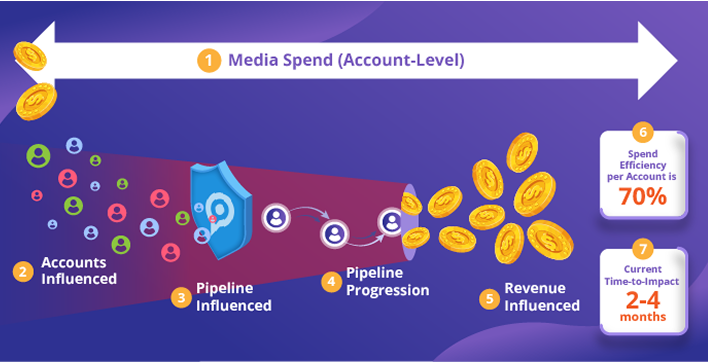
High-performing ABM teams focus on a small, yet important set of account-level metrics that connect spend to revenue, not activity to dashboards. Below are the seven metrics that matter and why.
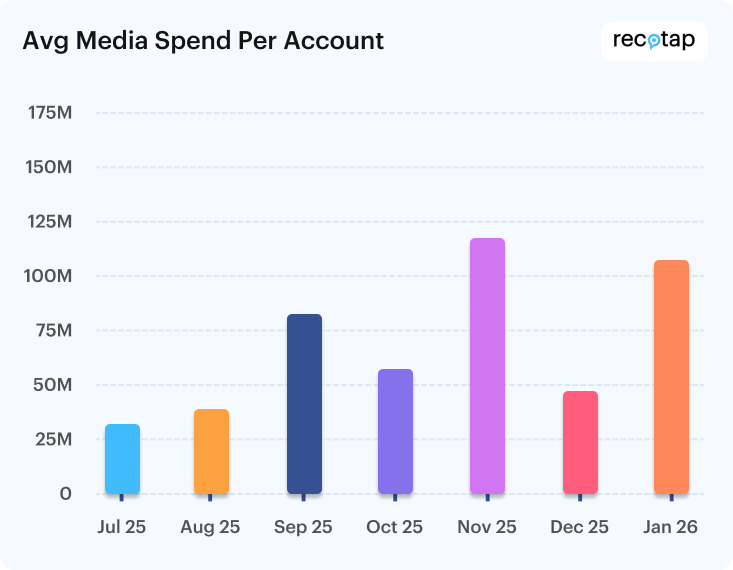
1. Media Spend (Account-Level)
What it answers: Where is our ABM budget actually going?
Instead of tracking spend by campaign, mature ABM teams track:
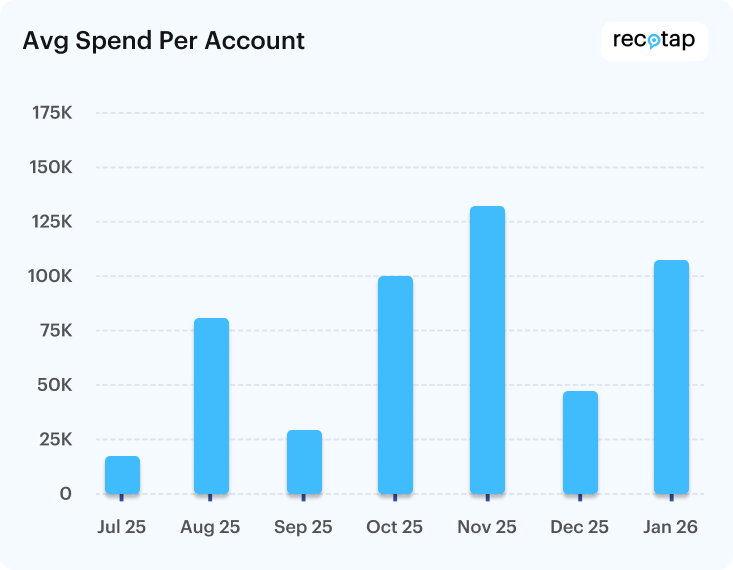
Total media spend influencing each account
Spend trends over time per account
Spend concentration across the target account list
Average spend per account to identify over-investment
How to Interpret: This immediately highlights waste and over-investment, especially when spending continues after accounts stop progressing. Recotap's dashboard shows both aggregate spend trends and per-account spend distribution, making it easy to spot when you're burning budget on unresponsive accounts.
2. Accounts Influenced
What it answers: Which named accounts actually responded to our ABM efforts?
Account-level influence replaces vanity reach with commercial relevance:
Number of target accounts influenced by ABM activity
These are accounts where the pipeline either created or progressed due to Recotap ad campaigns
How to Interpret: This is often the first metric that earns sales trust. When sales teams can see that marketing touched Account X on a specific date, they can coordinate outreach based on real engagement signals rather than guesswork.
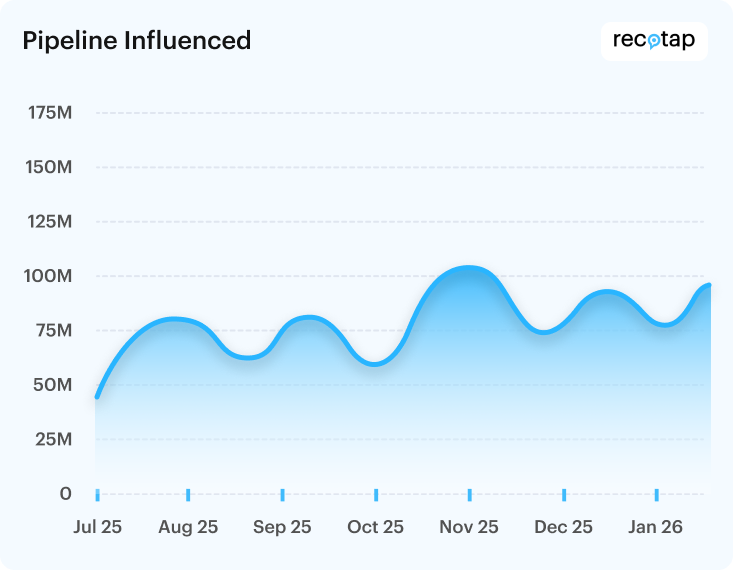
3. Pipeline Influenced
What it answers: Did ABM move real money, or just engagement?
Pipeline influenced tracks:
Total pipeline value touched by ABM activity
Pipeline trends over time showing peaks and valleys
Drop-offs and decay patterns revealing timing issues.
How to Interpret: Seeing pipeline rise and later fall reveals not just success, but timing. If pipeline drops after you reduce spend, that's evidence of ABM's direct impact. Recotap's real-time pipeline tracking shows exactly when accounts enter and exit pipeline stages.
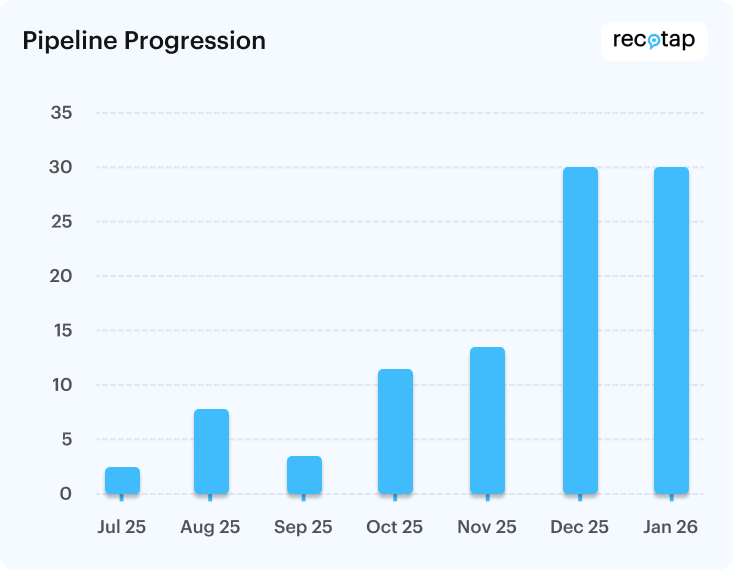
4. Pipeline Progression
What it answers: Are deals actually moving forward?
This is one of the most under-measured ABM metrics:
Stage-to-stage movement for each account
Velocity through the sales funnel for influenced accounts
Stalled versus accelerated opportunities identified by engagement patterns.
How to Interpret: Progression metrics turn ABM analytics from reporting into control. When you can see that accounts exposed to personalized campaigns move through stages 30% faster, you have proof that ABM accelerates deals, not just creates them.
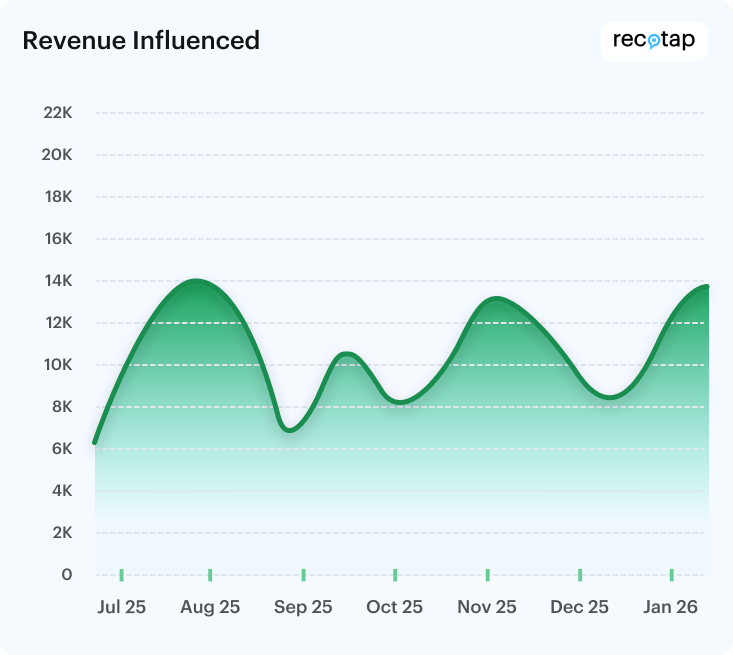
5. Revenue Influenced
What it answers: Did ABM contribute to closed-won revenue?
At the account level, this means:
Revenue tied back to accounts with ABM influence
Revenue trends following engagement campaigns
Clear spend-to-revenue visibility without complex attribution models
How to Interpret: This closes the loop without over-engineering attribution models. Recotap tracks which accounts were influenced by ABM activity and then connects those accounts to closed revenue, giving you a clear view of ABM's commercial contribution.
6. Spend Efficiency per Account
What it answers: Are we spending intelligently at the account level?
By combining spend, influence, and pipeline data, teams can assess:
Average spend per influenced account versus non-influenced accounts
Spend relative to pipeline value generated per account
ROI patterns showing which account segments respond best
How to Interpret: This reframes ABM conversations with finance. Instead of defending your total budget, you can show that you spent $X per influenced account and generated $Y in the pipeline, making ROI discussions concrete and account-specific.
7. Time-to-Impact
What it answers: How quickly does ABM create momentum?
Time-based metrics reveal:
Lag between first ABM influence and pipeline creation
Lag between pipeline creation and revenue conversion
Momentum loss patterns when spend stops or decreases
You can use this formula to make a calculated observation of time to impact.
Average Influence-to-Pipeline Time = Sum of (Pipeline Date - First Touch Date) ÷ Number of Accounts Average Pipeline-to-Revenue Time = Sum of (Close Date - Pipeline Date) ÷ Number of Deals Total ABM Cycle Time = Avg Influence-to-Pipeline Time + Avg Pipeline-to-Revenue Time
How to Interpret: Speed matters, especially in long sales cycles for B2B software & IT/ITES companies catering to enterprises. Recotap's engagement scoring and real-time alerts show when accounts cross activity thresholds, allowing sales teams to strike while intent is high rather than waiting for quarterly reports.
How Recotap Makes Account-Level Analytics Actionable
Recotap's ABM platform is built around the principle that analytics should drive pipeline, not just create reports. Here's how Recotap unifies the seven metrics into a practical decision-making system:
Real-Time Unified Dashboard
Recotap consolidates media spend, account influence, pipeline data, and revenue in one dashboard. Instead of jumping between LinkedIn Campaign Manager, your CRM, and spreadsheets, you see the complete account journey in real-time. The platform surfaces exactly what's driving the pipeline across campaigns, so that you can double down on winning strategies.
Account-Level Spend Tracking
Recotap tracks every dollar spent influencing each account. The platform shows spend trends over time and calculates average spend per account automatically. This visibility prevents over-investment in unresponsive accounts and helps you reallocate budget to high-intent targets.
Two-Way CRM Synchronization
All engagement data flows into your CRM, and CRM updates flow back into Recotap. This ensures sales teams see marketing influence directly in their workflow while marketing teams track sales acceleration without manual exports. Account scores update in real-time based on combined engagement signals and CRM activity.
Signal-Based Progression Tracking
Recotap maps accounts to buyer journey stages based on intent signals from first-party engagement, third-party intent data, and CRM progression. The platform's scoring engine ranks accounts by real intent, making it clear which accounts are moving toward pipeline and which have stalled.
Automated Alerts for Account Movement
When accounts cross engagement thresholds or change pipeline stages, Recotap sends automated alerts to sales teams. This transforms analytics from backward-looking reports into forward-looking action triggers. Sales knows exactly when to reach out based on real account behavior.
The Real Shift: From Reporting to Decision-Making
ABM analytics works when these seven metrics are viewed together, not in isolation.
When teams can see spend → influence → pipeline → progression → revenue in a unified view, ABM stops being something you justify after the quarter ends. It becomes something you steer while deals are being built.
Recotap's platform makes this shift practical by connecting data that normally lives in separate systems. You see which accounts marketing touched, when they were touched, how much you spent, whether pipeline was created, and if deals progressed.
This visibility creates three immediate benefits:
Sales Trust: When sales teams see account-level influence in their CRM, they stop questioning whether marketing contributed. The data is specific, timely, and tied to accounts they recognize.
Budget Optimization: When you can see spend per account and resulting pipeline value, budget allocation becomes evidence-based. You stop guessing which campaigns work and start knowing which accounts respond.
Speed to Revenue: When alerts fire based on account progression, sales can engage at peak intent moments. This shortens sales cycles and increases win rates by capitalizing on engagement momentum.
That's when ABM starts delivering on its promise, not as a reporting exercise, but as a pipeline engine.
Summary
ABM analytics only delivers value when measured at the account level. The seven essential metrics are:
Media Spend (Account-Level): Track budget allocation per account to identify waste and over-investment
Accounts Influenced: Quantify which named accounts responded to ABM efforts
Pipeline Influenced: Measure total pipeline value touched by ABM activity
Pipeline Progression: Monitor stage-to-stage movement and deal velocity
Revenue Influenced: Connect ABM activity to closed-won revenue
Spend Efficiency per Account: Calculate ROI at the account level for budget optimization
Time-to-Impact: Understand lag between influence, pipeline creation, and revenue
Recotap makes these metrics practical by unifying spend tracking, engagement signals, and CRM data in real-time dashboards. The platform transforms ABM analytics from quarterly reporting exercises into daily decision-making tools that help teams allocate budget efficiently, coordinate with sales effectively, and accelerate sales acceleration.
When you can see the complete journey from spend to revenue at the account level, ABM stops being something you justify and starts being something you steer.
Frequently Asked Questions
Q: What metrics should I track for ABM campaigns?
A: Focus on seven account-level metrics: media spend per account, accounts influenced, pipeline influenced, sales acceleration, revenue influenced, spend efficiency per account, and time-to-impact. These metrics connect your ABM investment to commercial outcomes without requiring complex attribution models. Track them together in a unified dashboard to see the complete picture from spend to revenue.
Q: How do you measure ABM ROI effectively?
A: Measure ABM ROI by tracking spend per influenced account and comparing it to pipeline and revenue generated from those accounts. Calculate the ratio of revenue influenced to total ABM spend for overall ROI, then break it down by account segment to identify which targets deliver the best returns. Recotap's platform automates these calculations by unifying spend data from LinkedIn with pipeline and revenue data from your CRM.
Q: What's the difference between campaign-level and account-level metrics?
A: Campaign-level metrics measure aggregate performance across all targets (total impressions, average click-through rate, cost per lead). Account-level metrics track individual account behavior and outcomes (how much you spent on Account X, when Account Y entered the pipeline, whether Account Z progressed to the next stage). Account-level metrics are essential for ABM because B2B buying decisions happen at the account level, not the individual lead level.
Q: How do you connect ABM spend to pipeline creation?
A: Connect ABM spend to pipeline by tracking which specific accounts were influenced by your marketing activity and then monitoring when those accounts create pipeline opportunities. Recotap does this through two-way CRM integration that tags opportunities with ABM influence data. You can see total spend on each account, when they first engaged, and when the pipeline was created, giving you clear cause-and-effect visibility.
Q: What is pipeline influence in ABM?
A: Pipeline influence measures the total value of sales opportunities created by or accelerated through accounts that are engaged with your ABM campaigns. An account is considered influenced if it showed engagement with ABM touchpoints before or during the pipeline stage. This metric proves ABM's contribution to revenue generation beyond just top-of-funnel awareness.
Q: How long does it take to see ABM results?
A: Time-to-impact varies by sales cycle length and account maturity. Most B2B SaaS companies see initial engagement within 2-4 weeks, pipeline creation within 60-90 days, and revenue influence within 6-12 months. Recotap's time-to-impact metrics track lag between first influence and pipeline creation for your specific accounts, helping you set realistic expectations and identify acceleration opportunities.
Q: How does Recotap track account-level analytics?
A: Recotap unifies media spend data from LinkedIn campaigns with engagement signals, intent data, and CRM sales acceleration in a single platform. The system tracks every dollar spent per account, monitors engagement across channels, scores accounts based on real-time activity, and syncs bi-directionally with your CRM to show pipeline and revenue outcomes. All metrics update in real-time in a unified dashboard.
Q: Can you prove ABM ROI without complex attribution models?
A: Yes. Instead of building multi-touch attribution models, focus on account-level influence. Track which accounts engaged with ABM, when they entered the pipeline, and whether they converted to revenue. This approach gives you clear spend-to-revenue visibility without requiring perfect attribution of every touchpoint. Recotap simplifies this by automatically tagging influenced accounts and tracking their progression through your CRM stages.